Hardware
8 piecesIn this section
pages
My childhood dream laptop
Hardware · 13 min · p. —
We need devices like the StarLite
Hardware · 10 min · p. —What if your laptop had a FOSS firmware?
Hardware · 7 min · p. —
What's up with Linux on Snapdragons?
Hardware · 9 min · p. —Roundtable: we love the Frameworks 12 and Desktop
This Linux laptop maker called me a Zombie
Two years ago I was contacted by a company called MALIBAL.
They were interested in a sponsorship, where I would simply put their link in the video description and get money for it.

I did a quick background check, and they seemed like a proper Linux hardware manufacturing company. I said I'd be happy to shout them out in the videos too, and we agreed on a price.

Initially, things seemed to be going pretty well. They did decide that my demographic wasn't that appealing to them and that they would thus sponsor one video per week, which is reasonable.
However, I made a mistake. I changed my publishing schedule last minute, which meant switching the description sponsorship from one video to another; what I did not notice is that towards the end of the video that I chose to be sponsored, I said, "This video is not sponsored." Big mistake on my side.

MALIBAL did notice. This is the sort of mistake that I can quickly fix through the YouTube video editor, but they preferred to directly end our partnership without enough context for me to realize the mistake. They also told me to bill for the GNOME video as usual.

One month later, as agreed, I billed them for the video. I still had no idea about the mistake. They replied with, and I quote,
You have a lot of nerve sending me this invoice considering you literally say in the video that it's NOT sponsored. What a crackhead. Did you really think you were getting away with that? KDE is the trash bin of the Linux world. There is no wonder that's what you like [sic]
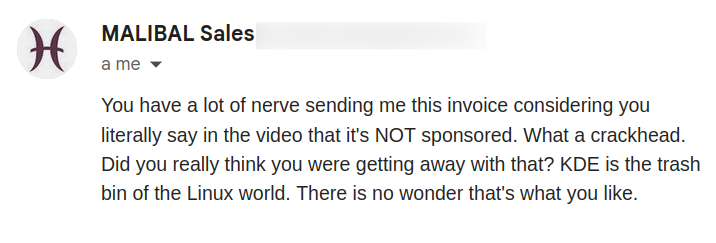
Woah. I decided to explain the mistake due to the change of schedule, and that I could've fixed it in the YouTube editor; but, I also pointed out that this sort of language was unacceptable.
They replied with the simple sentence "You're a zombie who is dead and empty inside. You don't even exist".

And that was it. I no longer did any sponsorship with MALIBAL, and I thought that was going to be the end of it.
However, if we perform a quick research on the user experience with MALIBAL, we discover that this type of reaction is pretty common.
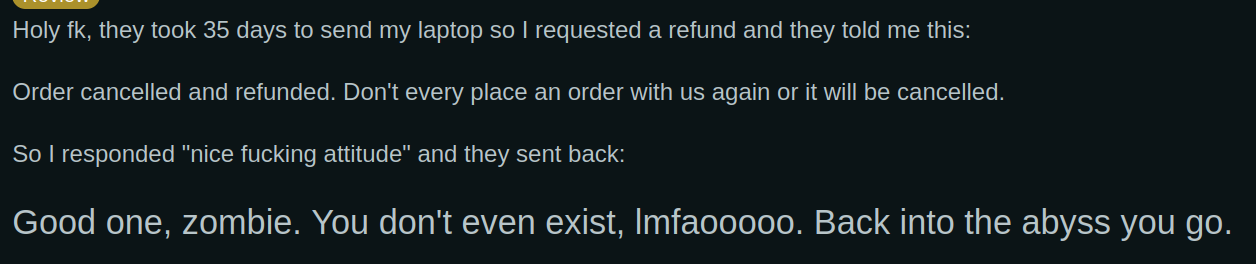
One user said that when he tried to cancel the order due to slow shipping, they replied with "Don't ever place an order with us again or it will be canceled", and soon after: "Good one, zombie. You don't even exist. Back into the abyss you go".
Another user received the reply "It's the response a phantom, zombie like you deserves. You don't exist. You're not a person. You are here to simply suck life out of the human. If you weren't dead and empty inside you would feel shame for what you have done".
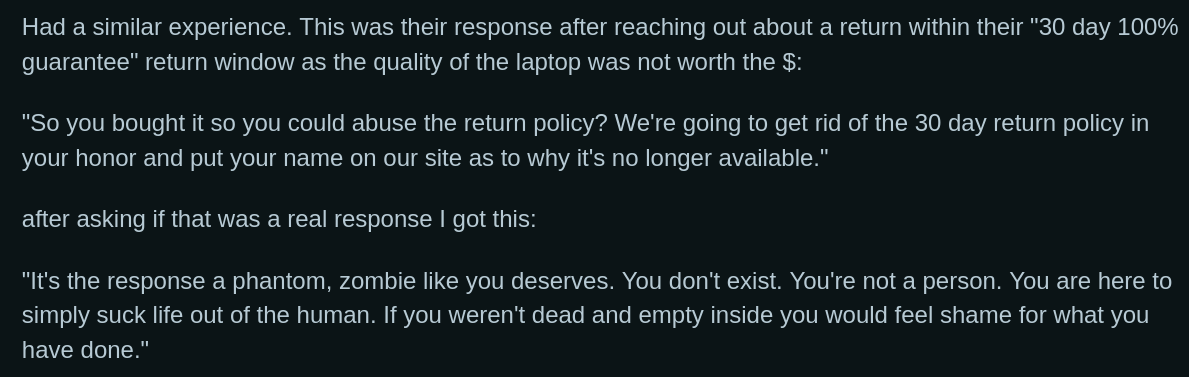
These are just a few examples. Reddit is full of this kind of support replies after the slightest pushback from the clients.

Even people who claim to have worked with MALIBAL professionally state that they had to "decline their business" as they were "too difficult to work with", eventually being called zombies as well.

This is just the tip of the iceberg in terms of the general weirdness of MALIBAL.
Firstly, they issued a response to this whole "zombie" accusation by trying to say it did not happen (but it did, it happened to me too), and saying that the official name of the accusation is "Zombiegate".
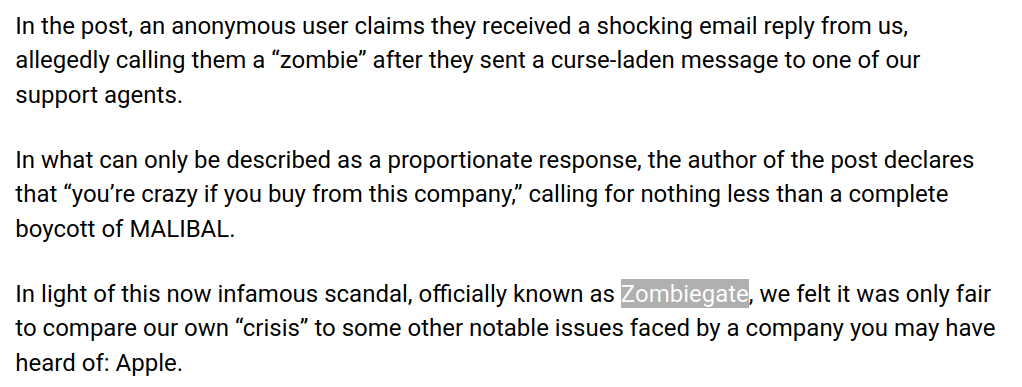
To distance themselves from it, they listed all of Apple's scandals, and then claimed that what happened with them is not that bad compared to it.
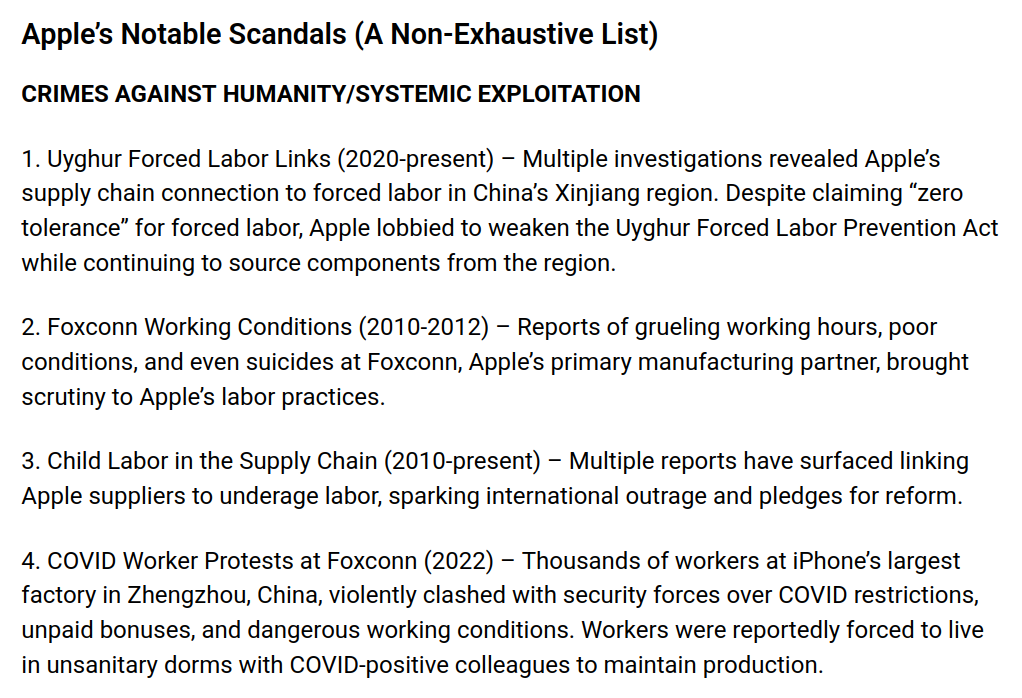
I absolutely love their closing statement here:
Our commitment? To tirelessly support our customers—zombie, ghost, or otherwise—while maintaining a level of integrity befitting the smallest scandal possible. After all, the abyss awaits us all… but here at MALIBAL, we’ll send you there with a smile. 🙂

I can't help but laugh to think that the person replying to the emails with insults is the very same person that approved this text.
As another example, due to a discussion about coreboot that I will later focus on, they have decided to ban the entire country of Germany from their services. They banned … Germany, due to the actions of a single person there. Oh, and they also banned Austria and Liechtenstein, because they're also Germany. Somehow.

They also don't ship to California due to regulations impacting small businesses there.

They also don't ship to Colorado due to the actions of Jeremy Soller.
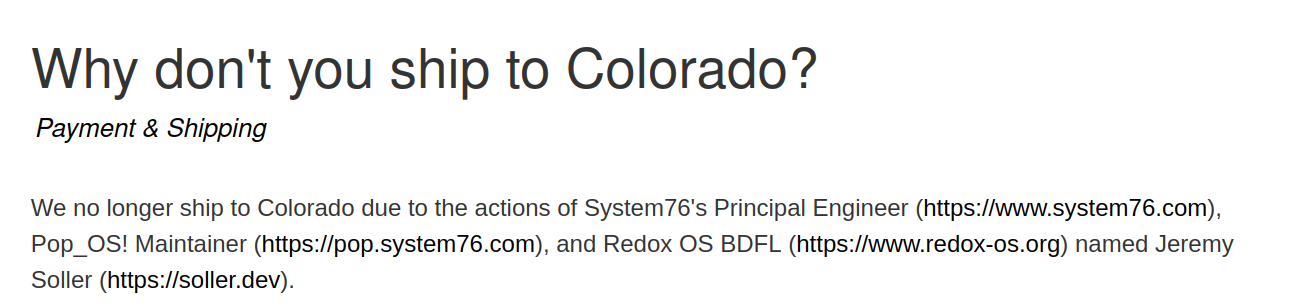
They also don't ship to Maryland due to the actions of Matt DeVillier.

They also don't ship to Poland due to the actions of Piotr Król.

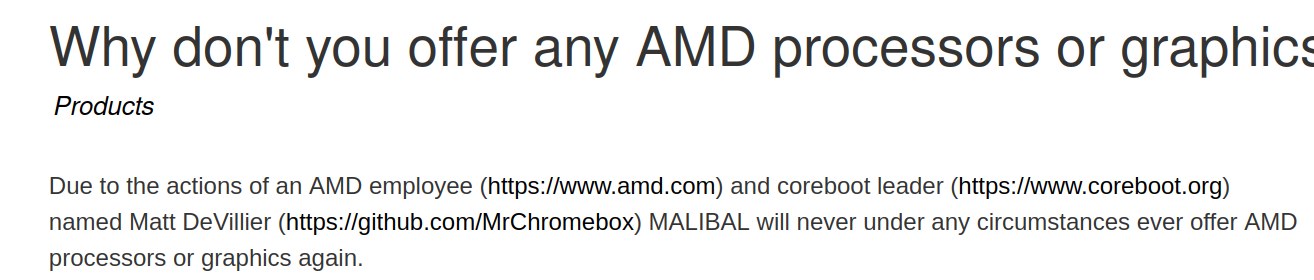
They also refuse to ship anything made by AMD due to, again, Matt DeViller.
Or - I just can't stop now - in their terms and conditions, it specifically says that you cannot use Chrome to access their website, nor can you use GMail to create an account in it, nor can you use a Pixel Phone to access it, nor use the Android operating system to view it, or any other products including Google Search. You literally cannot use Google Search to open their website, according to their terms and conditions. What!? If you are found to use any of these technologies, your account will be terminated without notice.
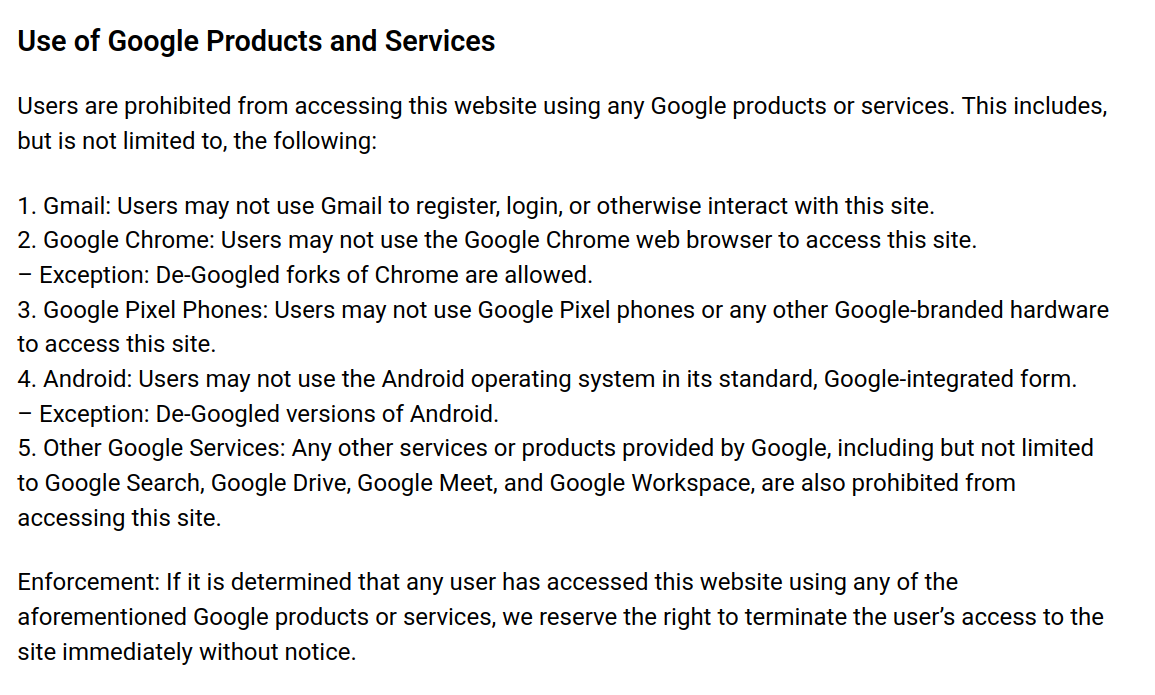
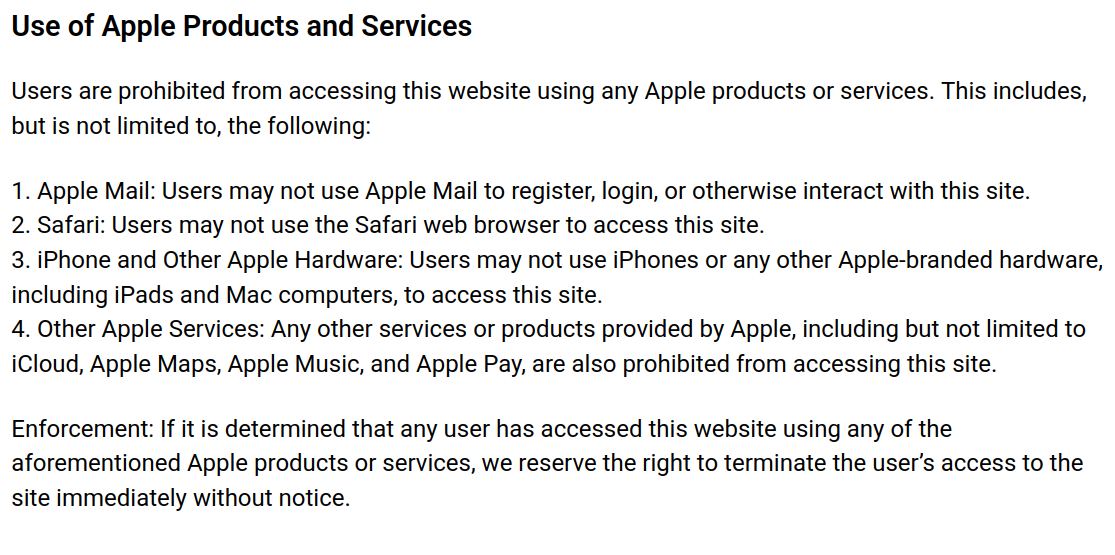
Oh, and, by the way, the same applies to Apple. You can't access the website through Safari, an iPhone or any MacBook, or register using Apple Mail.
Oh, and, by the way, the same applies to Reddit users. If you use Reddit frequently, you are prohibited from using this website. They also have half a page just to explain exactly what they mean by "active Reddit user".

They have quite a track record of doing all of this. Back in 2017, they were already in business and they were allegedly censoring negativity on notebookreview forums and banned users who had good warranties after they made negative comments.

More recently, they managed to get into the Linux news circle by publishing an article called "Don’t Support the Coreboot Project".

What happened? Well, they wanted their machines to support Coreboot, so they contacted 9elements to ask for coreboot-supported boards. When they learned that they were priced between 50k and 100k, they decided to instead develop them themselves. However, they did not have the necessary skills to do so, which made them come back to 9elements to ask them for help.
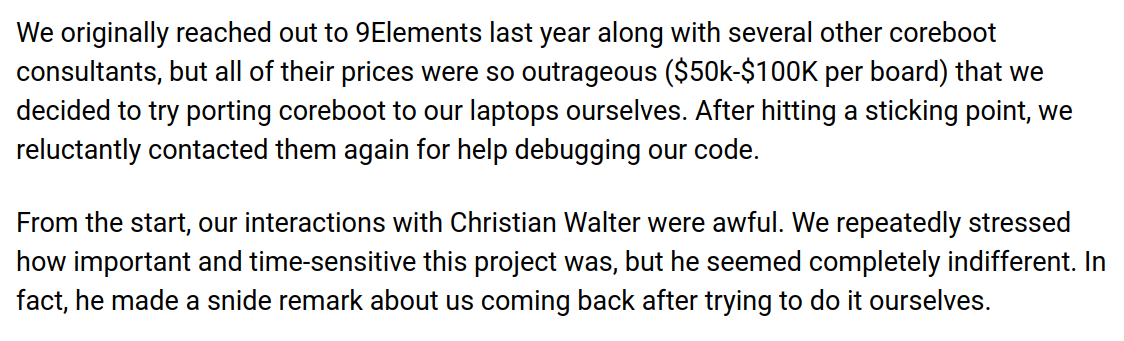
Now, Christian does not speak English natively, and he did apologize for the sometimes broken language and typos in his emails after this article was published. It however seems like most of the conflict stems from the fact that MALIBAL thought their code was pretty much ready and only required a little bit of debugging, whereas 9elements thought that there was much work to be done still.
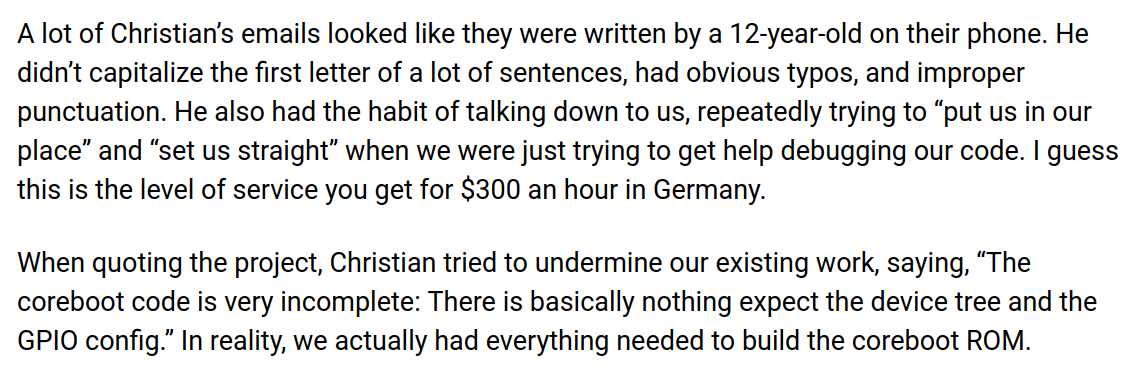
Christian offered to work to support coreboot on the laptops by taking a commission for each laptop sold, something MALIBAL saw as borderline stealing. Then, when they were assigned a developer called Max to work on the project, MALIBAL complained that he was not experienced enough.
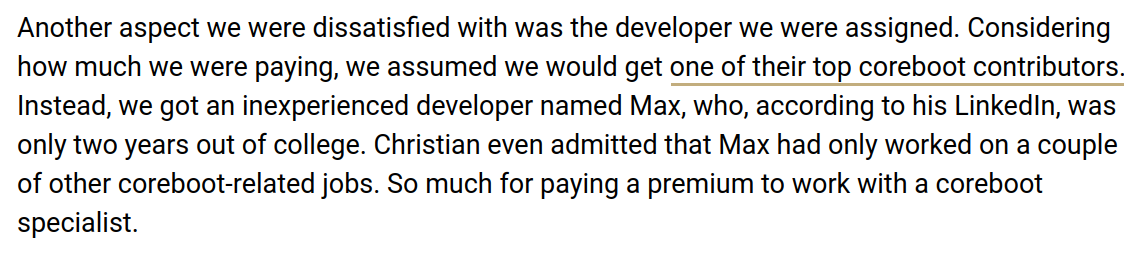
MALIBAL was also asking for updates to what it seems like an unreasonable pace. You can see it in their own article, as they point out that "several more days passed without any updates". This was also later confirmed by 9elements.

They started accusing Max of not working at an actual full time rate but only a few hours, and they asked for another developer to be working on the project. Mind you, by now, there was still no contract with 9elements and MALIBAL had not paid them anything.

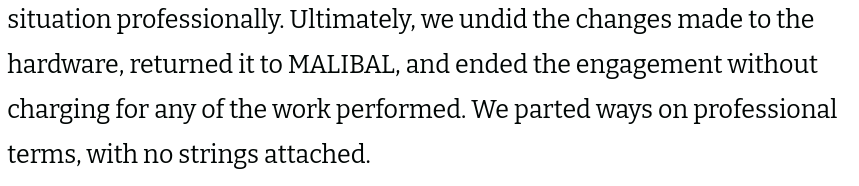
Eventually, Christian got fed up and decided to end the collaboration. They sent back to MALIBAL the test hardware they were given, and they did not charge them for anything.
MALIBAL then tried to collaborate with a second contractor company, 3mdeb. However, they were annoyed by the fact that 3mdeb offered a lower price if MALIBAL had used a Dasharo-braded coreboot instead of an unbranded one.

Frustrated, MALIBAL completely ignored their quote (which was 33k for Dasharo coreboot, and 66k for unbranded), and asked to pay $150 an hour with daily updates.

I do admire how 3mdeb managed to stay professional in their reply, where they pretty much said "we don't do per-hour contracting, we've sent you the quotes, that's what we're asking, and you can't just make up your own price".

As a very mature response to these two experiences, MALIBAL contacted the Coreboot project and asked to please remove 9elements and 3mdeb from the list of official contractors. Coreboot obviously refused, but Matt DeViller - from the Coreboot leadership team - told them he would try to help port Coreboot to their laptop.
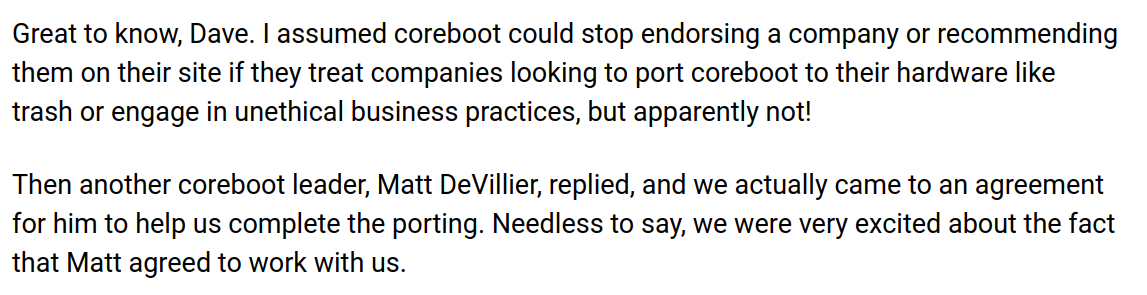
Now, I just have to read you the quote of their article about Matt, because it's pure poetry.
Matt DeVillier is the type of person who will suck your will to live out of you and leave you for dead. Nice guy. He embodies every trait you would never want in someone you hire for a job. He’s unprofessional, unreliable, untrustworthy, irresponsible, and incompetent. And, of course, he’s one of these types who will bludgeon you with all of these virtuous qualities, and if at any point you dare say a word in protest, he’ll try to turn things around and act like you did something wrong by calling you toxic. No, we’re not toxic, Matt. You just really honestly truly suck.

What did Matt do to deserve this? Well, the day after receiving MALIBAL test hardware - still without being paid anything, mind you - he was assigned a high priority project for AMD and warned MALIBAL that he could only start working a couple months from now.
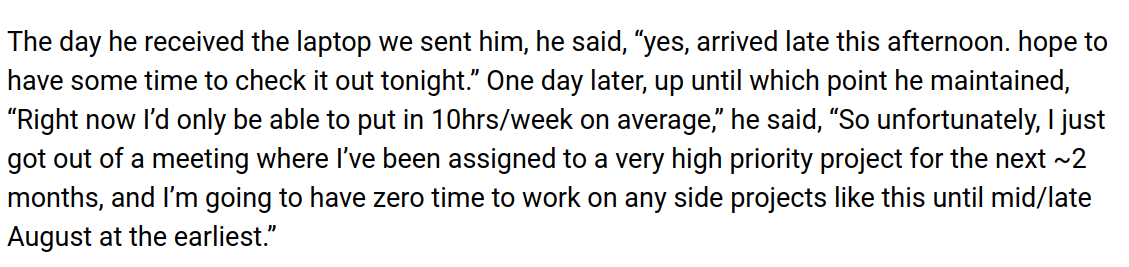
During this wait, Matt started buying the tools needed to work on this project. However, he bought one from China, which MALIBAL seems to consider a mistake in itself. He then decided to source one from the US.

Then, he pointed out that his unit had a damaged UART connector. This is also something MALIBAL blames on him.

They continued to put pressure onto him, asking for almost-daily updates, until Matt decided he was no longer interested in working with MALIBAL.

Since Matt claimed to have done nothing wrong, MALIBAL offered to let a neutral third party decide to arbitrate the matter – which I truly don't understand. Are they trying to get a moral high ground through some weird litigation process? They did not even pay the guy.

The article is full of extremely aggressive sentences, like "This is the type of gaslighting you would only expect from a sociopath" and, also poetry,

[Maximally bad] is where you do such a horrible job that it’s impossible to have done any worse. Not impossible for a person to have done worse; impossible for anyone or anything to have done worse: a person, a monkey, a rock, etc.

MALIBAL concludes this whole piece by saying that they think that it's possible to finish the project is barely 40 hours. They are unable to do it because they don't seem to have the skills to, but still, 40 hours.

Finally, MALIBAL wants us to know that during these exchanges, they've tried their best not to offend anyone and get along as much as possible. As an example, they did not anyone "a monkey", nor have they implied that they were one. Thanks, MALIBAL.

Now, most parties involved did briefly reply to this article. Matt stated:
FWIW, none of the entities listed ever charged or were paid by Malibal for any work done. Evaluation of the state of their existing work and what they wanted done was done as a courtesy, and any further work was declined by the consultant(s). No contracts were ever signed, no statements of work produced.

9elements also published a blogpost, which includes the following quote:
Throughout the engagement, we encountered communication challenges, including frequent status update requests and a misalignment between expectations and technical realities. The initial firmware required considerable work before it could be tested on hardware, which understandably caused some delays. Unfortunately, during this period, the tone of communication from MALIBAL became less constructive.
Now, I would love to know more about who's behind MALIBAL, and what's happening within the - probably, single-person - company. However, I have not found any information about that; if you have any, please feel free to contact me.
I do fear that, by publishing this piece, I might get the entire country of Italy banned from them. But I believe it's a risk worth taking.
My New Favorite Linux Laptop
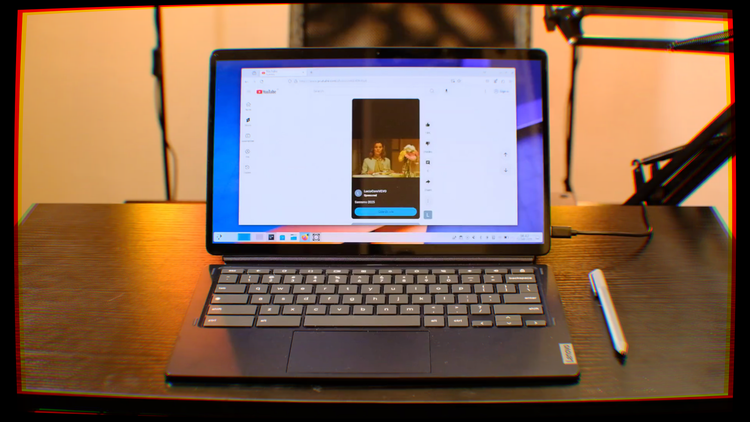
Hi, and welcome back to the never-ending journey of finding Niccolò's perfect laptop. Sadly, I have not found it yet. But I have something that gets close to show you.
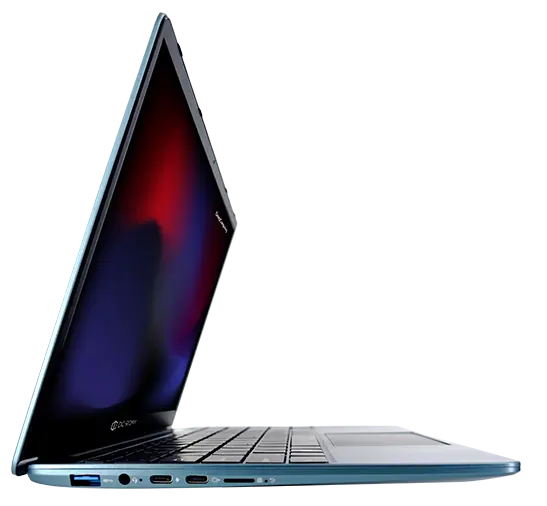
This is the Lenovo Duet 5. It's out of stock, so don't rush to buy it, but you can get one for a few hundred bucks on eBay. I have mentioned this device previously on this channel, but I have some new updates.
Let's talk software. This thing ships with ChromeOS out of the box, which is a dealbreaker. I could not use it for actual productivity tasks, or work. Which is why I would only ever bring it out to watch movies and maybe write some stories. That's it.
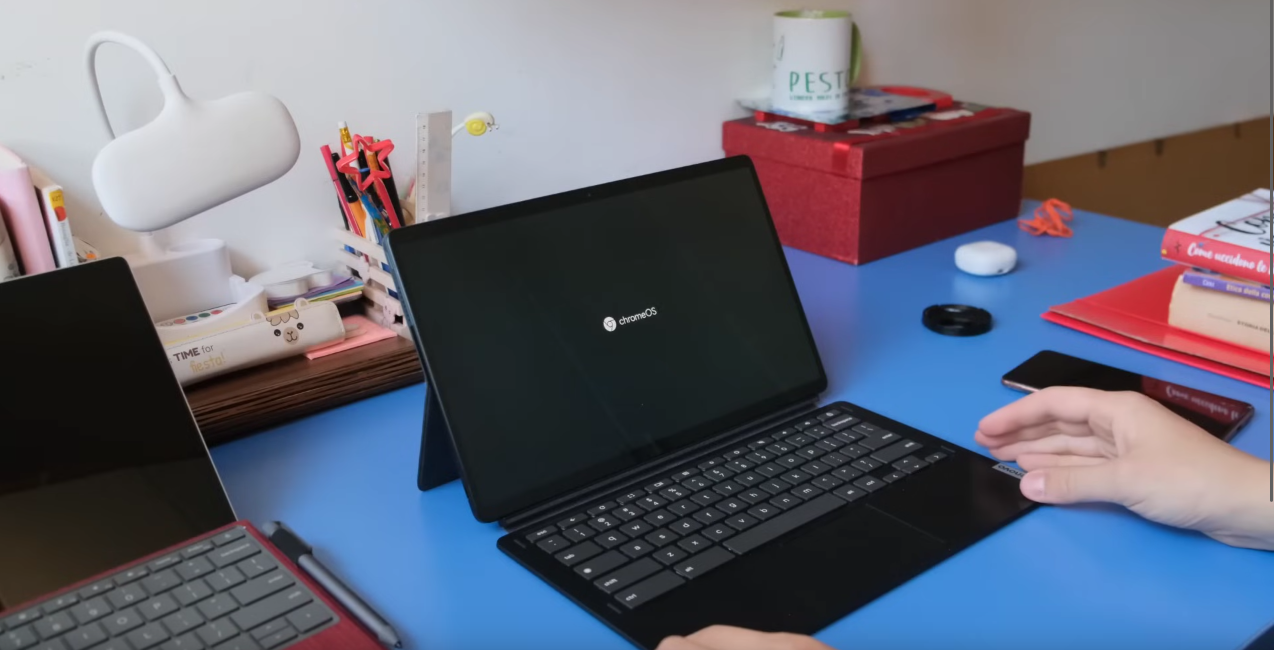
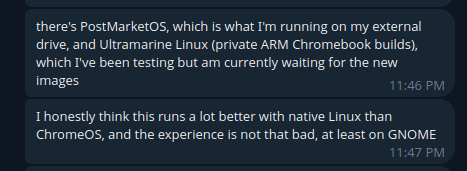
However, I was contacted on Telegram by a user called Jules Berre (I'm sorry if that's not how it's pronounced) who explained that I could run native Linux on the Duet, and he assured me that it would run very well and with almost everything working out of the box. Needless to say, knowing how these things go, I did not believe him. I was wrong.
The first step was to enter developer mode, which you can do from the bootloader. This is quite easy, but it does trigger a complete factory reset – that's fine by us since we'll replace ChromeOS with Linux anyway.
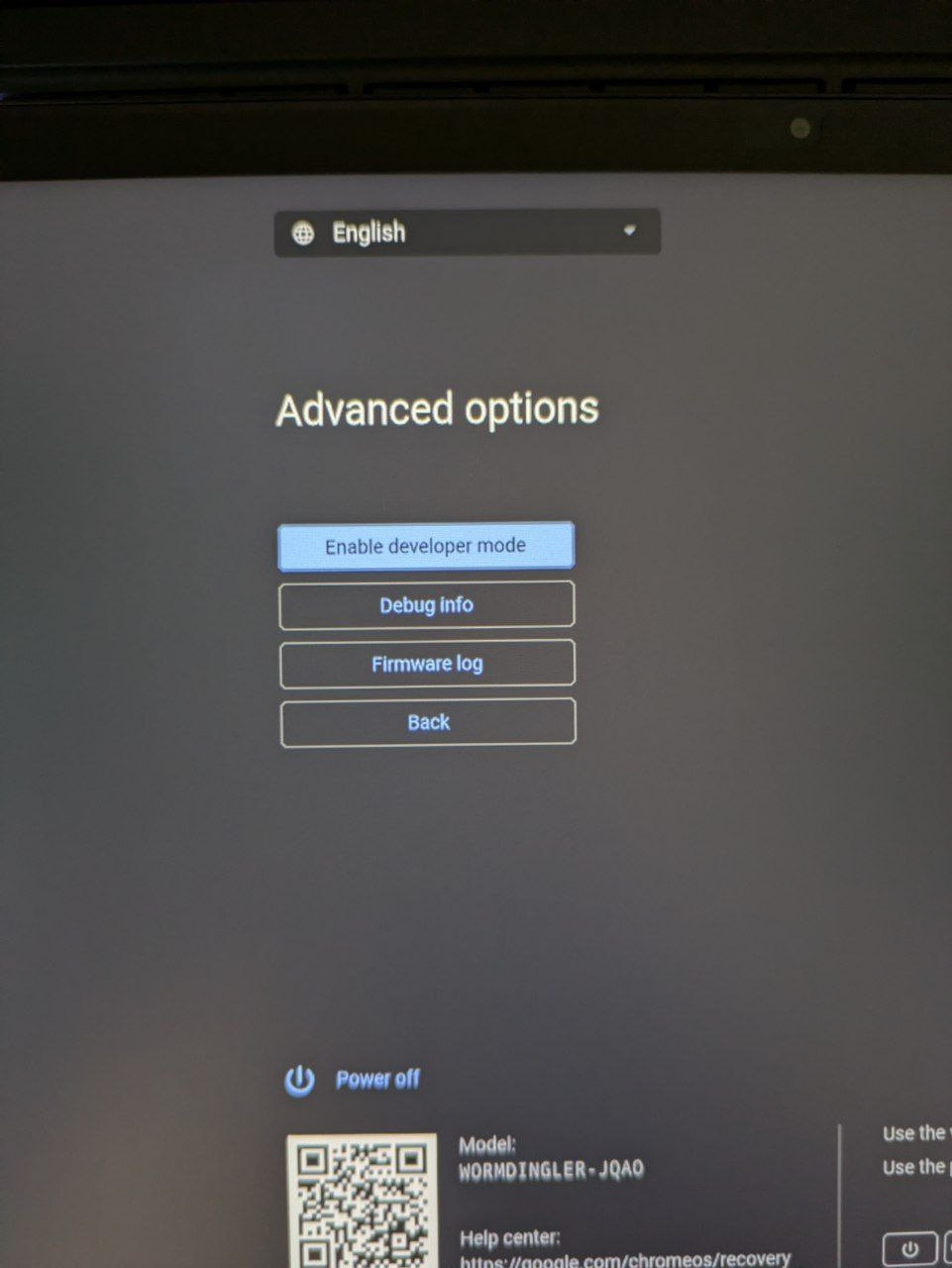
Then, I downloaded the PostmarketOS image for my device, codenamed Trogdor. This was the hardest step in the whole process, as the download kept failing due to connectivity issues, and I had to repeat it multiple times.
But when I finally had a correct checksum on the image, I flashed a USB stick, connected it to the Duet, selected "boot from external drive", and - voilà - Plasma 6 was running before my eyes. And immediately I was like, no way. And the Duet was like, way.
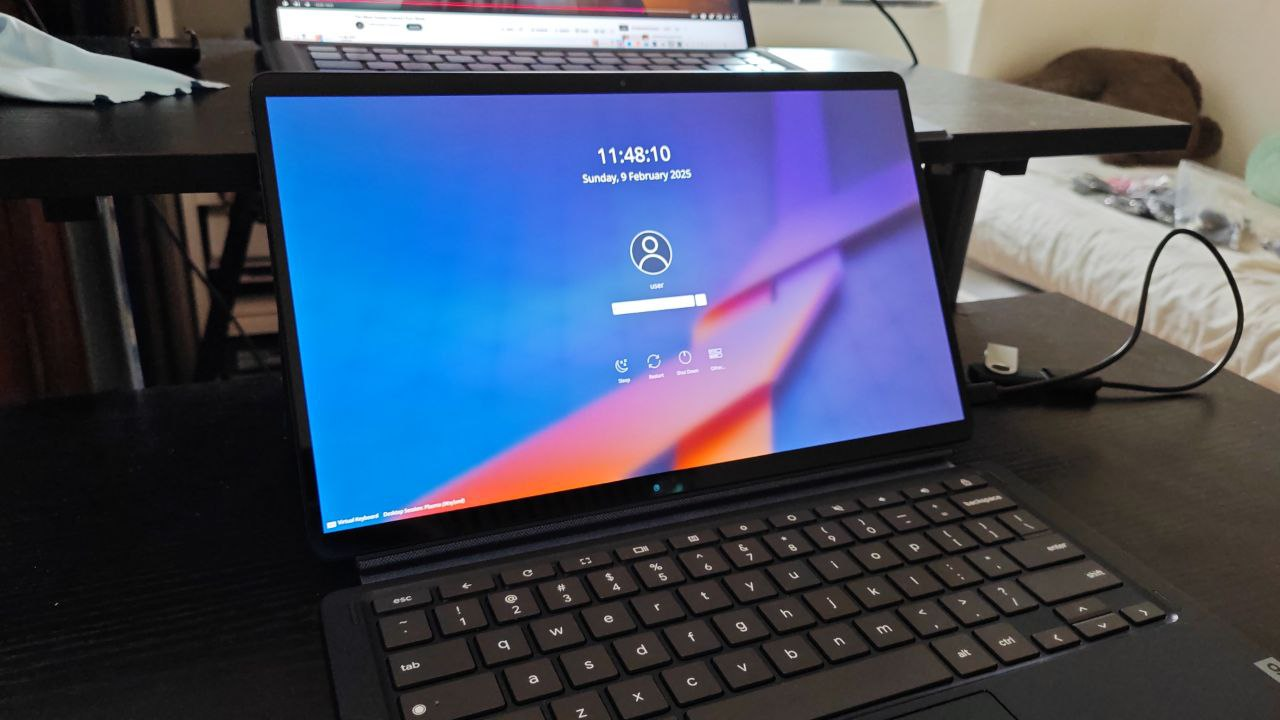
I started running my checklist of what worked on what didn't, out of the box. Touchscreen, keyboard, and touchpad – including touchpad gestures? Check.
Okay, but what about stylus support? Check. Mmh, pen pressure levels? Check. I could just open Xournal and start writing without missing a beat. Even better, the palm rejection worked much better compared to ChromeOS, rendering this an actually good device for notetaking on the go.
Next up, is connectivity. Wi-Fi? Check. Bluetooth? Check. All systems go.
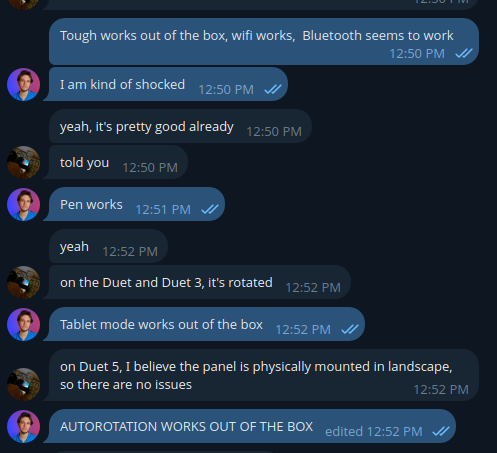
Okay, but what about the tablet mode support and such? Most devices fail here. Well, not this one: not only touchscreen work out of the box, but when detaching the keyboard the tablet will immediately enter tablet mode - meaning that all the icons become bigger and easier to click - and autorotation also just works.
For some reason, this shipped without any touchscreen gesture out of the box, but as soon as I set one up in settings, I could also access the Overview and drag and drop windows around in the blink of an eye. Switching desktops with three fingers also works.
Finally, for tablet mode, the virtual keyboard does come pre-installed, but it's disabled out of the box. I'm not sure why. As soon as you enable it, it works perfectly, and you can toggle it on/off in the System Tray. Check, check, check.
I feel like these messages are pretty representative of the emotion I was going through: I was just, like, woah, this actually works? I can't believe it! And Jules is like, dude, I told you.
Battery life is also fantastic. Though this is a used device, and I'm always keeping it a full brightness, and I was even running various tasks in the background, the battery applet would regularly show a 10 to 12-hour estimated lifespan. I will have to do some testing to see how that translates in real life, but it already sounds great.
Also, if you close it, it goes to sleep. I had not used this device for four days before writing this review - look, I was busy - and it has only lost about 25% charge since Sunday. Which is roughly 6% a day, or a battery drain of 0.25% an hour. Out of the box. If this does not sound exciting, my main device drains 25% in a few hours. It has a terrible battery, but still, that's impressive.
This is where I started noticing a few issues. Firstly: the webcam is not supported. If you know anything about making Linux run on these ARM devices, you are aware that this applies to almost any device, as sad as it might be.
Secondly, no audio output is recognized. I've been told that this is supposed to work, so it might be just my setup that's broken. But still, I'm trying to evaluate this laptop out of the box, and I can't play audio. (But headphones work just fine).
Oh, and the volume rockers on the device work out of the box too. That's a nice detail that you can't rely on. The power button also does put the device on standby, and you can wake it up pretty quickly.
Finally, it seems like libinput is misconfigured a bit, and I can only trigger four-finger gestures sometimes. Other times, it starts scrolling instead. This is not amazing, but it could probably be fixed too.
But, apart from these few issues - the only one of which that can't be solved is the webcam - this is a perfectly working device that I could use to run any Linux application, take notes with the pen, compile KDE to do development, write articles, yadda yadda.
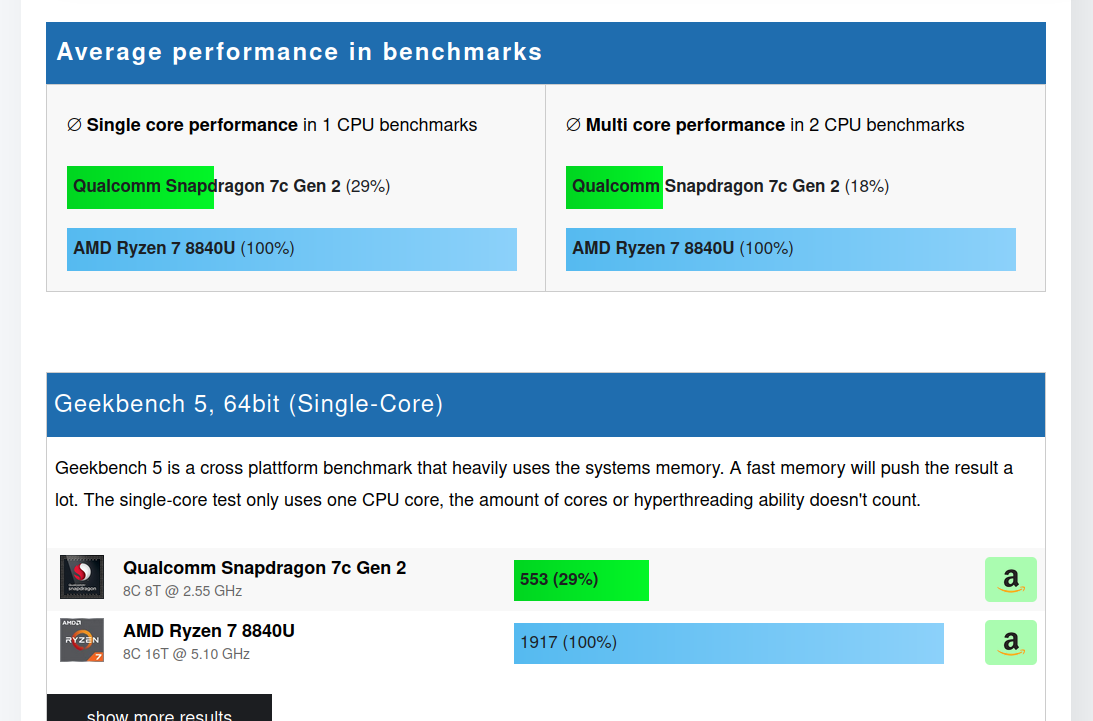
But would I want to do those things? How's the device? It does come with 8Gb of RAM, which is not plenty but good enough for me, and a Snapdragon™ 7c Gen 2 plus a Qualcomm Adreno as the GPU. This is probably the only weak spot of this machine: it's overall a bit laggy here and there and it won't perform power-intensive tasks very well.
According to CPU Monkey, my main device has roughly a five time better single multi-core performance and three times higher score in Geekbench. To be clear, this does not render the Duet unusable by any means, it's just not a very fast laptop.
However, it does pack a few punches here and there. Firstly, it has a gorgeous - and I mean gorgeous - 13inch FHD OLED display. It's bright, the bezels are very slim, it's a joy to use and to watch content with.
My biggest ever regret was to accidentally scratch the display on the top-left corner. I'm so annoyed by this that I'm quite tempted to just go ahead and buy an entirely new Duet 5 since they're very cheap anyway. Like, look at here. Aaaah.

Another upside is that it's quite thin, small, and lightweight. It only weighs 700g, and is 7mm thick, which is less than my phone. When you use it as a tablet, it feels like it's meant to be a tablet; my Minisforum is always a bit too big to use comfortably and has some excessive bezels. Not a fan.
The device does not come with a pen holder, but you can easily print one with any 3D printer, and that works pretty well. Finally, and this is my biggest design criticism, the keyboard is good but it lays flat on the table. I would highly prefer for it to magnetically attach under the screen to stay at a given angle.
So, what's missing? Why am I not using this as my main and only device, webcam and performance aside?
Well, what I did not mention is that so far I'm using everything in a live session from the USB. It's nice, and it works, but apparently, I did mess up a step of the installation process; it looks like ChromeOS wanted to do some system upgrades when I tried to install PostmarketOS on the device. Now, when I try to boot from internal storage, I get a message "Your device is being updated", but it can't update, so that fails, and throws me back at the bootloader. Sad. I'm working on it.
If you consider that this is something you can get for a few hundred bucks, depending on where you live, it's honestly a steal. I'm seriously happy that I have bought this device, and - as soon as I fix the booting problem - I can't wait to use it to do research, write articles, and do some development on the go.
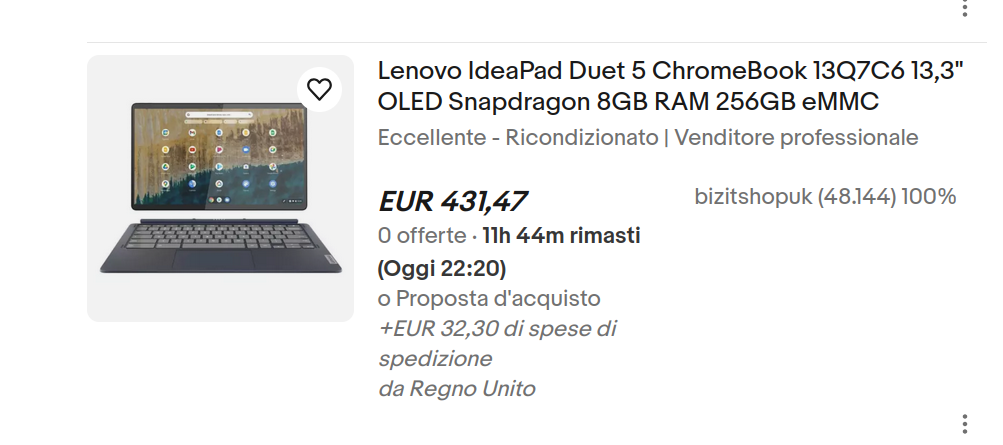
Lately, I quite dislike my main Minisforum v3, so this is definitively my favorite Linux laptop(-ish) right now.
RISC-V on Framework Laptops, explained
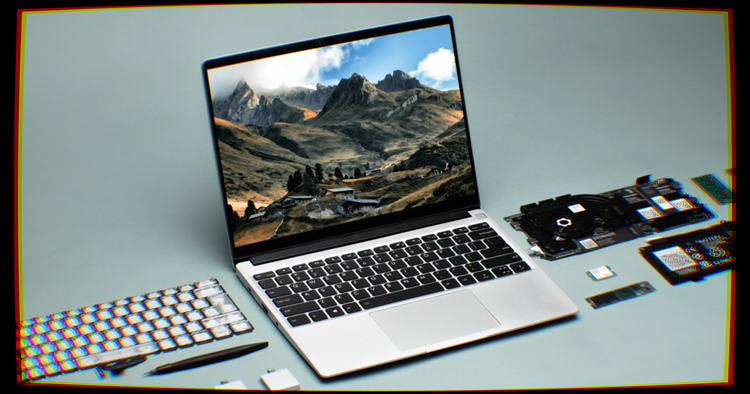
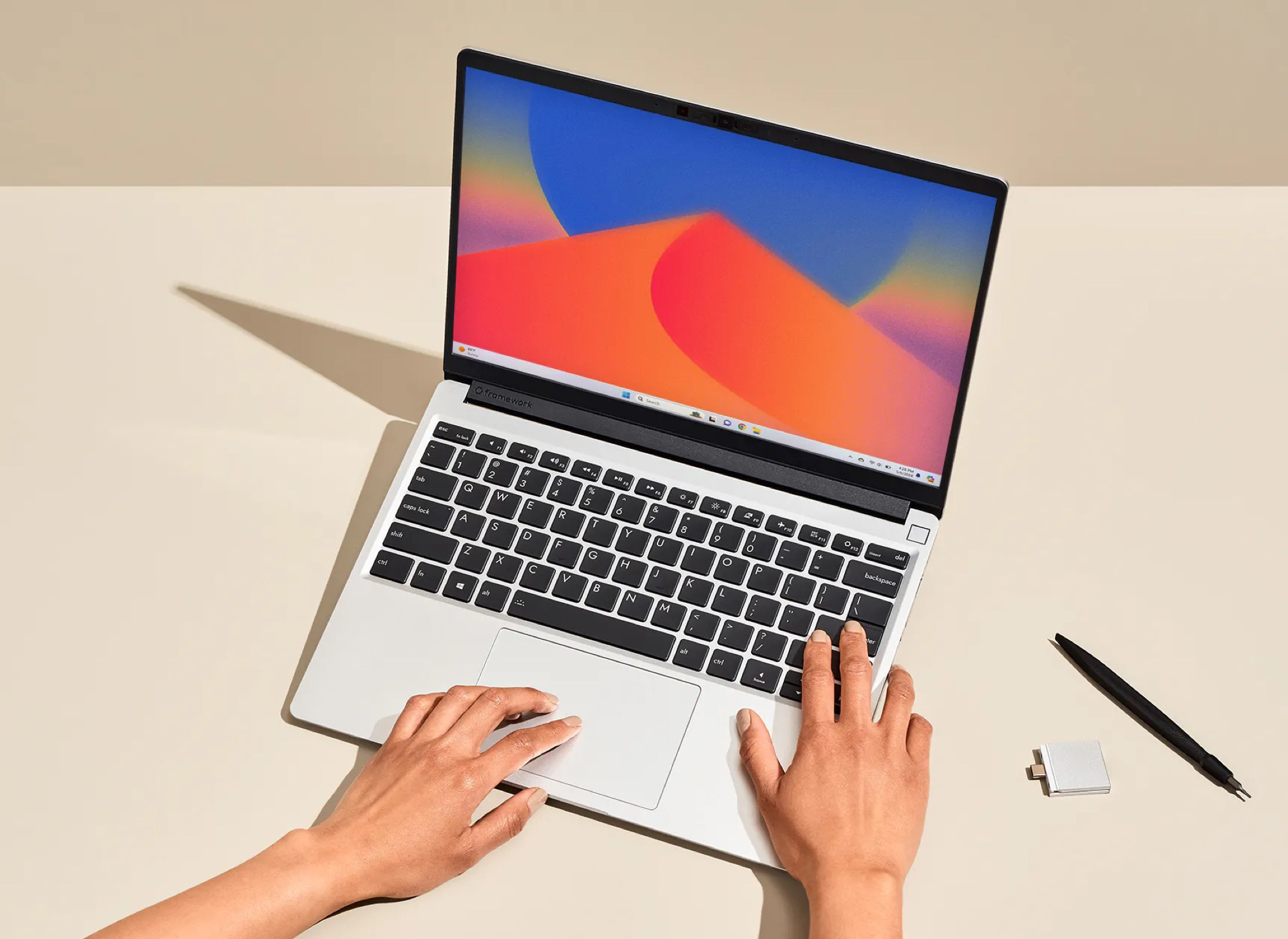
As you might have heard, Framework, the company behind highly-repairable and Linux-compatible laptops, has just made a new motherboard available for its main product, the Framework Laptop 13. Up to now, nothing crazy or out of the ordinary - Framework maintains their laptops well-supported and has a long history of delivering on making CPU platform upgrades over time; but this is something that does not quite pack the same punch for now, but that every Linux and free software enthusiast should definitely be excited about. This new motherboard, in fact, is based on the RISC-V architecture.
What about RISC-V?
Technically speaking, RISC-V itself is not a CPU, but an Instruction Set Architecture - in short, ISA, that also happens to be completely free and open source. To understand what this means properly, though, we'll need to backtrack for a second, and get an idea about how CPUs work. If you already have a basic background in this area, feel free to skip ahead to the next section.
What is an ISA?
As you know, the main component in a computer system can be considered the CPU, the Central Processing Unit, also known as the "Processor". It is easily the most important thing that's on your motherboard, as it is the component that runs instructions and makes arithmetic and logical calculations all the time to make any computer work.
While modern CPU's are pretty complex, and exist within the context of a System-on-Chip (which we will talk about more in detail later), every CPU shares the same fundamental blueprint and components:
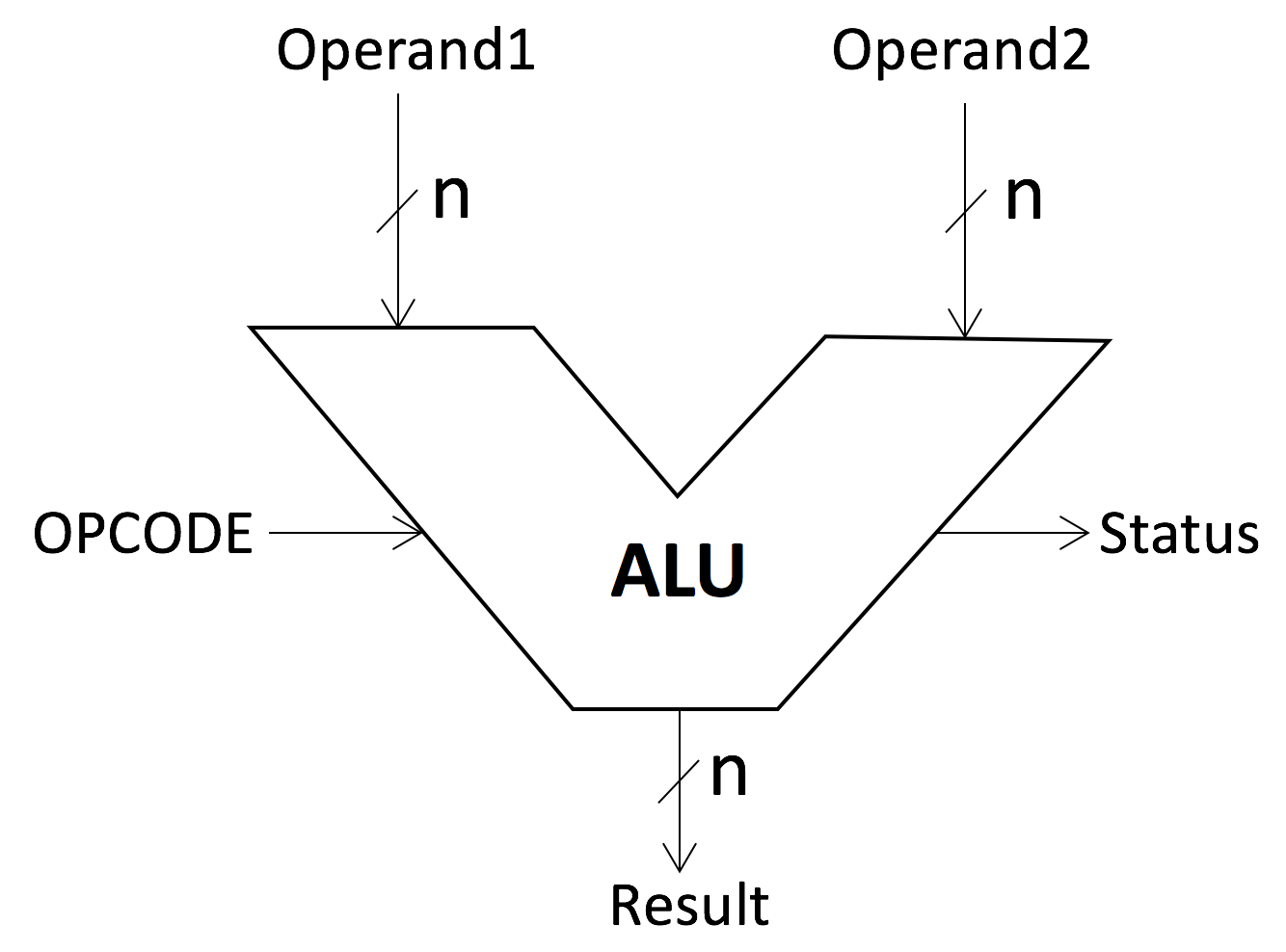
- The main part of the CPU is the Arithmetic and Logic Unit, ALU for short. It's the piece of circuitry that actually computes all the mathematical operations that are required for your computer to work.
-
The registers, a memory location that is integrated in the CPU and that can be used to briefly store values, such as the inputs or the result of a mathematical operation executed by the ALU
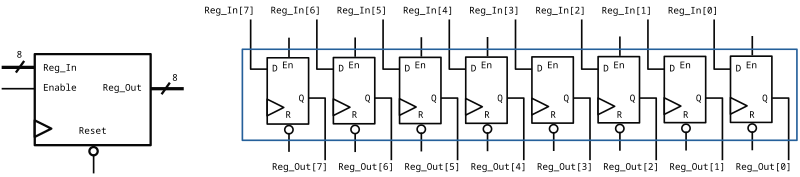
-
The Control Unit, "CU" for short, which is the component that acts a bit like an Orchestra director for your CPU. It fetches the next instruction to run from memory, it decodes it in order to figure out how it needs to be executed, and then it executes it; for example, feeding the operands for an operation to the ALU, and having it compute the result.
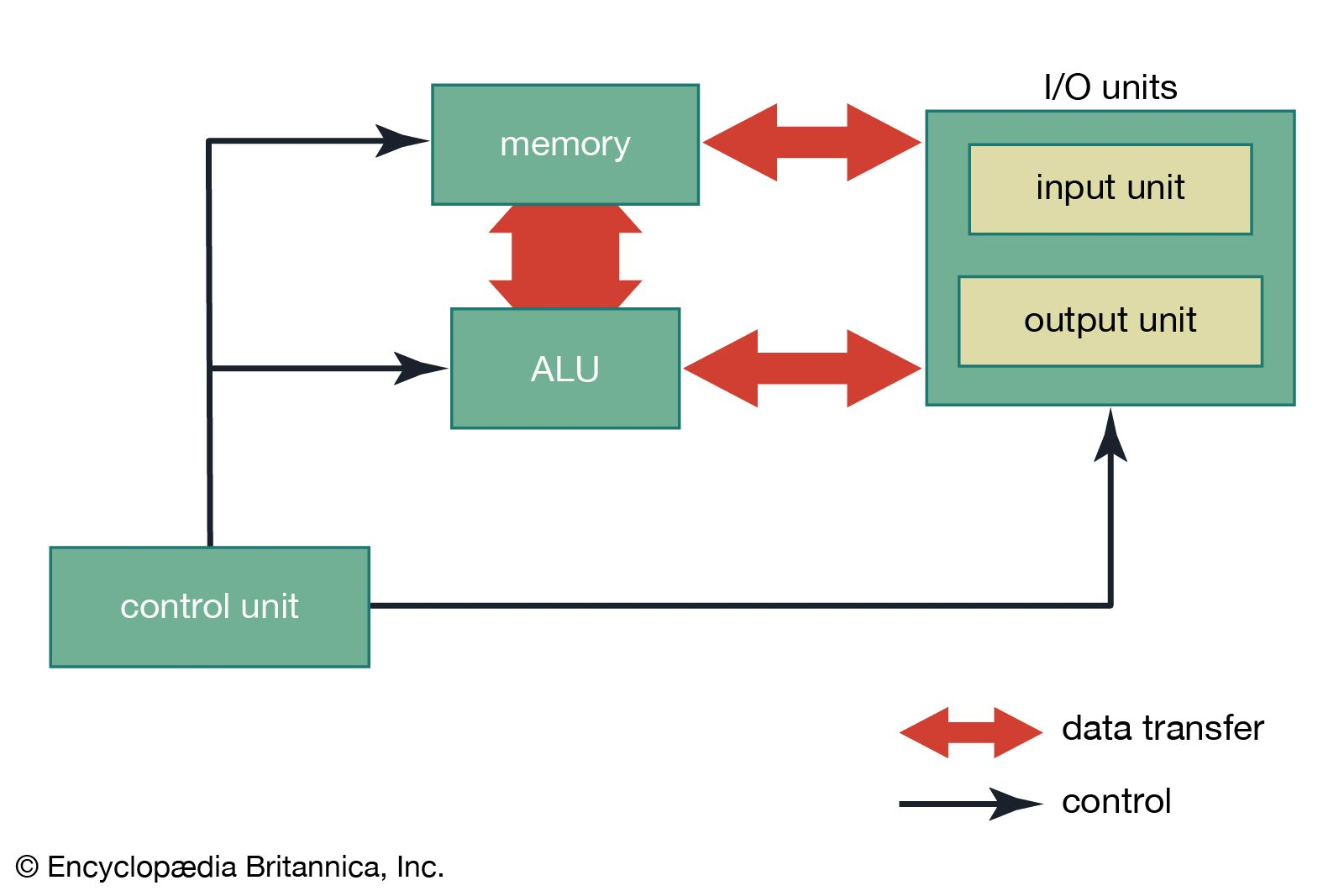
But what about these instructions? What kinds of instructions can a CPU execute? How are they defined? This is where the ISA comes in. The Instruction Set Architecture is a model that defines all aspects of how this works: it enumerates all the instructions that a CPU supports and everything related to them, such as the data types they accept as input and produce as output, the registers that they use and how they use them, and how a lot of other basic functionality like memory handling and I/O works. Unlike all the other components we have previously seen, though, the ISA is not a physical entity that is made of transistors - it is an abstract, theoretical model that defines how a CPU works.
So, what is RISC-V?
With the basic context out of the way, what is RISC-V? RISC-V is an ISA that is completely free and open source. Purely due to this, it fills an important position, as it is one of the very few ISAs that are not proprietary. Unless you are running on a RISC-V computer or something similar, though, you are currently using a CPU that has a closed-source ISA: it should be an Intel or an AMD processor, or some kind of ARM SoC. What this means is that, except for some basic facts about the architecture that have been documented by the chip-maker, you do not know how it really works and you cannot create your own compatible version on the same ISA, since you are not licensed to do that. Even if you could, the specifics on how exactly to achieve that are tied to a trade secret, and are someone else's intellectual property.
This changes with RISC-V. The open ecosystem around it makes it the perfect candidate for completely free hardware that you can use, study, modify and redistribute freely, without fees or restrictions, in the same spirit Linux is distributed under. In fact, the related documents are provided under a Creative Commons License or a BSD license - it's free as in freedom, public domain.
This is a big deal. We have already seen that an ecosystem is worth more than the sum of its parts, and that the collaborative nature of open source ecosystem makes technological process flourish: just look at the Linux ecosystem, perhaps one of the healthiest ecosystems around, and home to the one piece of software that is likely to outlive us all.
In RISC-V land, a hardware manufacturer can start designing IC (Integrated Circuits) that implement the RISC-V ISA specification, and add their own extensions around it - things like PCIe and USB bus connectivity - as well as do their own experimentation on additions to the ISA. Individual players are encouraged to submit proposals for improvements to an official RISC-V board, who helps evaluate the proposals and make the ones who are found to be a good fit with the project direction to be included in future versions of the ISA. This collaborative environment closely mirrors that of the early days of computing: it's exciting, and it fosters growth. One chip manufacturer can find a performance improvement or another enhancement and, if it's a good one, then all the other manufacturers have access to it. This is exactly what helped make the RISC-V Framework Laptop a reality: a company had been building ICs around RISC-V, and they ultimately were able to provide the cores that power the board itself.
This is a great balance: while it's not quite the far west - there is no guarantee that your change will be approved upstream - it is still leaps and bounds better than what happens on ARM land, where the ARM company owns the ISA, and licensed hardware manufacturers have little freedom on what to do with it. This climate is the opposite of collaboration and, rather than fostering growth, it often fosters drama and disagreement. A good example of this is that fact that we are still talking about the rocky relationship between ARM and Qualcomm - two companies within the same ecosystem that are in a weird dynamic where they can't seem to get along, but they are symbiotic to each other's growth. It is also incomparably more open than the reality in x86-land, which is fundamentally a duopoly between Intel and AMD.
Another advantage over ARM is that commercial ARM boards are often very locked down, requiring proprietary drivers to be able to work properly, and very often shipping with locked bootloaders that prevent the installation of other operating systems. Remember when we talked about the Snapdragon X Elite back in August? In retrospect, I might have been a little bit too optimistic: Linux support on that chip is not panning out well to say the least, as Qualcomm has been really dragging their feet on their original Linux support promises, making the Linux experience on the X Elite largely a no-go, several months after release. Never has any Intel or AMD laptop chip been in such a rocky state Linux-support wise after this much time for a very long time. Qualcomm has been facing a lot of challenges on the ARM for Windows side of things - the part of the X Elite project where the money really is, and where there is a binding contract with Microsoft to fulfill - and it seems like Linux has been a second thought since then. Radio silence on Tuxedo's promised ARM-based laptop as well: it's just not panning out. By sheer contrast, Linux support on RISC-V platforms is amazing, and support for those platforms gets upstreamed quickly.
As a consumer, RISC-V means you get more freedom from choice - real choice, without gatekeepers like ARM. As a power user, it means that you are no longer merely an user of your hardware platform, but you are also potentially a developer or a designer: you are free to tinker, research, and contribute your findings back upstream for everybody's benefit, doing science like it was meant to be done. As a Linux user, it means that you will be getting amazing platform support, where Linux is finally the first-class citizen rather than an afterthought that gets some of the features destined to Windows systems much later if ever - something that happens more often on other platforms - resting assured that the upstream kernel will be enough to run your SoC just fine, with no need to fetch a patched kernel, or load proprietary modules.
RISC-V is not only interesting for consumer hardware, though. In fact, its growth is becoming increasingly attractive for the High-Performance Computing field, prompting a slew of research around how RISC-V could fit in performance computing, like this brand new August 2024 paper titled "Evaluating ARM and RISC-V Architectures for High-Performance Computing with Docker and Kubernetes", which explores with great detail just how promising this architecture it for serious workloads, though it still needs some time in the oven.
Meaning of the RISC-V name
But why is RISC-V called RISC-V?
First of all, RISC-V is a Reduced Instruction Set Computer - RISC.
An ISA can either be a Reduced or Complex Instruction Set Architecture.
- The most common home computers, based on the x86 family of processors, of which the most important players are Intel and AMD, have a Complex Instruction Set Architecture, CISC for short. What it means is that their ISA contains a large number of different instructions, each of which can be very powerful and represent the equivalent of running several simpler instructions consecutively. This allows the ISA to be very expressive.
- Imagine we are in the 60's. Still well in the beginning of computation, and we are still mostly figuring out the best way to trick rocks into thinking. There are several limitations to keep into account, such as that computers have very limited amounts of memory, so programs must be very small and simple.
- The advantage to this approach is that the instruction set already directly targets several high-level programming concepts like calls and loops, making writing Assembly code - the code that represents sequences of hardware instructions the CPU must execute in batch - potentially more comfortable, allowing programmers to collapse what would be several lines of code into just one.
- As a result, this approach allowed programmers to create smaller Assembly programs, which used to be a big deal back in the 60's, where computers were much more memory-constrained compared to today.
- If up to this point it looked too good to be true, that's because it was. Later on, it turned out that using complex instructions often didn't translate into the best performance, but it was possible to drastically speed up several programs by ignoring the big, high-level instructions and using batches of small ones instead. This happened for several reasons, one of which being the fact that CPU manufacturers were so obsessed with making Assembly programs shorter that the CPU microcode began to expose instructions that the CPU could not operate efficiently and quickly: programmers didn't know that though, so they would use them anyway, blissfully unaware of how that single advertised processor operation actually costed.
- The RISC approach takes the opposite idea. RISC is what ARM processors, like the one in your phone, use - as well as RISC-V itself.
- We are now more in the 70's and 80's. Some of the shortcomings of CISC have been acknowledged, and we are no longer as memory-constrained as we were a decade back. We can finally afford to run some slightly larger programs.
- The idea behind RISC is to really simplify the ISA. Only basic, primitive operations are included, where each instruction takes a fixed size, and the same thing a line of CISC code achieved required several lines of simpler RISC instructions. RISC operations do not perform more than one thing, and different instructions are separate in scope.
- With this paradigm, performance is great. RISC computers can enjoy few simple addressing modes, all the instructions are of about the same size and length, and they all take roughly the same ballpark of time to complete, making execution times much more predictable, which allows design simplification, which often translate in even better performance in a vicious cycle.
- Many RISC-based computers came and went, but CISC reigned supreme in most home computers and servers for a while, mostly due to compatibility reasons with software previously written for CISC processors, especially on the Windows platform. However, RISC has been making a comeback with ARM, because of its highly performant and power-efficient nature, that makes ideally better than CISC for most use cases, while also making it possible to achieve good performance while running in incredibly constrained environment and embedded devices, like smartphones, still managing to get incredibly good performance, drastically more efficiently, so, with significantly less heat to dissipate, finally allowing for passive cooling to be viable in a lot of situations.
So, there we have it. RISC-V is called like that because it's a RISC ISA. But why V?
Brief history of RISC-V
Towards the 90's, the benefits of RISC-V triggered some academic curiosity, which itself birthed the publication Computer Architecture: A Quantitative Approach, co-authored by David Patterson, who later participated in RISC-V. This publication was a RISC ISA called DLX, which was more of a "toy" architecture meant for educational use.
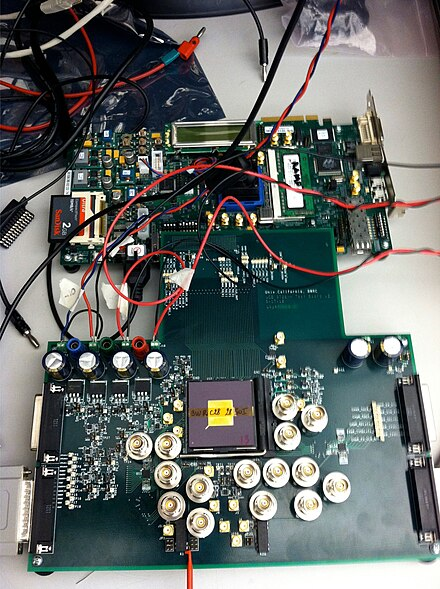
In 2010, the same David Patterson decided to aid UC Berkeley academic Krste Asanović, who wanted to create an open-source operating system as a short side-project involving some graduate students. That is how the Berkley RISC ISA was born. The small side project that was meant to only last for about three months turned out not to be so small, and it went through five different iterations. RISC-V is the name it took at its fifth iteration, after being officially introduced on August 6, 2024.
Well, does this not remind us of something? Linux, too, was meant to be a short hobby project, never meaning to be big or anything like that. This is another time that a side project grew way out of scope and became a very big deal.
Why is it important?
As more time passed, the writing on the wall was clear: RISC-V has started proving itself as a viable platform, and it has started spreading like wildfire among tinkerers and researchers due to its open-source nature, which actively encourages development, rather than prohibiting it.
While adoption is still in its early stages, RISC-V already exists commercially in several embedded chips: for example, those of you who are reading on a Framework laptop - yes, the regular CISC one - are actually using a tiny RISC-V chip every day, every time they unlock their laptop by tapping their finger on the fingerprint reader!
Fast forward to now, we are finally starting to see some development boards - complete, usable RISC-V systems that can be used by developers to start contributing to the RISC-V ecosystem, or porting their software over to this new architecture.
One of the manufacturers who currently provides these dev boards is DeepComputing, the manufacturer behind the Framework RISC-V board.
Before we dive into DeepComputing, though, I would like to talk about today's sponsor -- nobody. Or, you.
Who is DeepComputing?
DeepComputing is a Hong Kong-based company that was founded in 2022 for the goal of pioneering RISC-V technology. Their Framework Laptop mainboard is not their first rodeo: the company already has quite a bit of experience in the RISC-V ecosystem, between embedded / IoT products of sorts (they even have a RC car!) and other mainboards.
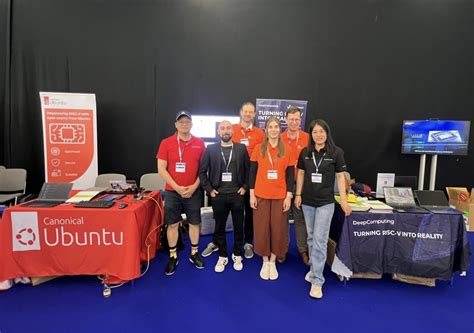
Their Framework mainboard is, in fact, based around their "DC-Roma" SoC, which has been available in a separate development board for a while.
Not only that, but a similar chipset was integrated into another laptop solution that they sell, called the DC-Roma RISC-V laptop IIwhich is marketed to be first laptop in the world to ship directly with RISC-V. That project is similarly exciting, especially if you consider that Canonical, Fedora and other Linux distros have been on board the entire time to ensure it gets supported properly by their images. The Laptop II is more powerful than the Framework board, boasting twice the RISC-V cores on its SpacemiT K1 SoC, twice the RAM and at a faster transfer rate, as well as more ports. But it's also a completely different product: it's more of a regular laptop, as opposed to Framework's solution, which is more focused on modularity and repairability.
RISC-V on the Framework Laptop 13
So, we are finally ready to jump to the interesting part: How is the motherboard itself? First of all, you have to keep in mind that this is a chipset development board adapted into a more consumer-friendly form-factor. Although it is usable for basic tasks, it is still primarily meant for development and tinkering purposes, and it is really nothing special, performance-wise, compared to the more mainstream SoC's already on the market. You probably shouldn't buy this if you are expecting the snappiest performance for your daily tasks, but you probably should if you are the kind of person who wants to find out why it is not running faster yet, and help figure out how to improve it.
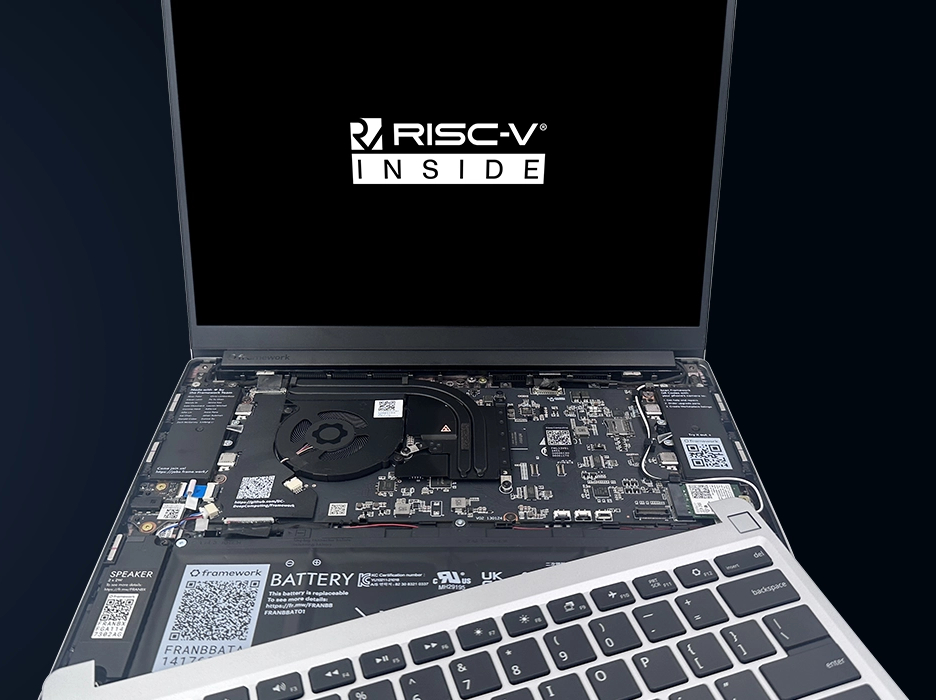
The CPU is a quad-core chip with a frequency of up to 1.5 GHz with its own Imagination GPU, combined with a pretty small 8 GB of soldered-down DDR4 memory, and... a 64 GB MicroSD card as far as storage goes. Once again, this is not going to win any performance benchmark, but it will get you running RISC-V on a consumer laptop that you can totally take to the library and prepare your next exam on - and that's incredibly cool.
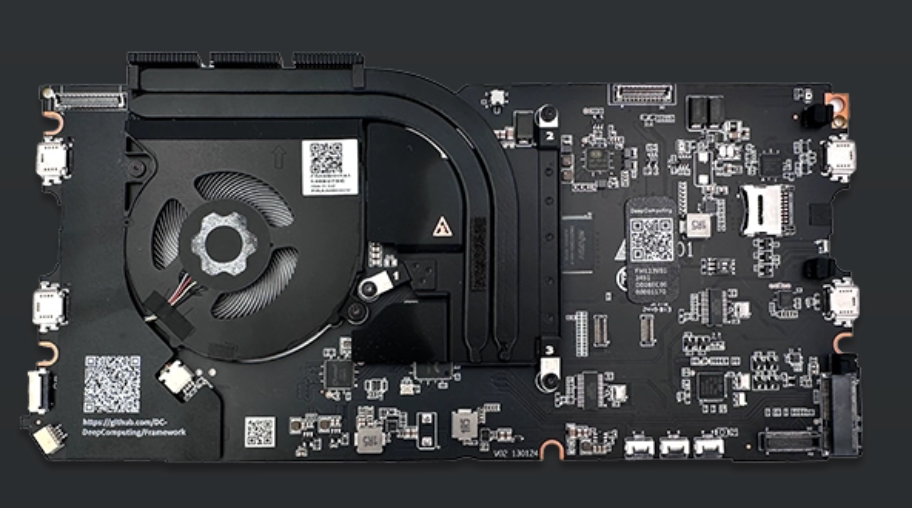
Connectivity wise, things are a little closer to the more established counterparts out there: the Type-C interface supports the USB-PD 3.0 protocol for charging at a maximum of 60 W, DisplayPort 1.4 video output allows you to use this motherboard together with an external 4k monitor with no issues, all with USB 3.2 or USB 2.0 speeds. As far as the Wi-Fi and Bluetooth, it relies on a standard PCIe m.2 2230 interface, and it ships with the Intel AX210 Wi-Fi 6e card, which is known to be one of the best-supported WLAN cards for Linux.
Aside from that, it has everything else a regular Framework mainboard has: a fingerprint reader for biometric authentication and a basic audio system with laptop speakers and a 3.5 mm headphone jack.
Software support is already pretty good: initial support for the riscv64 architecture is there since Linux kernel version 5.17, and this specific mainboard is completely supported by Ubuntu 24.04 and Fedora 41.
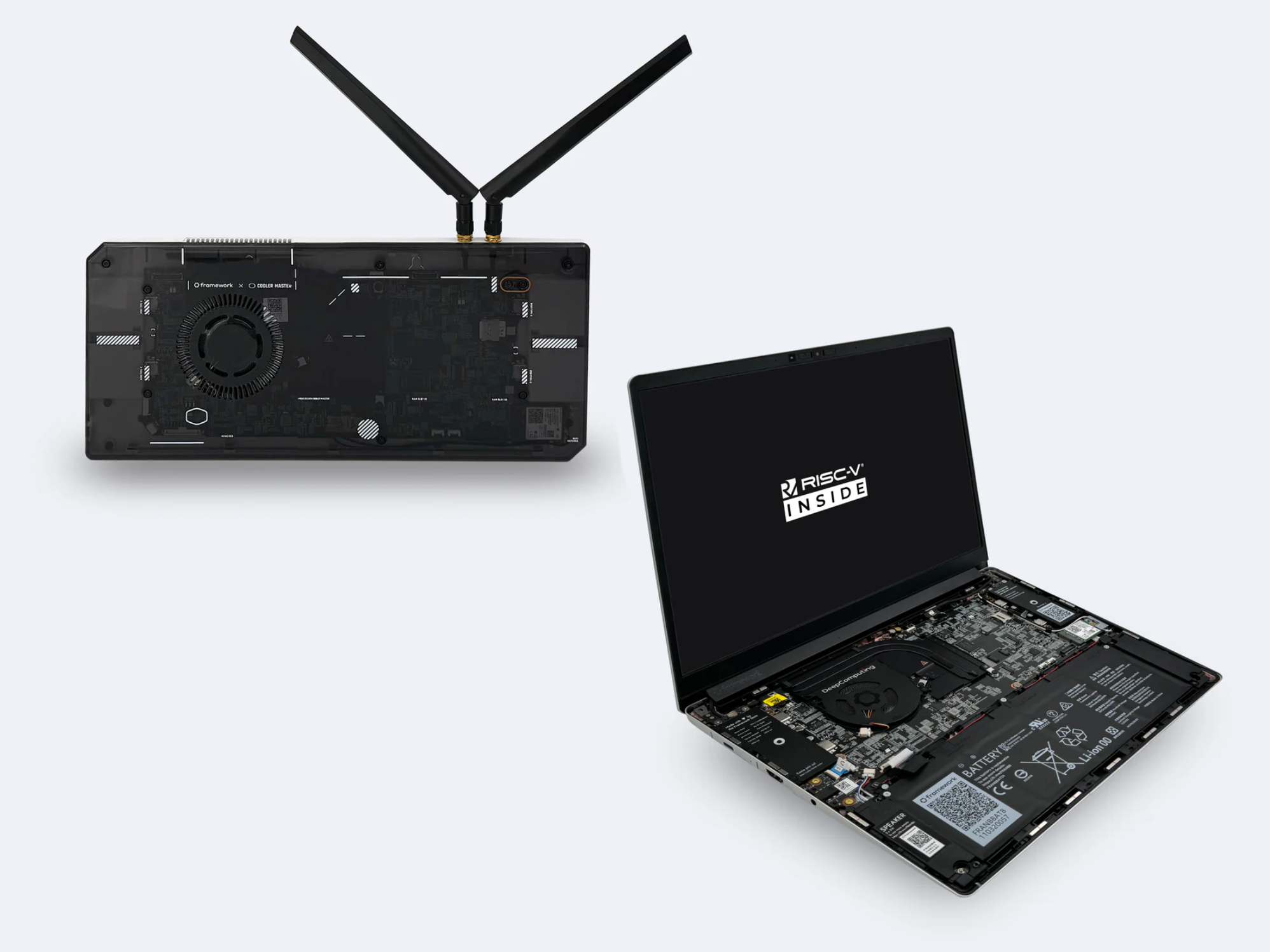
Additionally, as all Framework motherboards, this mainboard can be used either within a Framework Laptop 13, or using the Framework x Cooler Master case as a mini-PC, in desktop mode, without the need for owning an entire Framework Laptop to use it. This is especially useful for existing Framework 13 users, who might already have an AMD or an Intel motherboard installed, and may want to cycle between that and the RISC-V board inside their laptop, while still having the other, unused, motherboard available for use as a desktop PC. A particularly enthusiastic RISC-V users may decide that they do not need a ton of computer power on their laptop and use the RISC-V board inside of it full-time, leaving their existing Ryzen board at home as a "mini-PC" designated for heavier tasks,while most regular users will probably stabilize on keeping the Ryzen board inside their laptop for the long haul, mostly playing with the cool RISC-V development board in mini-PC mode.
Conclusion
This is exciting stuff. I genuinely think what is happening with RISC-V is a very positive and thrilling development, certainly one of the things we should be happy and excited about, although we are living in increasingly troubled times. Personally, I hope I will be able to get my hands on this marvel of innovation sometimes soon - but what I hope the most is that we will see a day where this technology reaches a state that is at least comparable to something like the Pine64 sooner than later. Even if it would have limited support for proprietary executables due to it being a new architecture mostly focused around the free software ecosystem, I would definitely love, one day, to be able to get away with using a RISC-V laptop for at least the majority of my light daily tasks. Great work, Framework, DeepComputing and all the amazing people behind RISC-V.
Help us break even
We only run on donations. We have a goal of reaching 300 subscriptions, which would allow us to hire staff.
If you subscribe, you'll gain access to a few members-only pieces, though we aim to keep most of our content free for all.
no ads · no trackers · cancel whenever