Browsers
10 piecesIn this section
pages
Thunderbird is launching its own mail provider
Browsers · 6 min · p. —
Why I recommend against Brave
Browsers · 14 min · p. —
Servo vs Ladybird
Browsers · 11 min · p. —
No, Mozilla did not receive any USAID money
Browsers · 8 min · p. —The Linux Experiment ditches Firefox, but I'm not sold

The Linux Experiment made a video in which he says that he has lost trust in Mozilla and is therefore abandoning Firefox and Thunderbird (or any other Mozilla product).

This is a legitimate take, which I can't argue with. You do you. However, I find that the arguments he made to support his claim are quite misleading. I want to go through them.
Firstly, his criticism of the new Mozilla terms of service - and I quote verbatim - is that:
The vague wording also does mean that Firefox has access to everything that you type inside the browser, and potentially anything you upload through it.
To which my simple answer would be: ...no shit? Firefox has always had "access" to everything that you typed or did in the browser, just like any application has "access" to everything you do using it.
Of course, the key difference is that now Mozilla has a license to that data, not just access. Look, I'm nitpicking, but it's an important distinction. The idea here is that the license is required for Firefox to use data you're submitting, like the URL you want to visit; other browsers do that too, like Google Chrome or Microsoft Edge. The Word text processor also has that, Safari has a similar wording, and so on.

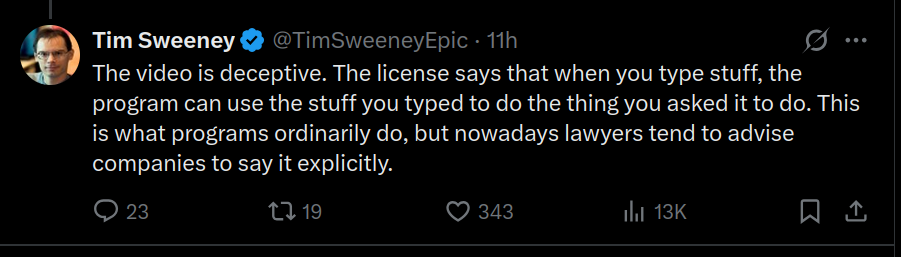
As the CEO of Epic Software claims, there has likely been an internal legal review of the current Firefox privacy documents, and it turned out that this line should've been there already, but it wasn't, and thus they rushed to add it.
But this does not change what Mozilla can do with your data. Before this, they could access all of your data and share it around according to their Privacy Policy; now, they can still access all of your data and still share it around according to their Privacy Policy. Nothing changed.

He also complains that the Terms of Use can change anytime without your explicit consent, but again, the same applied previously. We did not have "Terms of Use", but the usage of your personal information was contained in the Privacy Notice, which could've changed anytime. And it did, as we've just seen.

What also did not change is the fact that Mozilla has advertisement partnerships for the new tab page and for the search bar; it collects some aggregate information specifically about your interaction with those ads, and that aggregate information is shared with the advertiser. They've been doing that for years: what you saw on-screen is the old Privacy Policy, not the new one.

Again, most likely following the above-mentioned review of the legal documents, it turns out that this practice is technically considered "selling user data" in some jurisdictions. Thus, they had to rush to remove the "we don't sell your data" promise. Now, here Nick says that:
Except, that's also a really weird justification because first you're not supposed to collect any personal information, up to that point: that's why you introduced the terms of service; to have the right to collect and access that data. So, you [previously] wouldn't be affected by any definition of "selling" because you didn't have anything to sell.
This is WRONG. He is saying that now that the terms of use have been introduced and now that they have a license, they're collecting and selling your data, and so they had to remove their "we don't sell your data" promise. That's NOT what happened. They are doing exactly what they were doing for years: collecting and sharing aggregated data about advertisement interaction. The privacy policy already told you that. Here's the same image as above to re-iterate this point.
Simply, they now realized that they can't legally do this and, at the same time, say that they "don't sell your data".
Now begins the sketchy - IMO - part of the video. Nick points out that AI needs data to be trained on, which, fair enough, it does. He also points out that Mozilla is trying to generate revenue by developing privacy-respecting AI. Fair enough, they are.
And, through what becomes very wild speculation, he claims that the Terms of Use are the first step to harvesting all of Firefox users' data to train AI, which is something that does not have any evidence or even hints that this might happen.
Do the new Terms of Service allow for AI training or similar? No, they don't, as they still have to follow their Privacy Policy.
Does the new Privacy Policy allow for AI training? No, it doesn't, as it says that none of your personal data (your page content, files you upload, what you type on pages, and so on) is uploaded anywhere, not even for ads.
Do the new Privacy Policy or Terms of Service make it easier to use your data for AI training later on? Also no. That had always been up to the Privacy Policy, which always could've been changed like that (snaps fingers). If this is a "first step to sell your data", it's a completely unnecessary step that does not get them closer to their goal.
Nick claims that in the future, some kind of AI could be integrated within Firefox itself. He makes the example of Orbit, an extension by Mozilla that implements some AI functionalities like summarizing documents in the browser. He says: one day this might become integrated in the browser, and then they'll use your data for training or something.
This is where it becomes clear just how off-track he is, in my opinion. Let's talk about Orbit for a second: Mozilla tried its best to implement Orbit in the most privacy-respecting way possible. It does not send your data to any of the big AI players out there, but rather it uses a Mozilla-hosted Mistrial instance, which is open weight, does not collect any information about the model input after working with it, and in no way contributes to the training of any model, let alone with your data.
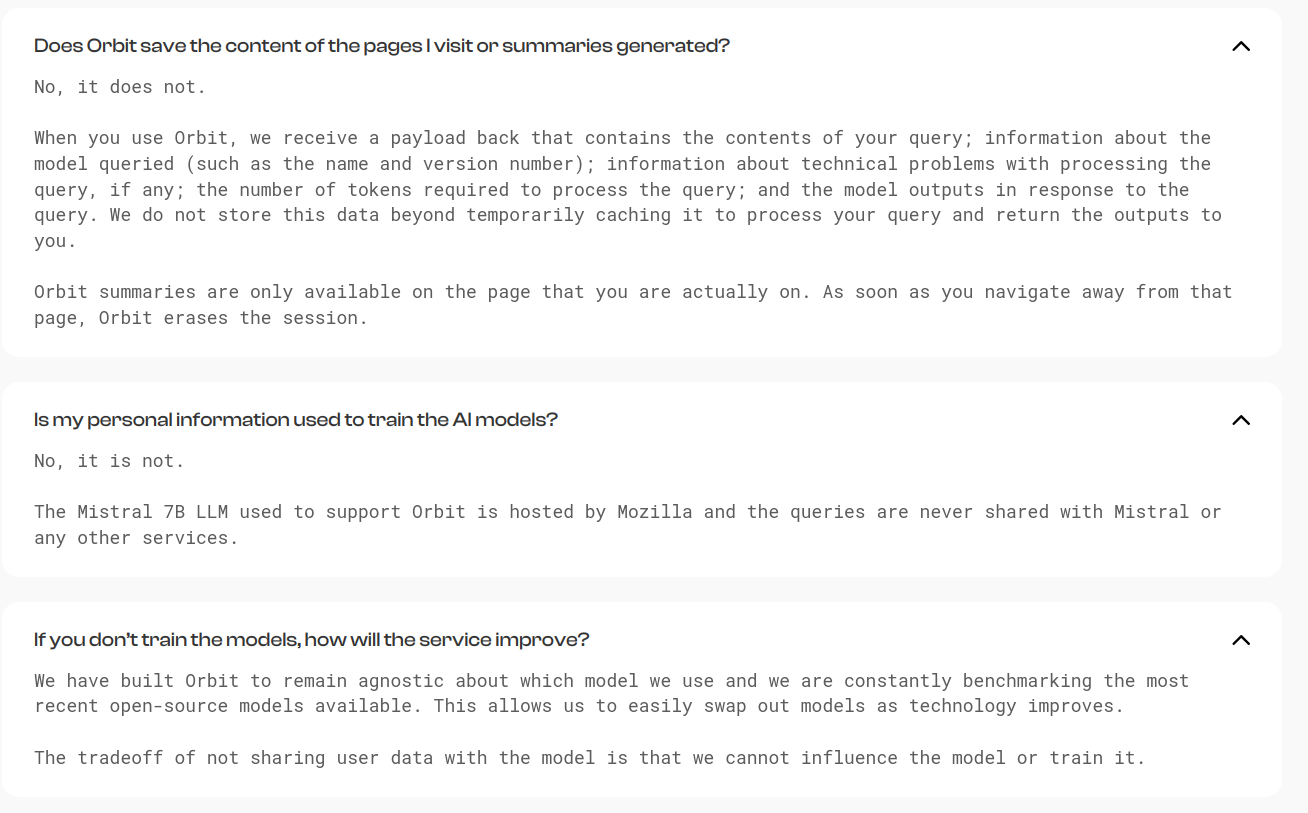
Unless you run a model locally, which isn't always possible, this is as privacy-aware as AI can get. If you don't like it, then you don't have to use it, but some people like this kind of feature, and it's great that Firefox is working on a privacy-aware way of providing them.
He concludes this section by saying:
At that point, their Term of Use will also include transparently without you ever noticing it or accepting it by clicking a button, [...] the fact that they're going to use that data to train an AI model or to make the AI features work which will very likely be just Firefox just selling your browser data maybe anonymized maybe not to AI companies. That's exactly what the plan sounds like to me
Which, again, has no basis whatsoever in reality. If Firefox one day updates their Privacy Notice to say, hey, we now sell your data to train AI… then (a) everybody will freak out, and it certainly wouldn't go unnoticed, and (b) they could've already done that, no need to add these Terms of Use. And this is even assuming that they want to do it, whereas everything Mozilla has done so far is exactly the opposite: they're working on locally-running AI to avoid giving your data to other parties, they worked with AI companies to allow artists to opt out from AI training, and so on.
There's only one - ONE - thing that Firefox is doing and that we don't like: they are collecting interaction data with ads on the search bar and sharing that data with advertisers. They were doing that already, they are doing that now, and you might rightfully dislike that. It might be an opt-out feature, I did not check. But to think that this is all part of a big plan to harvest your data and sell them to AI companies is completely absurd.

Now, I'm using some strong language here, but - if you follow my channel - you know that I have the upmost respect for Nick.
He says that, given Mozilla's past, we should no longer give them the benefit of the doubt. Fair. But here we're gone all the way to a complete assumption of bad faith, assuming the scenario where Mozilla is most evil instead of the most likely one.
As another example, Nick here says that Mozilla is beginning to act like a for-profit. And I think it's important here to remind everyone that the company that develops Firefox is a for-profit. The Mozilla non-profit organization is a different entity, with different organization and working on different things. Sure, the former is a subsidiary of the latter, but they are nonetheless different entities, and the former is still a for-profit company.
I trust the for-profit Firefox company as much as I trust any other for-profit that I rely on: very little. I use an Honor phone, but I don't particularly trust Honor, and I would ditch them instantly if they gave me any reason to. I use a Fujifilm camera, but I don't trust them either, and I'll happily switch to whatever manufacturer - or browser - works best for me. Right now, that browser is Firefox. It might not be for you, and that's fine.
Now, Nick is switching to a fork of Firefox, and he's free to do that – it's a tradeoff, where you get delayed updates in exchange for an additional set of eyes on the code. It's also a bit of a risk, as if everyone switches away from Firefox to a fork, I'm not sure Firefox would be developed anymore, nor do I think that forks would be able to maintain the browser on their own. Still, I'm not questioning that decision; rather, I am (yes, heavily) criticising the reasoning he's giving to more than a hundred thousand people.
His stance feels so strong that he is also ditching Thunderbird. I believe this decision to be somewhat irrational: the company behind Thunderbird is a different one than the one that drafted these Terms of Use, and it's led by different people. They've already said that they will not adopt similar legal language. Thunderbird is an extremely cool and community-driven project, and I would hate for people to associate that with whatever Mozilla is doing for no reason (except, of course, Thunderbird's company being a subsidiary of Mozilla).

I could go into more detail about the new Terms of Use, but I've already done an entire article about them last week. I could also go into more detail about some specific claims, such as the fact that they paid their CEO "too much" money, but I've already done that a few weeks ago.
This leads directly to what might be the most important question of this video: how much did Mozilla pay me for this article? Sadly, their check bounced, and they are ghosting me, so it looks like I won't receive the money they promised me. This puts me in a tough spot since the cost of running this channel - from servers to equipment to contractors - is double the current income, and I'm running on a deficit. If you could support economically the making of these videos, it would mean a lot to me: links are in the video description.
I have a new favorite browser

If I asked you to think about a web browser, how would you visualize it?
For most people, the answer would be simple: you would imagine a window with a stacked layout composed of an array of tabs, a text box to search the web or input a URL, a bookmarks toolbar, and a body. There might be some variation: there may be more or fewer buttons, and maybe there is a menu bar, or maybe not. Perhaps a sidebar to show a tree-style tab view or your bookmarks is present. But, if you think about it, the overall skeleton of the user interface you are picturing is not fundamentally different from anything we had back in the 90s.
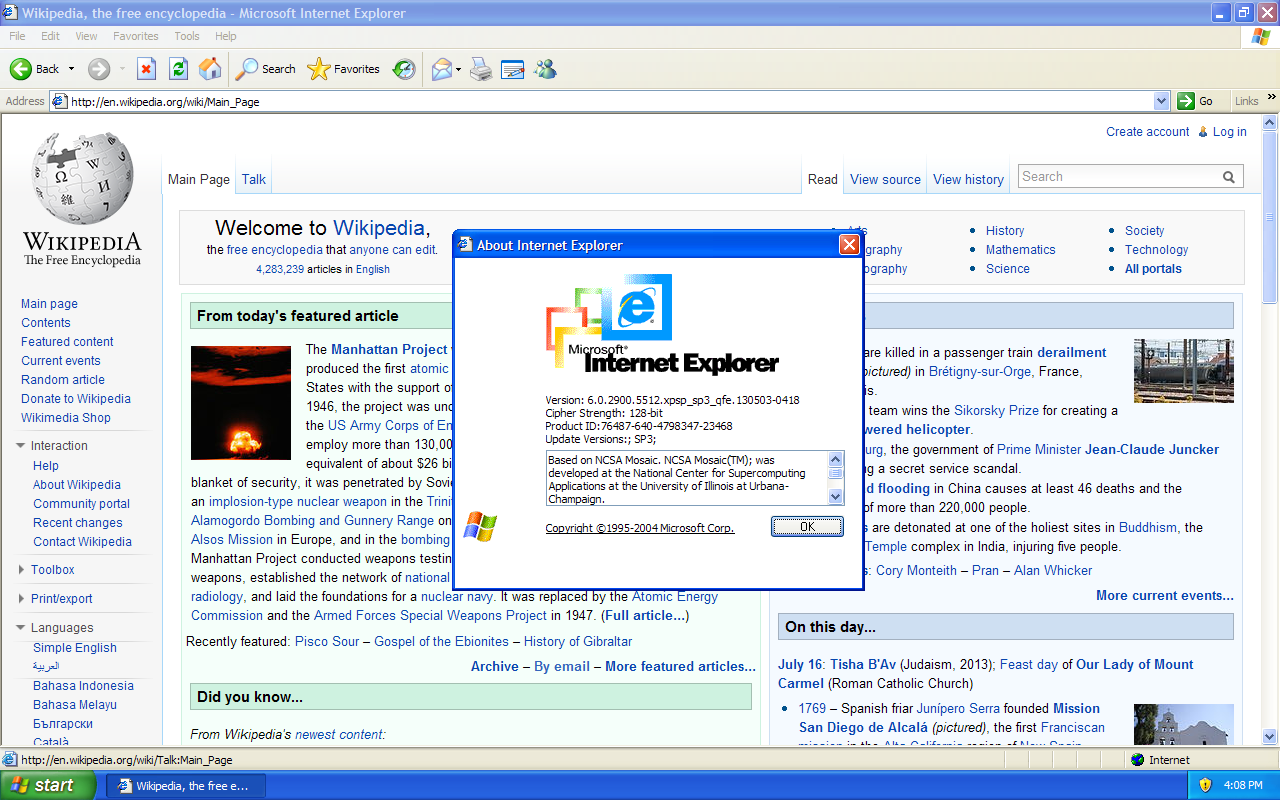
Sure, there have been some iterations. The URL and search bars have been collapsed into one, the menu bar is no longer visible, and tabs exist now. Some browsers have added tab groups, some even allow you to display the contents of some extensions in a sidebar. Fundamentally, though, that does not change the fact that the user interfaces we use in modern web browsers are a minor iteration over what we used 20–30 years ago, and have had very few changes in a decade.
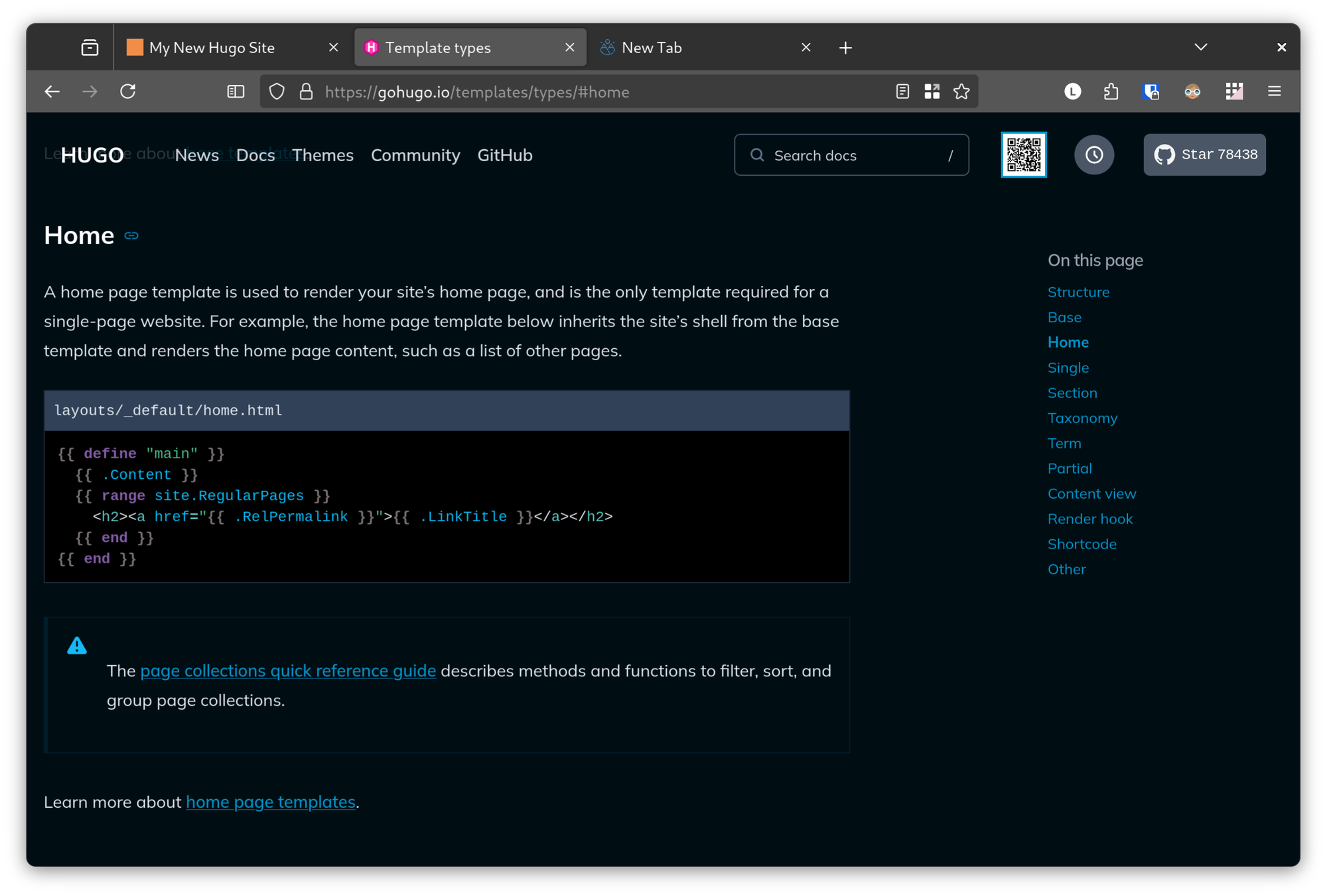
Even though it might seem pointless when something like this happens, I often ask myself: Is it because this design is perfect and flawless, or is it because we have not tried to find a better way to do it? This way of thinking is what got me into GNOME, with its unconventional, controversial but delightfully modern and efficient workflow. The same aptitude got me curious about this new browser, for what it's worth. But, first, before focusing on Zen alone, let's take a more general look at the situation.
Trying to move forward from the traditional browser
While most people are perfectly happy with the conventional browser paradigm, over the years, there has been a niche, but dedicated, community of Firefox tinkerers that did not feel that way. One of the nice things about the Firefox web browser, indeed, is just how customizable it is: while the GUI only exposes regular color themes, there is some manual setup you can do to go above and beyond that. Users may enable an experimental setting that allows them to completely override the look and feel of Firefox by replacing the default CSS stylesheets and UI configuration with custom alternatives. Subreddit /r/FirefoxCSS is a great showcase of what people have achieved with this functionality, and it contains some very interesting takes on the default UI, where several design conventions that have been a staple since the 90s are completely discarded.
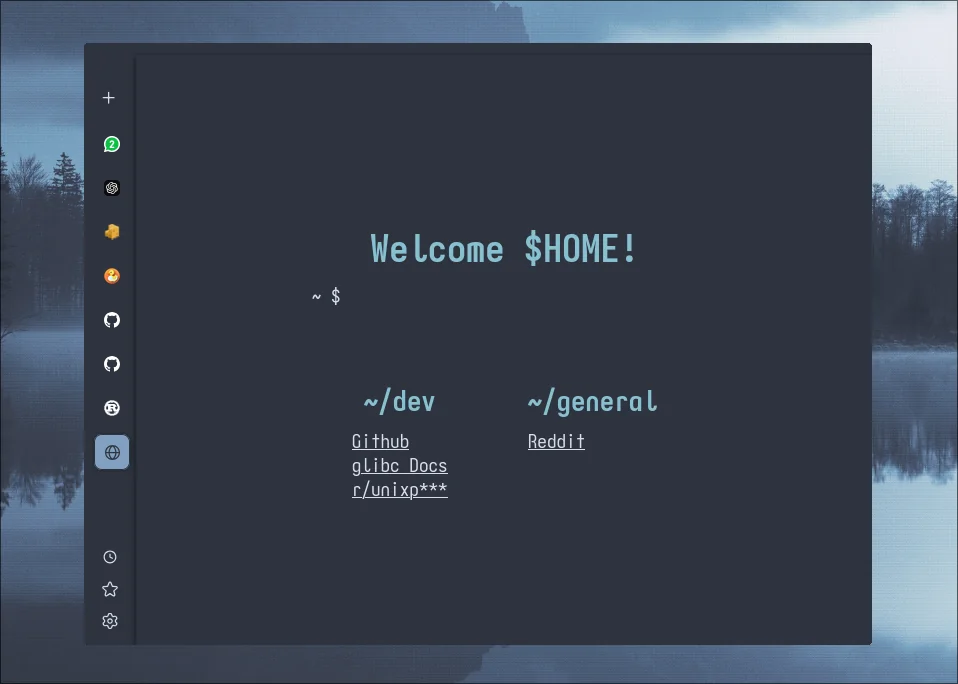
However, visual themes can only go so far, and they cannot be considered the most radical philosophical shift that the traditional browser workflow has undergone. That would be the fault of Arc Browser.
The release of the Arc Browser
A little over a year ago, back in 2023, a startup called The Browser Company released Arc, a Chromium fork that completely overhauled the user interface. At first glance, Arc is not remarkably different from a custom Firefox CSS theme, but stopping at that assumption would be wrong. Actually, rather than subtracting something or altering the default Chromium UI, Arc threw the entire paradigm into the trash can and thought it over from the get-go. Not only were numerous UI elements moved around, but the entire UX was redesigned so fundamentally that it required people to learn how to use a browser again. The Browser Company decided to create a browser UX trying to do something new because it works better, not because this is the way things have worked for the longest time.
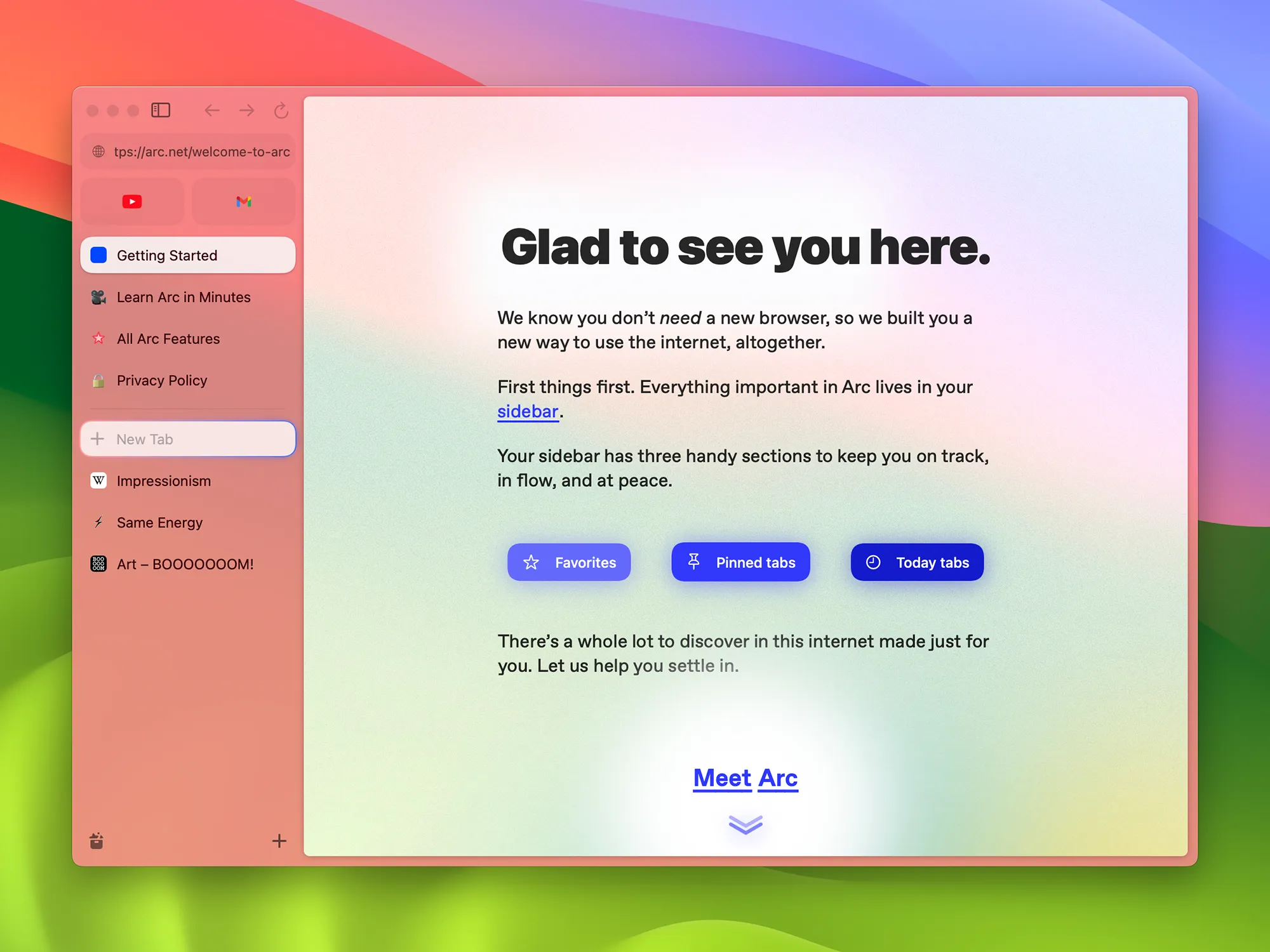
This shift of mentality certainly paid off for The Browser Company. People loved that. Arc was blessed by media and influencers alike, tons of people tried it, and many liked it so much that they stayed. Tons of students, developers, and professionals alike, reported they were much more productive in their tasks when using Arc, so its popularity quickly skyrocketed.
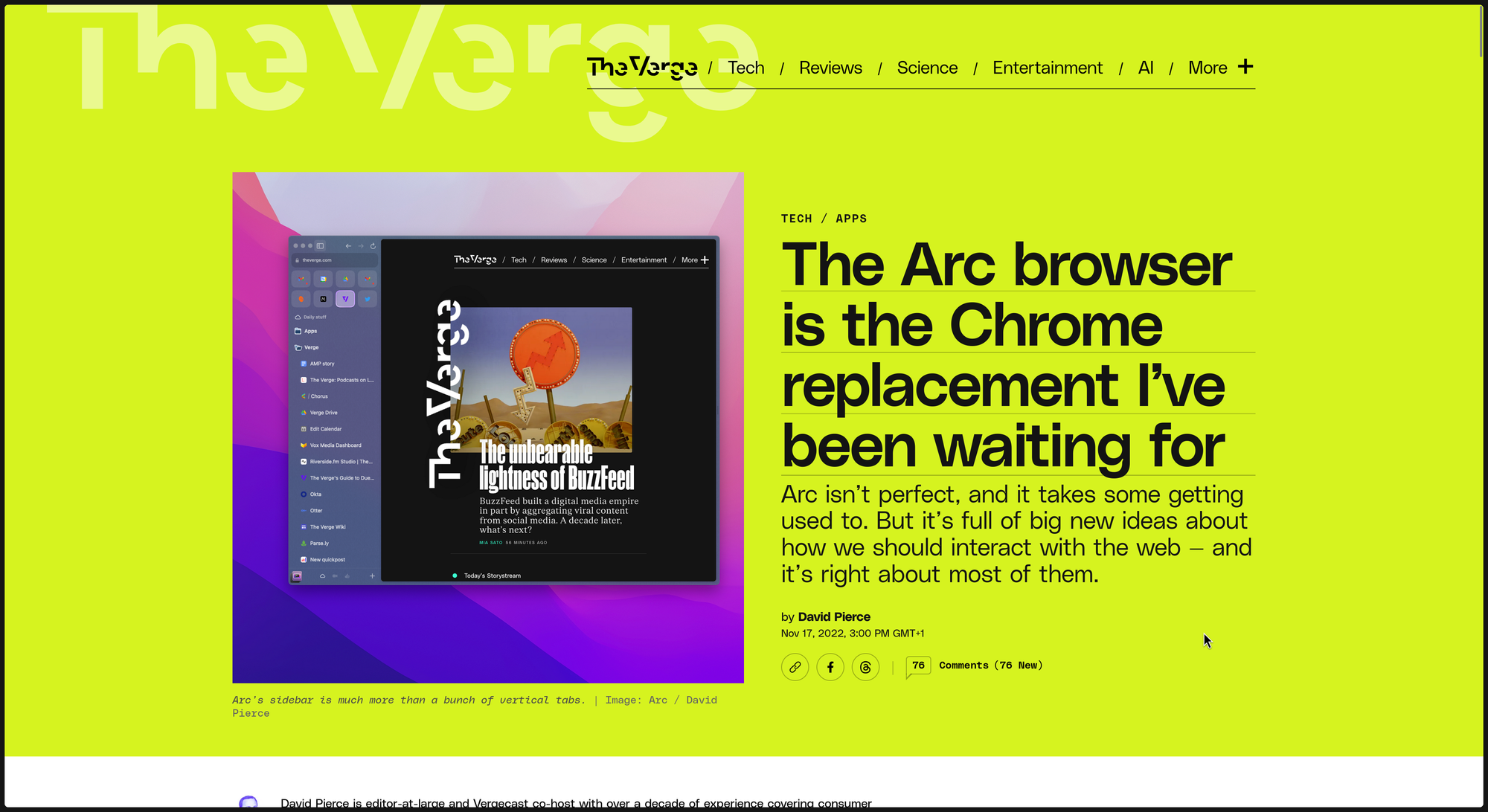
This was the first time in a long time that a simple browser UI — nothing special, just a different coat of paint — drew so much public attention.
As you might have guessed, though, it was not all sunshine and rainbows. Arc suffers from a few fundamental problems:
- It's proprietary software. That means the code is not available out in the open and the community is not allowed to become part of the project and contribute to it.
- It only runs on macOS and Windows, leaving Linux users with no good way to run it.
- It's based on Chromium, Google's browser backend. This is a problem: the dark times of Internet Explorer 6 have shown the world why it's a terrible idea to hand over the entire web to one single company. Also, it does not support Manifest v2 WebExtensions, meaning content blockers and several other privacy extensions will not be able to work properly on it.
- As of late, it has taken a focus on AI that not all users have liked. Some users report stability and performance have been on a steady decline, as more AI features are being integrated into the browser.
Overall, these concerns have been enough to prevent a lot of users from switching or to make them return to a traditional browser.
This is the situation that Zen Browser seeks to cure.
Welcome to a calmer Internet.
Zen Browser is a new web browser that is heavily inspired by Arc but seeks to correct its mistakes. The improvements it brings are substantial. Firstly, Zen is completely free and open source and developed from within the Linux community, which automatically makes it a browser worth at least taking into consideration. The browser is such an essential part of what you do on your computer, and it needs to handle so much sensitive data, that it makes no sense to opt for a proprietary one. Zen also ditches the Chromium backend, in favor of a Firefox base. This is great: if you already use Firefox, switching to Zen will be pretty smooth. Zen is still Firefox under the hood — it just comes with a more modern UI. It still does everything you expect from Firefox, though: it contrasts the Chromium monopoly, it supports all Firefox extensions and features, and it even still supports all the Mozilla services you are already keen on using — such as Sync, Relay, and the VPN — just as if you were using vanilla Firefox.
These three are, in fact, some external Mozilla services that are well-integrated with Firefox. Firefox Sync, as the name implies, syncs a set of bookmarks, tabs, and other information between browsers. I use it extensively: there is no Zen for phones yet, so I use Firefox on my smartphone. Thanks to Firefox Sync, I can seamlessly switch between the two browsers and pick up where I left off.
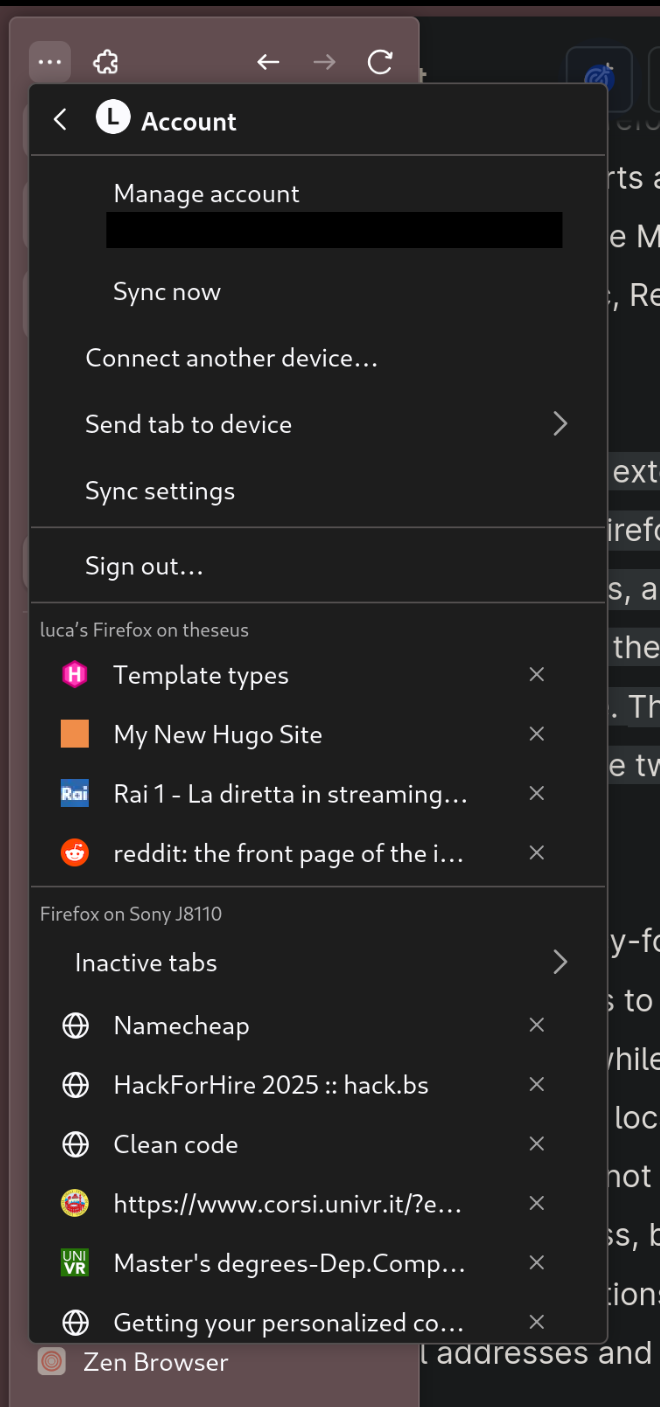
Firefox Relay is a useful privacy-focused service that allows you to create "proxy" online identities to hide behind when creating accounts on other websites, while still being able to control all of those identities from a central location. When you use Relay to register to a website, you will not be handing out your personal phone number or email address, but Firefox Relay will take care of - well, relaying - all communications between your actual phone number and email addresses and the fake ones it exposes.

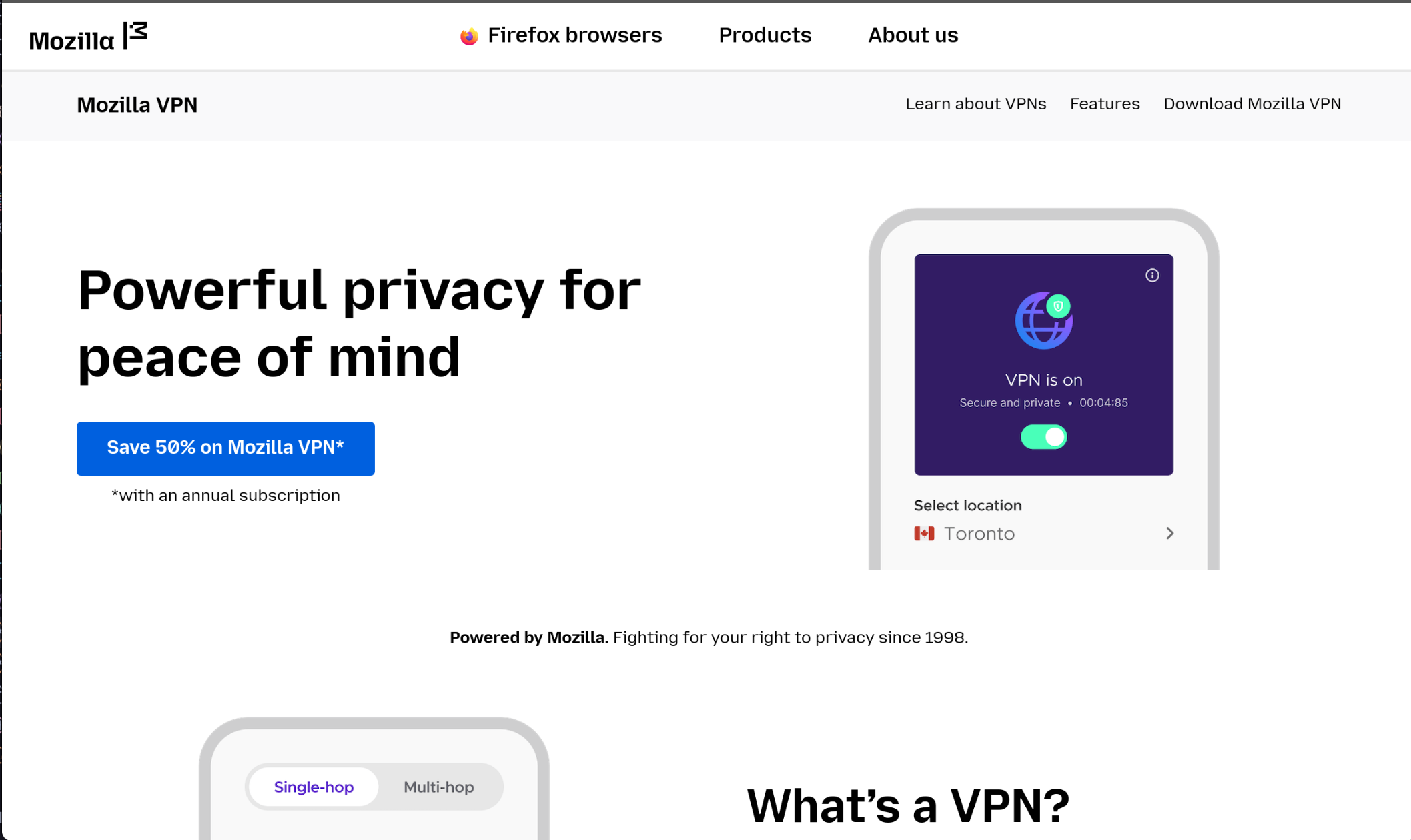
Mozilla VPN is similar - it's fundamentally a wrapper for Mullvad, widely considered the best and most private VPN provider available, with very good Firefox integration.
This is the reason a lot of people do not like Firefox forks: on the contrary, I think this is an advantage. Firefox itself is good, so there is absolutely value in adding some quality of life to it, especially since Mozilla has been dragging its feet on this front for a while. Finishing up with the improvements over Arc, of course, it runs natively on any operating system, and it has no AI anywhere.

My first impression of using Zen is that… I could finally breathe. In its default single-sidebar configuration, browsing the web is incredibly comfortable with it, and it feels like there is a lot less clutter. The focus is the content, not the UI. This paradigm goes very well with GNOME, which I like for the very same reasons.
Setting Zen up
Zen Browser feels different from the initial setup already. The design looks stunning, with polished and smooth animations. After that, the user is dropped right into Zen, with a bunch of open tabs to help get accustomed.
Zen Browser setup
The Zen Experience
Let us now talk in more detail about what the experience of using Zen on the daily looks like.
Horizontal tabs
There are already several differences folks will notice here. The most important one is, tabs are now vertical, rather than horizontal. While this does take some getting used to, it's a great improvement over tradition. As it currently stands, horizontal tabs scale poorly. They work well as soon as there are only a few, and you keep closing the older ones. Many people think this is fine, but I disagree. For many of us, having to keep closing tabs while studying, focusing on a project where we have to look up a ton of documentation, or — psst — writing an article or a script, opening a lot of tabs is necessary. When you do that, though, the previews get so short it's just about impossible to guess what the tab contains, and you need to scroll through them horizontally which is, frankly, just horrible. This is something that I had just sort of lived with for the longest time, but it had always frustrated me.

Over these weeks, I have found vertical tabs to be significantly more useful: knowing what I had open at all times became easier, which not only made me more productive but also greatly helped me get rid of redundant tabs. When you have a ton of horizontal tabs loaded it's easy to get complacent: you do not know what is behind a tab, so you will not want to spend a few seconds to find out just to see if it's safe to delete it. When I used horizontal tabs, I would usually wait until the end of a project to nuke the entire tab group (using the Simple Tab Groups extension) and call it a day.

Workspaces
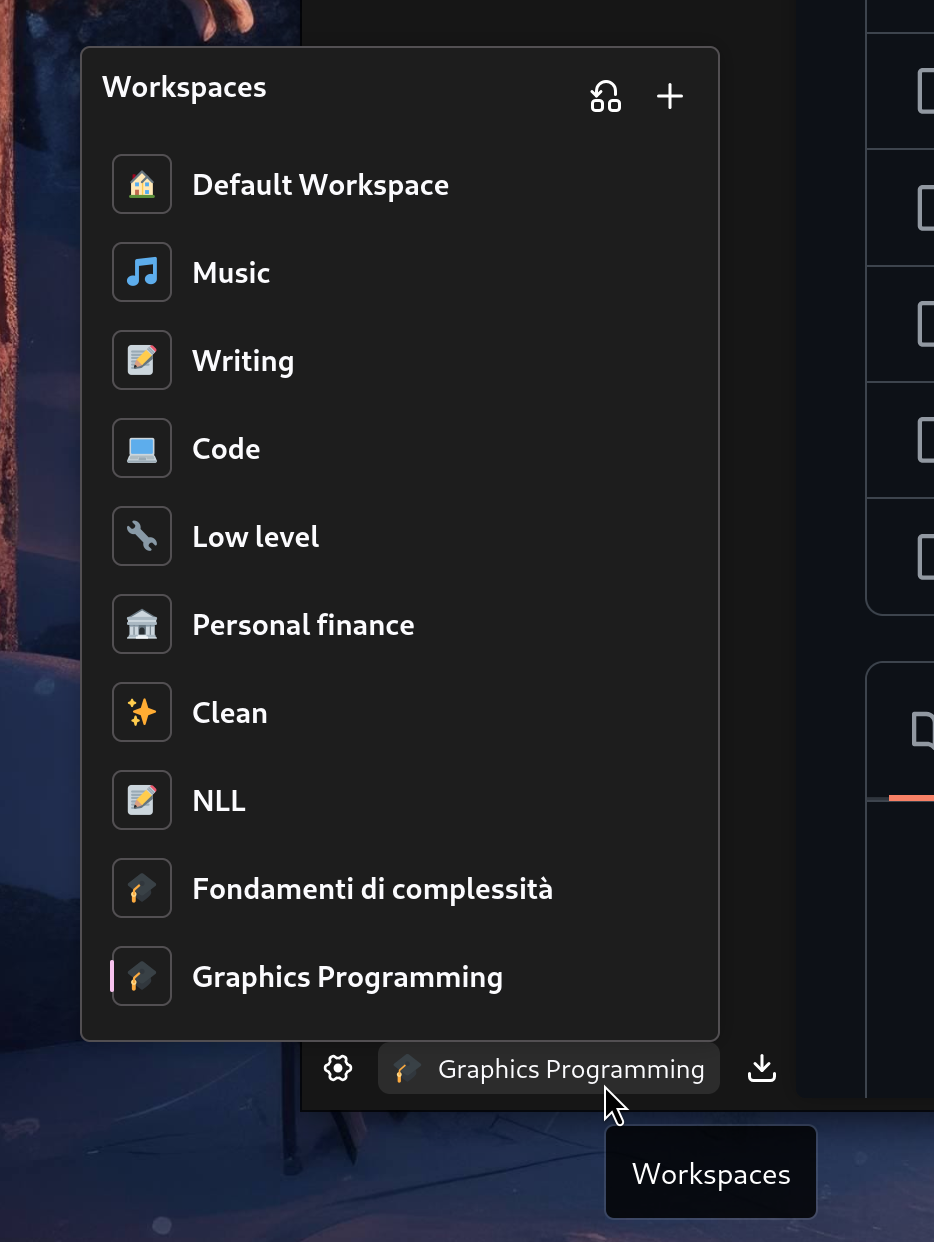
By default, Zen has support for several workspaces. They are great. You probably use your browser for multiple things at once, and you might have found that keeping all your tabs in the same place is messy, it gets crowded quickly. With Workspaces, every activity you do has its own space and its tabs. For my use case, I use it to separate everything: there is a default workspace that contains a bit of everything, others for media consumption, others for coding projects, one as a space dedicated to writing these articles, one for managing my finances, and one for every University exam I am preparing. You never have to close your tabs when switching contexts - you just switch workspaces, and what you were doing will be waiting for you.
It would be a sin to base your browser on top of Firefox without taking advantage of its most remarkable feature of all, though - c'est-à-dire, the Multi Accounts Containers. This is a Firefox feature that allows you to set up separate spaces for different things you do online. These are not necessarily linked to a workspace because they are a logical separation, not a visual one. A container acts like a separate instance of Firefox, with its separate set of cookies, cache, sessions, and credentials, which allows you to keep a strong separation between multiple domains. This increases security, as well as allowing you to easily have different sessions on different websites.
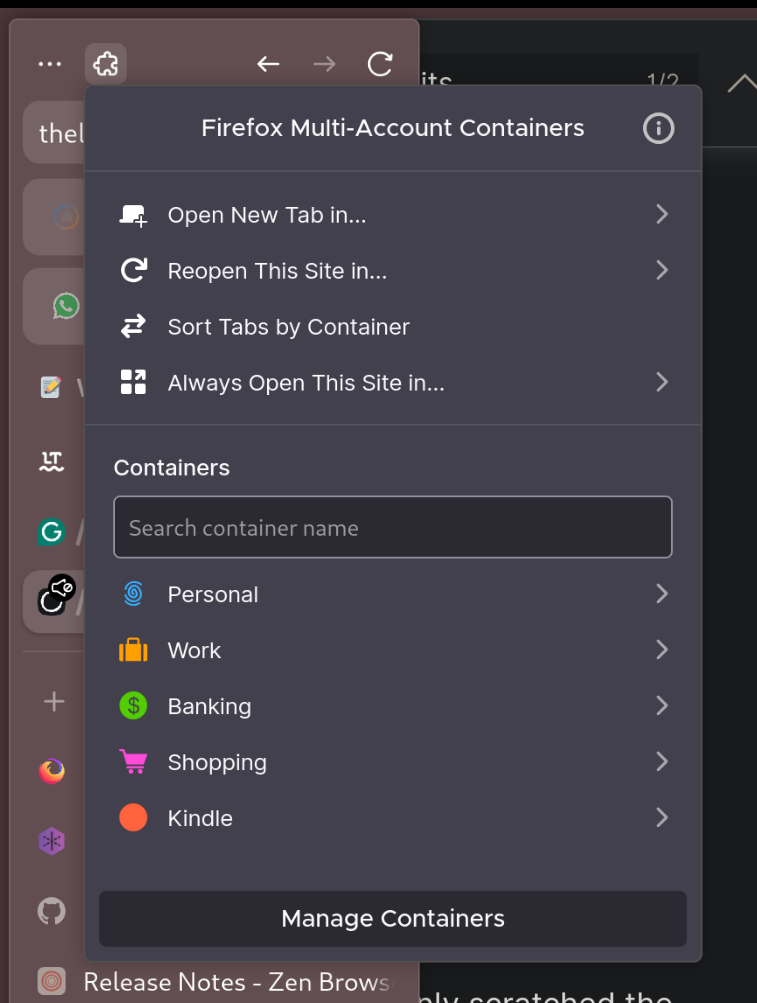
A great example is the Microsoft Outlook suite: in my case, I have three of them to manage - my personal, company, and academic instances - and containers make it a lot easier to manage that. You do not want to try to log in to Minecraft with your work account or send a work-related mail with your academic one. It's the kind of oversight that gets you in trouble.
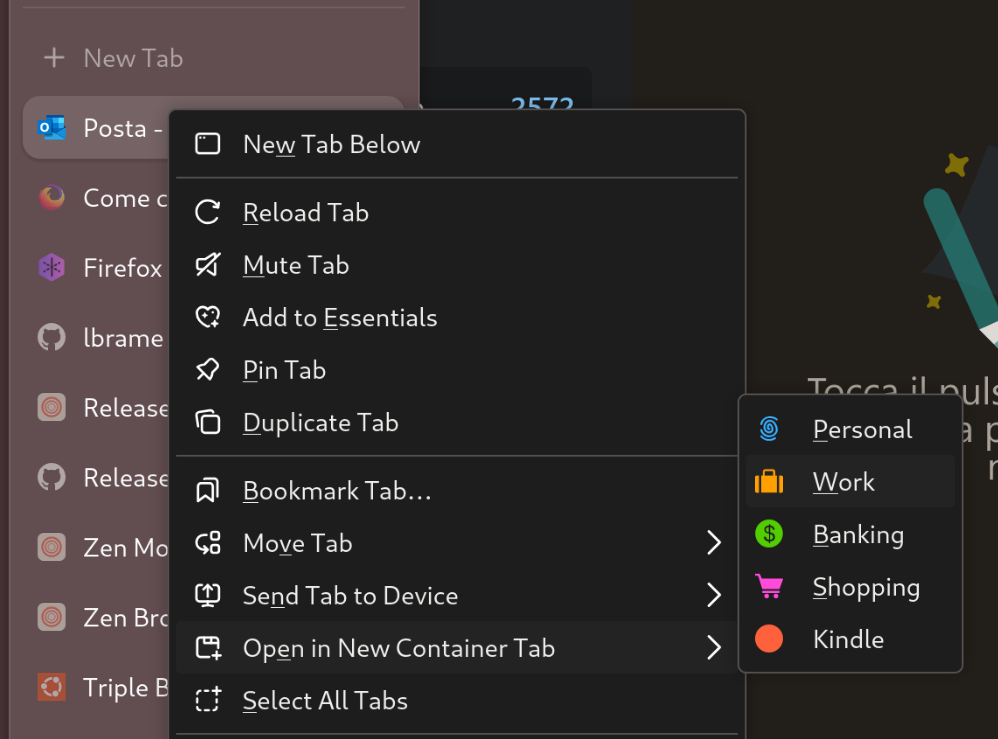
Well, on top of supporting opening a tab within a container like regular Firefox, Zen also allows you to easily link a container to a workspace. This makes using containers seamless; it should be useful to those who mean to use containers on Firefox, but constantly forget to.

This is a great example of how well Zen handles its Firefox base. It does not try to hide it, it does not even rely on its existing UI too much, but it augments it, seamlessly integrating the two layers. This results in a very pleasant experience that takes all the good bits of Firefox and iterates on the rest.
Pinned and Essential tabs
Zen allows you to have two types of tabs: pinned and essential tabs.
Pinned tabs are a category of tabs that are, well, pinned to the top of the stack, distinct from regular tabs, and are specific to a workspace. Each workspace has its own pinned tabs. For example, the workspace I use to work on LibreNews has a conveniently pinned Ghost Admin tab, so that I can go from the research I am doing back to the article I am writing easily.

Essential tabs are tabs that are common to your entire session. They reside at the very top of the browser, and they are represented by just icons. You should populate them with things you will want to access all the time, such as your mail, any background music, instant messaging like WhatsApp and Discord, or a LLM.
Pinned and Essential tabs
This distinction does not exist in regular browsers, but it is immensely helpful when you are fundamentally living in your browser and doing a lot of things in it.
Compact mode
The best feature of Zen Browser itself, the one that sold the browser to me, though, was the compact mode. If you would like more space, you can simply press Ctrl + Alt + C, and the whole user interface on the left disappears, leaving you with your content full-screen. Of course, you can still move around with keyboard shortcuts, and the interface pops up again when you reach for it with your cursor. This has obvious benefits, not only in helping you focus but dealing with websites and web applications that also have their sidebar on the left: having two sidebars showing would just waste space. This also makes web applications feel way more native, and it has improved my experience in using them.
Splits
Another useful feature is splits. Just as you may do with your windows in various desktop environments and tiling window managers, you can tile different browser windows seamlessly, which is massively useful, for example, if you are studying or taking notes.
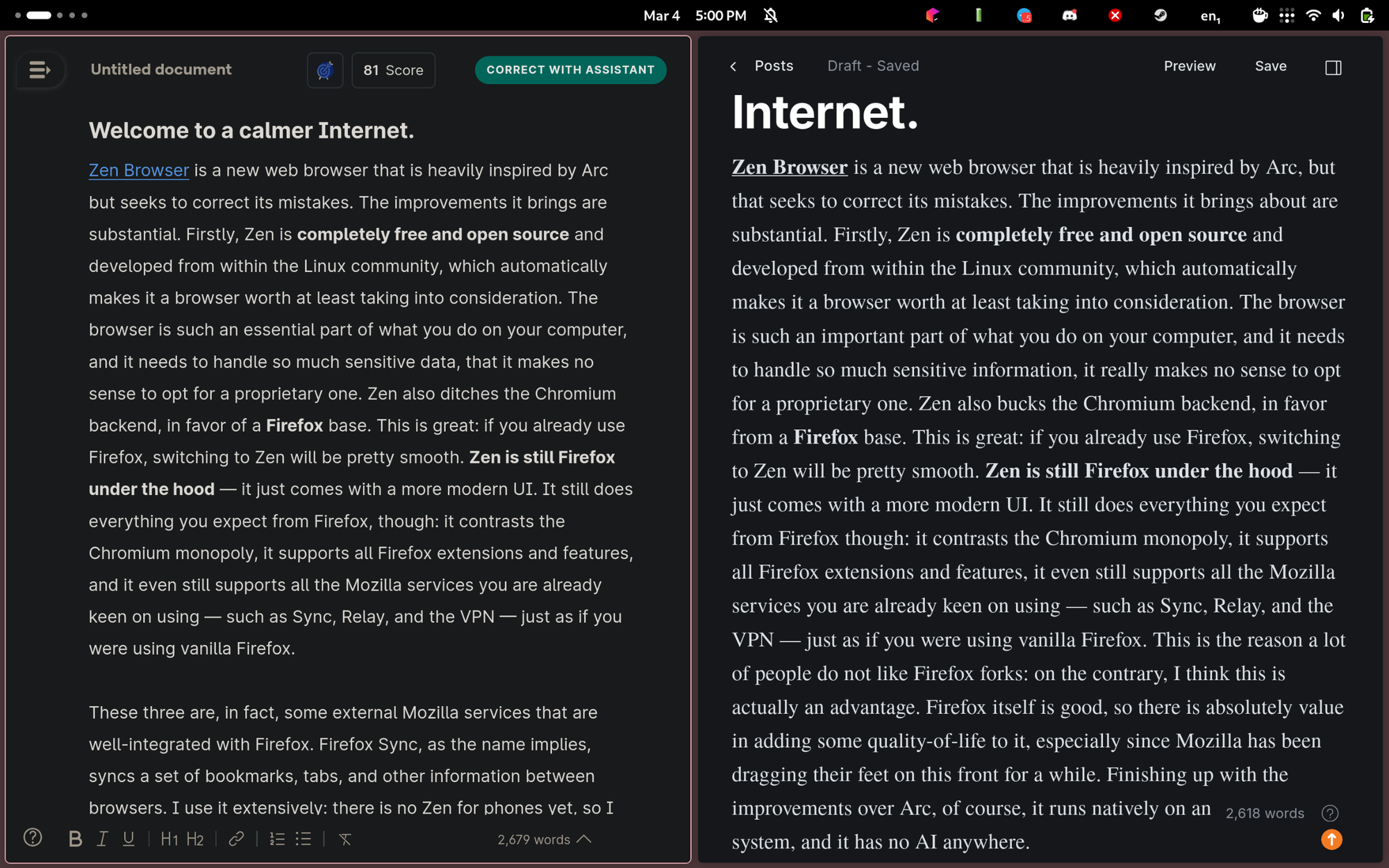
Customization
Zen also offers many customization options. Not only can just about anything be tweaked, but it is also possible to assign a color or a gradient to each workspace. See for yourself here!
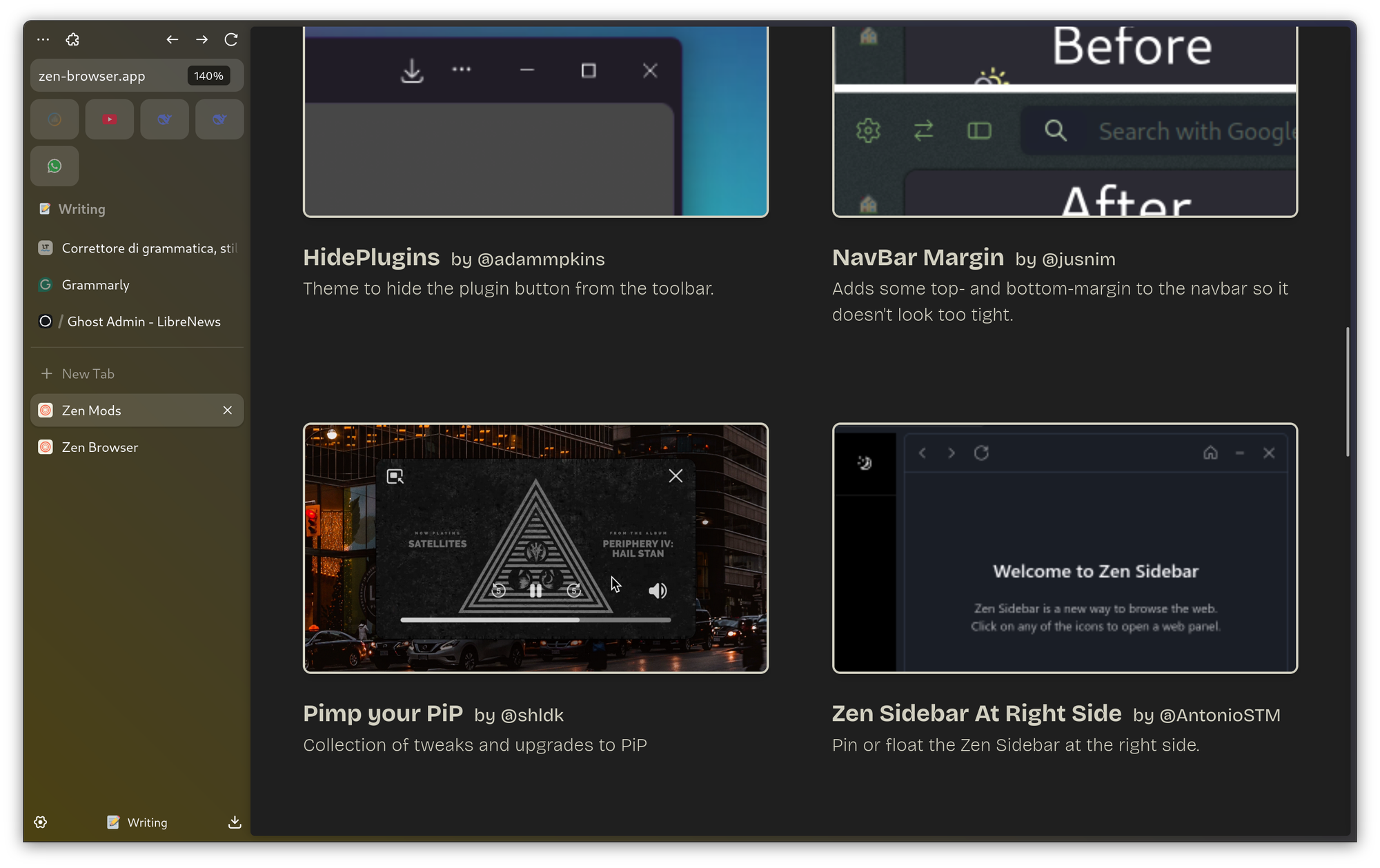
To that effect, another special feature of the Zen browser is the Zen Mods - special extensions that allow you to customize the behavior of not only the Zen overlay but also other Firefox features, in a more powerful way than traditional WebExtensions do. This also happens to be one of the several ways where Zen, as a Firefox fork, firmly steps out of its role of simply a good custom CSS: this feature acts as a superset on Firefox and allows customization that was impossible without patching the browser itself first.
In conclusion...
So far, we have only scratched the surface of what Zen can do, but I believe we covered everything important. While I encourage you all to go out and try it, though, it's only fair to warn that Zen Browser is not perfect. While it is not in beta quality anymore, it is still pretty young, and it does have more bugs than Firefox. Ironically, I lost all my non-pinned tabs while writing this article by triggering a nasty, known bug! It happens, though. Simple Tab Groups on Firefox has the same problem, though it's easier to create and restore backups of it without needing to resort to Tab Session Manager, which works on Zen, but does not quite keep the tabs sorted by their workspaces. Still, I think Zen is a promising frontend to Firefox and a great contribution to the FOSS ecosystem!
Mozilla has better lawyers than PR

Two days ago, Mozilla introduced new terms of use and an updated privacy notice for Firefox.
This is the reaction. What the general public took out of the new terms is, well, we should probably switch to another browser.

I spent yesterday reading tweets and private messages all saying something to the tune of: goodbye Firefox!

But is there any truth to this? Well, let's dive in.
Firstly, the facts. Mozilla announced a new set of Terms of Use, which we had not had before, and an updated Privacy Notice. Let's start with the former.
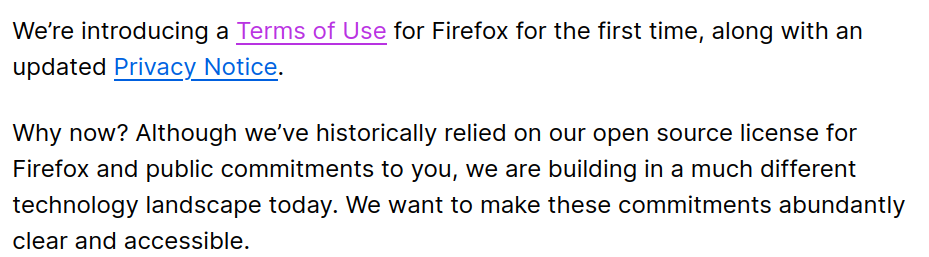
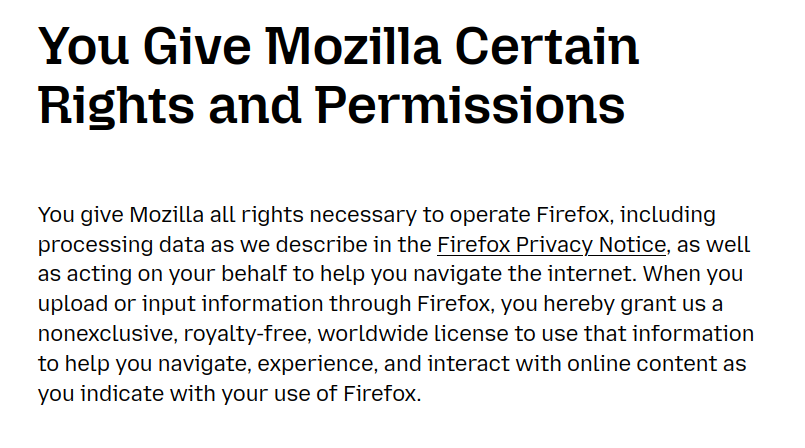
The controversial paragraph is the following, and I'm going to read it in its entirety:
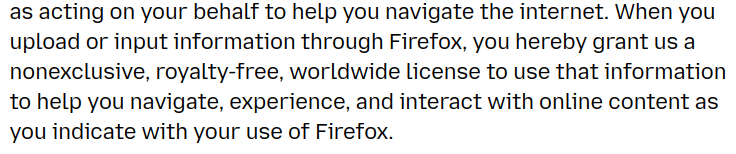
You give Mozilla all rights necessary to operate Firefox, including processing data as we describe in the Firefox Privacy Notice, as well as acting on your behalf to help you navigate the internet. When you upload or input information through Firefox, you hereby grant us a nonexclusive, royalty-free, worldwide license to use that information to help you navigate, experience, and interact with online content as you indicate with your use of Firefox.
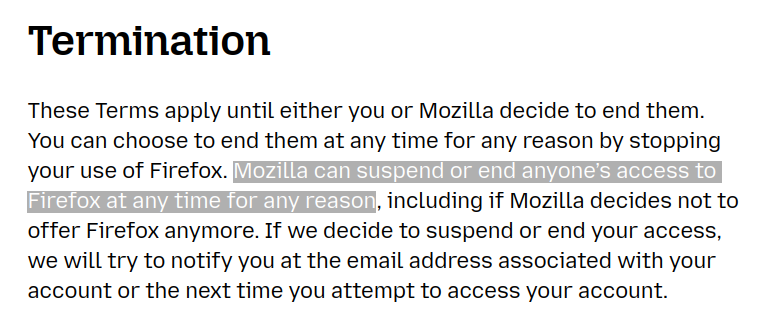
There are a few other problematic sections. A few paragraph below, Mozilla warns that they can now "suspend or end anyone's access to Firefox at any time for any reason", though I'd love to see them try.
Finally, your use of Firefox now must follow a newly-created "Acceptable Use Policy". These include bans of most illegal activities (pirating, theft, violating copyrights, violating any person's privacy, harming children, and more):
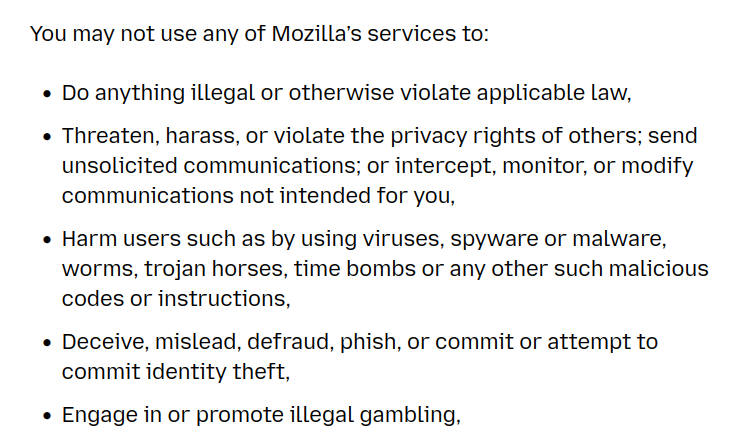
However, you also cannot "Upload, download, transmit, display, or grant access to content that includes graphic depictions of sexuality or violence", i.e., you are no longer allowed to watch, upload, or distribute pornography or anything that depicts violence.

The rest of the Terms of Use is what you would expect: a few indemnification clauses, software is provided as is, yadda yadda.
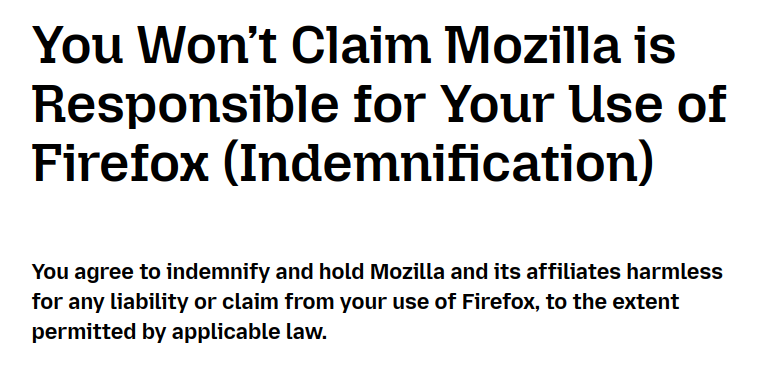
Now, onto the Privacy Policy. This document is quite detailed and - I believe - understandable.
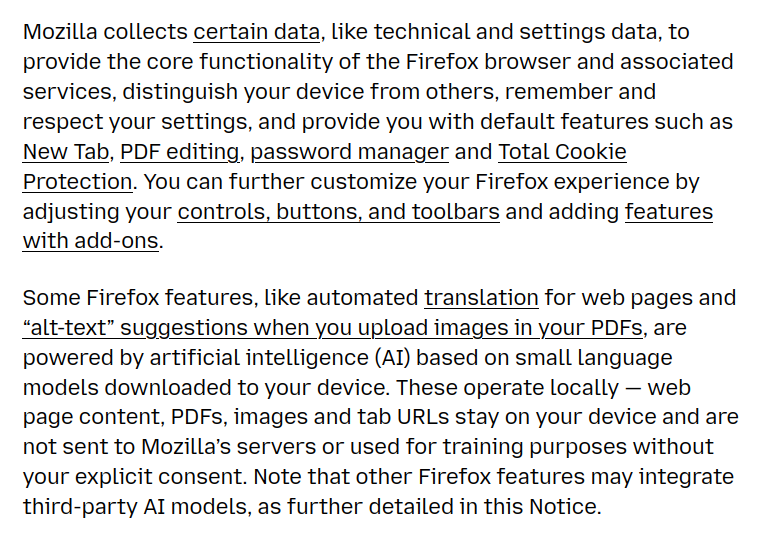
Firstly, there's a list of all data collected to make the Firefox browser work. This includes the browser settings, the password manager, customization options, and such. Your browser history is also kept locally (e.g., for autocompletion purposes), as well as web form data (so you don't have to re-write everything if the browser closes), and so on.
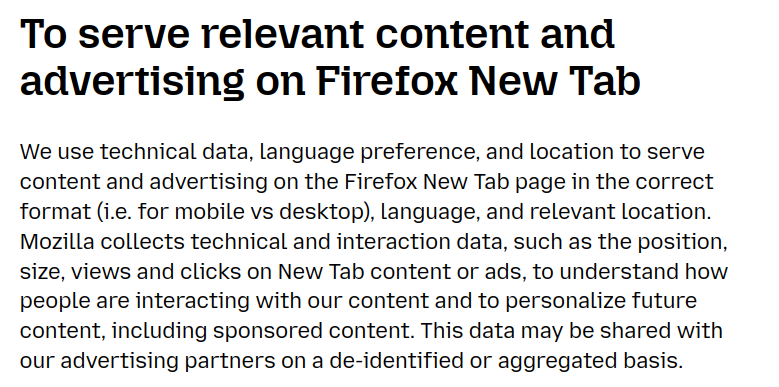
There are a few advertisement clauses. If you search for location-related keywords and you have Sponsored Suggestions turned on, then you will be served advertisements related to that keyword, though they'll never link it directly to you as an individual. Firefox New Tab might also show advertising, and some technical and interaction data (how you interact with the ad) is collected and shared with partners on a de-identified or aggregated basis.
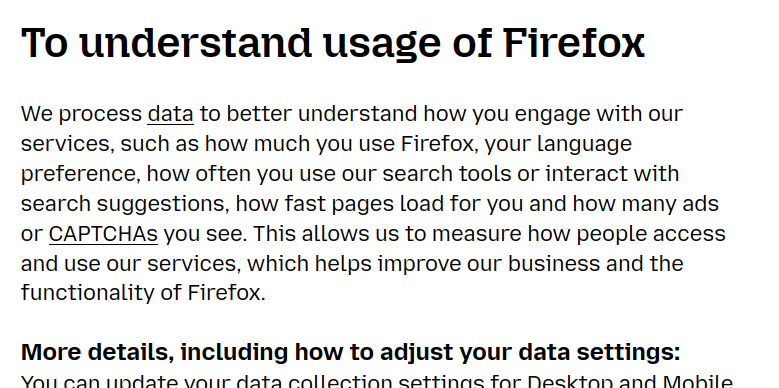
There are also a few sections regarding that data that you might want to share with Mozilla to help them improve their browser, such as how fast pages load for you and how many ads you see – all of this is, again, de-identified or aggregated (and you can opt out).
Nothing else catches my eye, though you might want to go check the webpage yourself.
Finally, Mozilla also updated its FAQ page to remove all mentions of Firefox not selling your data. In all places where this was mentioned, it's not anymore.
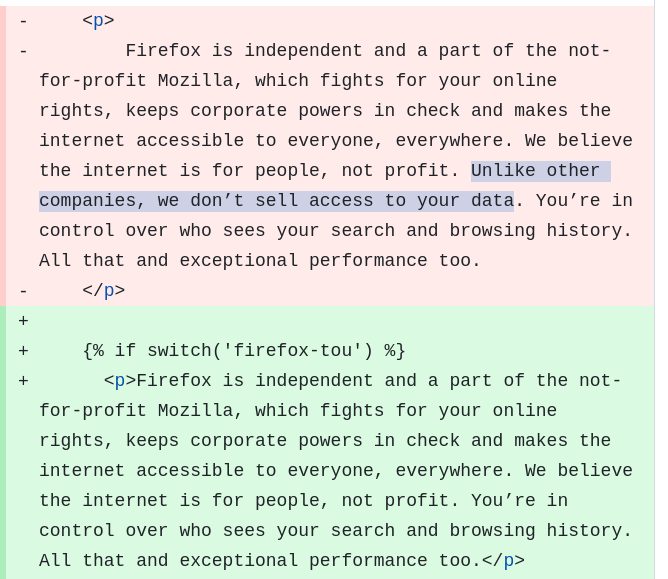
Even worse, the entire question "Does Firefox sell your data?" (to which the answer was, "no obv") was also removed.
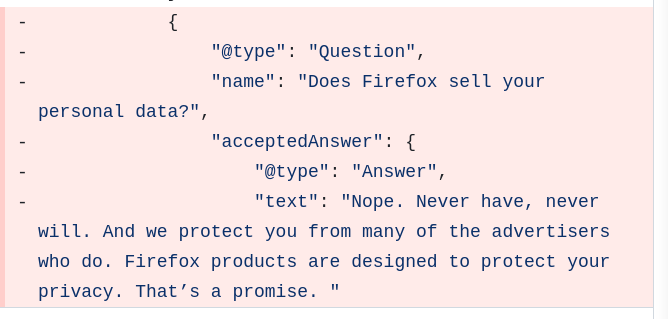
I believe that's all. Of course, this paints a very bleak picture for Mozilla; some of us are left wondering why all of these changes are taking place, while others don't care and are jumping ship already.
So, let's play a game. Let's try to build the best possible defense for Mozilla and see if it's solid. If it's not, that's a pretty big issue. Let's start with the "nonexclusive, royalty-free, worldwide license" to your data. According to Mozilla,
We need a license to allow us to make some of the basic functionality of Firefox possible. Without it, we couldn’t use information typed into Firefox, for example. It does NOT give us ownership of your data or a right to use it for anything other than what is described in the Privacy Notice.
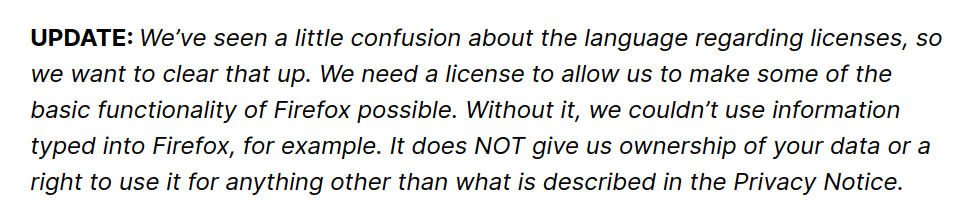
Brodie here dutifully points out that, no, the TOS does not give them ownership of your data, but it does grant them a license to it. However, this does not change the fact that they're still bound to their Privacy Notice, which did not allow for data usage aside from, well, operating the browser.
Indeed, I'd like to stress that the license is "to use that information to help you navigate, experience and interact with online content as you indicate with your use of Firefox".
The CEO of Epic Games and creator of Unreal Engine, Tim Sweeney, similarly defends Mozilla on this specific point:
The license says that when you type stuff, the program can use the stuff you typed to do the thing you asked it to do. This is what programs ordinarily do, but nowadays lawyers tend to advise companies to say it explicitly.
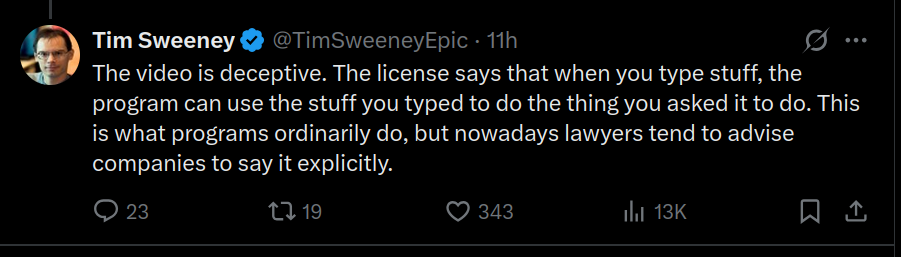
I don't hold particular sympathy towards him, but I believe he knows more than me about what the lawyers are up to these days.
Many claimed that other browsers work just fine without this legal wording, but that's simply false.
Google grants itself a worldwide, non-exclusive, royalty-free license to "host, reproduce, distribute, communicate, and use your content" and "modify and create derivative works" for the "limited purpose" of "operating and improving the services".
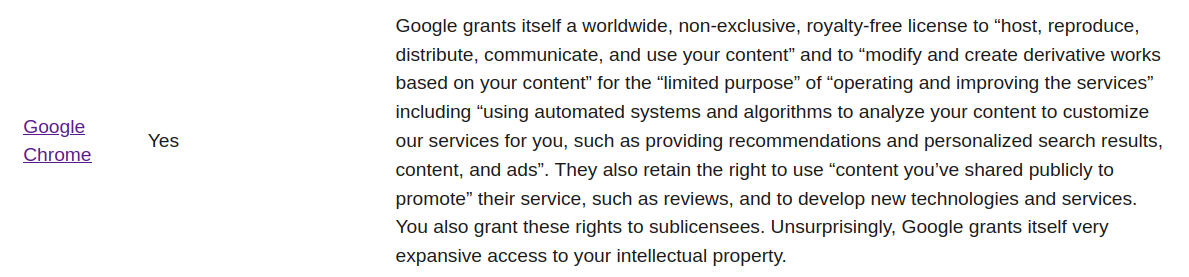
The same applies to Edge: Microsoft grants itself a "worldwide and royalty-free intellectual property license to use Your Content, for example, to make copies of, retain, transmit, reformat, display, and distribute via communication tools Your Content on the Services".

Outliers here are Safari, Brave, and Opera, which do not seem to currently have this mentioned.
Other software have similar sentences, though; as an example, you're also giving Microsoft a full license to everything you write with Word, if you use that kind of software.

Let's assume that's why the sentence was there. But why ban pornography?
The key here is that the Acceptable Use Policy starts with: "You may not use any of Mozilla’s services to".
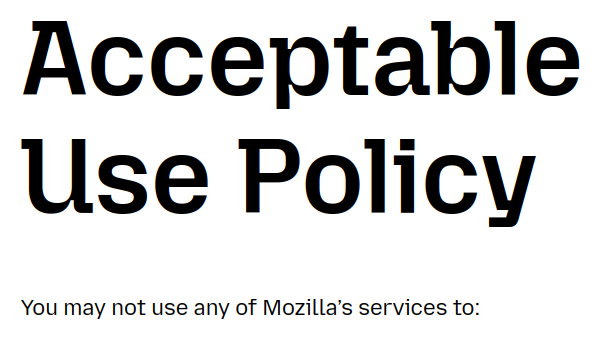
In the Terms of Service, the word "services" is defined as: Mozilla VPN, Firefox Relay, Firefox Monitor, Firefox Note, Firefox sync and Pocket. This does not seem to include Firefox.
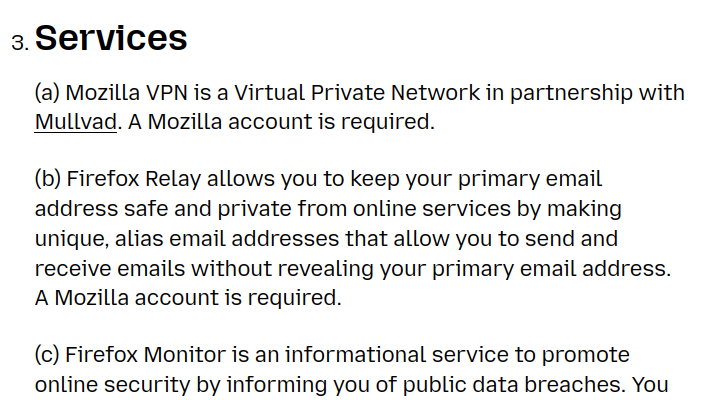
Thus, what the Acceptable Use Policy is likely asking to do is avoiding anything illegal (or pornographic) when using their VPN, and maybe when saving articles to Pocket.
Out of curiosity, I checked whether NordVPN, one of the most well-known VPN companies, also has the terms. They do, disallowing any illegal content, but also "threatening, stalking, harming or harassing others, or promoting bigotry or discrimination".
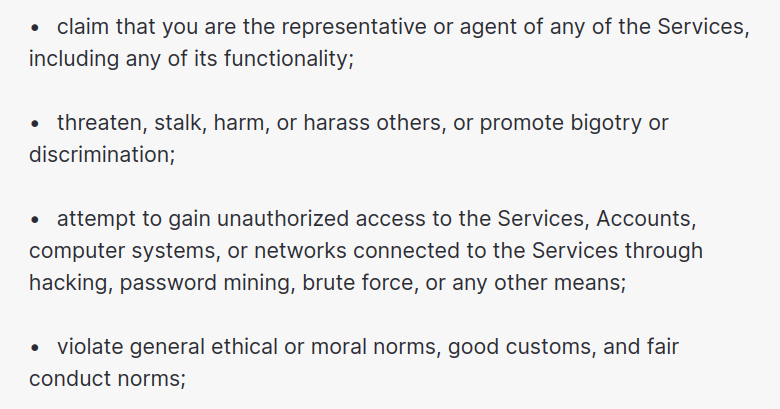
So maybe this can be clarified as a VPN-type of thing that does not apply to Firefox, since it's not a service. But this still does not explain why on earth they would remove the "we won't sell your data" from their FAQ page.
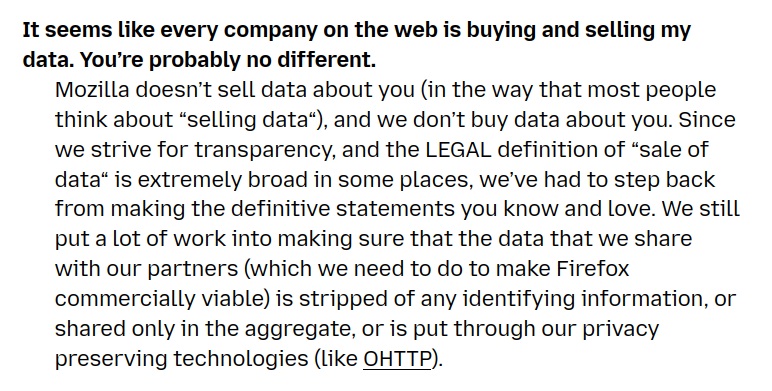
Well, Mozilla did some damage control by adding a new question, phrased as "It seems like every company on the web is buying and selling my data. You’re probably no different.".

This is not a question, but the answer is nonetheless very interesting:
Mozilla doesn’t sell data about you (in the way that most people think about “selling data“), and we don’t buy data about you. Since we strive for transparency, and the LEGAL definition of “sale of data“ is extremely broad in some places, we’ve had to step back from making the definitive statements you know and love.
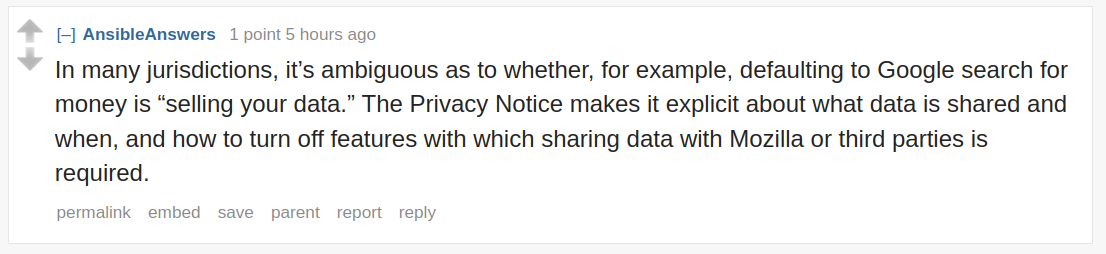
A few people here are speculating that the deal with Google might be at fault: since they receive money to use Google out of the box, which in turn collects your data, that might be considered "selling your data" in some jurisdictions.
That concludes the best defense of Mozilla I could put up. I would classify it as decent but not particularly compelling.
A criticism I would like to immediately bring up, regardless of whether Mozilla is correct or not, is just how badly all of this was communicated. I'm not sure if they tried to hide these changes - like removing the "we won't sell your data" question - in the hope we wouldn't notice. Because if you knew we were going to notice, why wouldn't you immediately have an explanation ready to go? Why wait to explain yourself?
And, even if I'm right in the distinction between services and the Firefox product, meaning I'm still allowed to watch porn… why is it so badly worded? The terms of service specifically talk about Firefox, and then there's a link to this list. Anyone would assume that it applies to what you do with the browser. Why not write more clearly?
However, there are more direct flaws in my argument, too.
Firstly, many users are pointing out that if I download the Firefox browser (and I operate it), therefore not necessarily using any of Mozilla services, I shouldn't need an agreement with Mozilla at all; why would then I license them my data?

This might have some explanation, such as Firefox using Mozilla's DNS, but it's getting into legalese speculation enough that I don't feel confident in weighing in.

Ultimately, everything relies on the Privacy Policy, as it's all as solid as that document is. Is it solid? Please tell me it's solid.
Let's start with data that Mozilla shares with "partners, service providers, suppliers and contractors". If they "sell your information", it's to them.
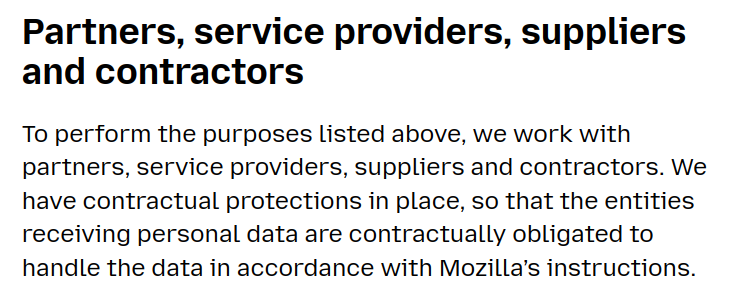
These partners, according to the webpage, are their search partners, such as Google, advertising partners, and a few related to Mozilla services you don't have to use (such as AI chatbots).
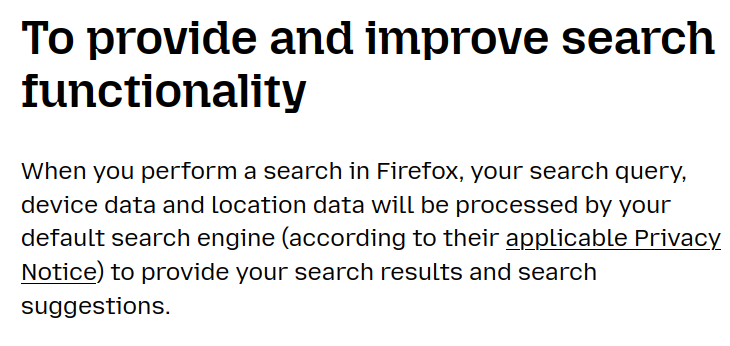
To provide search functionality and advertising, the following types of data are collected: technical data, location, language preference, settings data, unique identifiers, system performance data, interaction data, and search data.
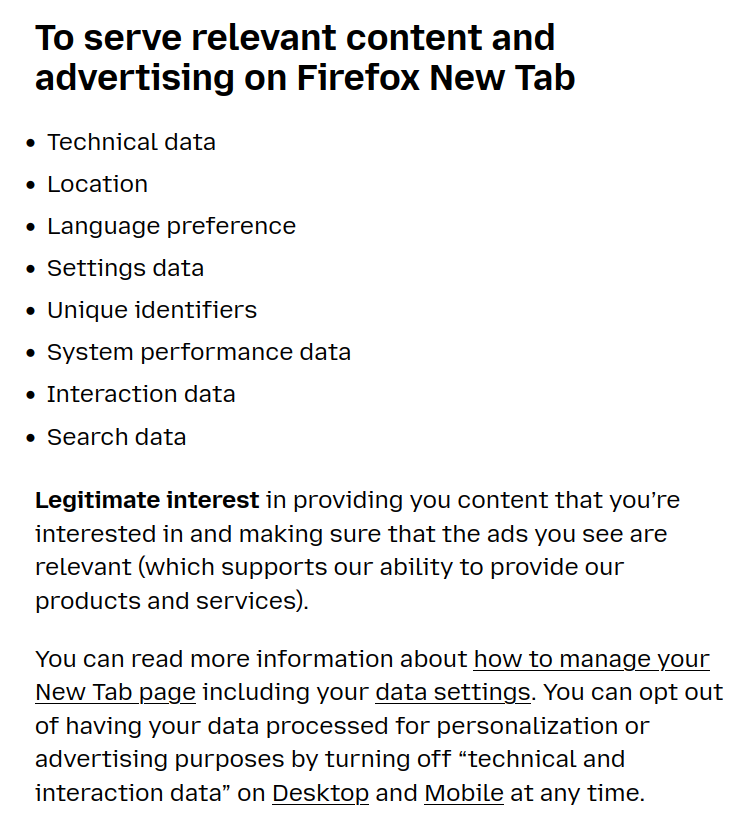
Technical data is defined to be only about the hardware you are accessing the service from, the device type, operating system, IP address, and ISP.
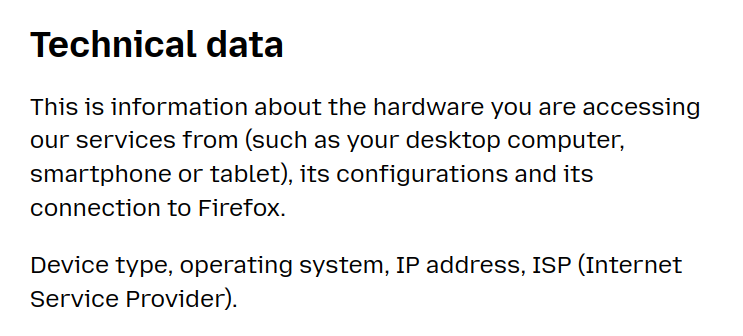
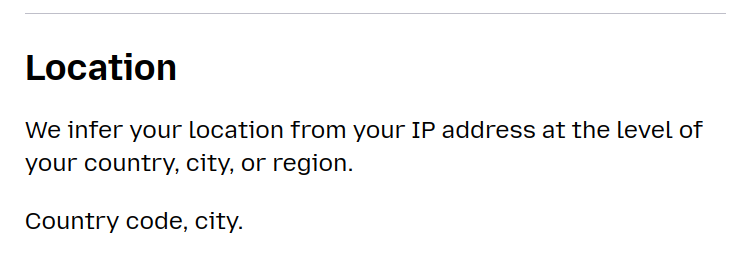
The location only refers to your country code or city, and it does not include your precise location.
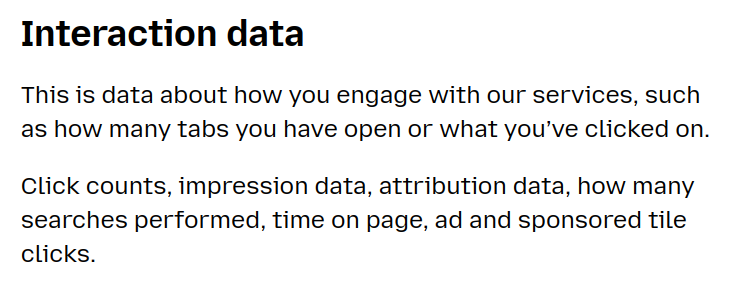
Interaction data only refers to how you engage with their services ("how many tabs you have open or what you've clicked on, click counts, impression data, attribution data, number of searches performed, time on page, ad click").
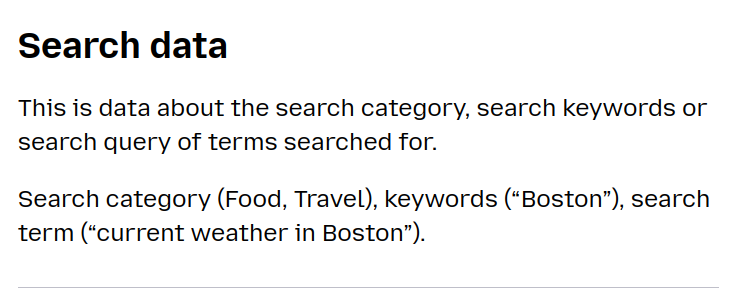
Search data is what you search for.
This should be everything that Mozilla can share with partners, and according to them, it only does so in a de-identified or aggregated way.
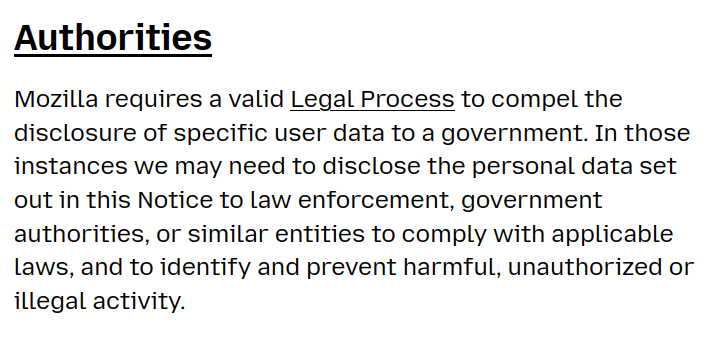
Then, there are authorities, such as governments. If there's a valid legal process ongoing, Mozilla might have to disclose personal data to that government in response to a Notice to law enforcement.
What kind of data? Any.
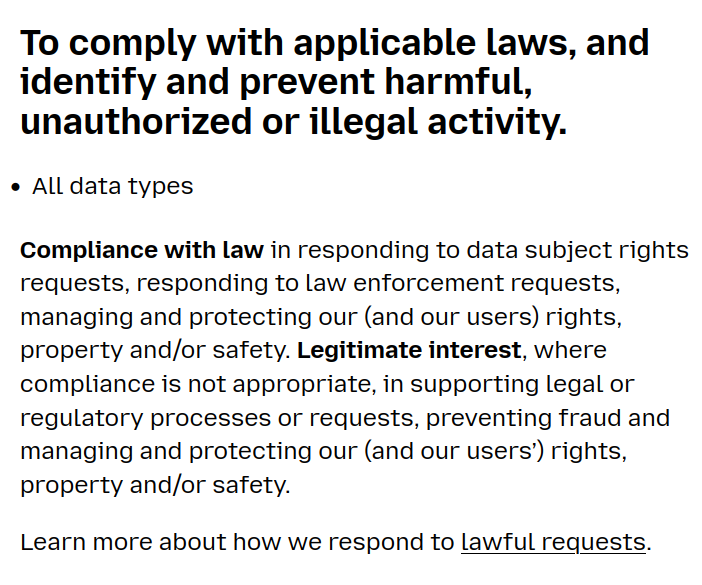
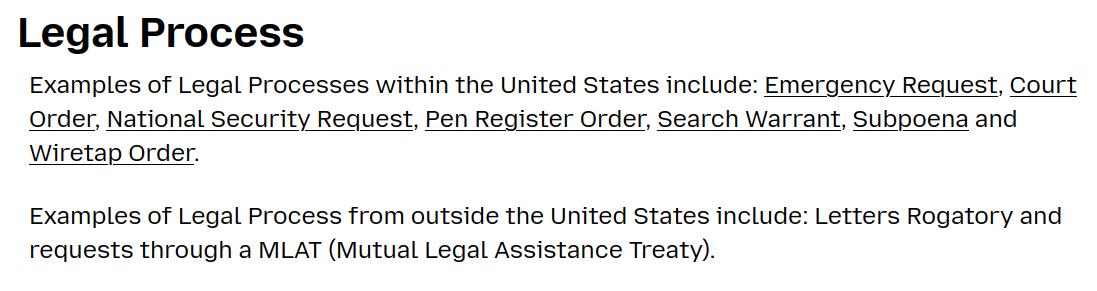
Examples of legal processes that would make Mozilla share personal data are Emergency Requests, Court Orders, National Security Requests, Pen Register Orders, Search Warrants, Subpoenas, and Wiretap Orders.
Of course, this is not exactly a great look, but I don't think Mozilla could've done anything differently here. The safety net does not come from relying on the fact that Mozilla won't share your data with governments if asked, but rather from the fact that you don't need to use Mozilla services in the first place, so that your data is kept on-device and secure, plus you can build Firefox yourself so that you can trust it fully.
So, to recap: to the best of my knowledge, no, Firefox/Mozilla can not use your data however they want, and I still consider it to be a very privacy-aware option. You also can still watch pornography - I think - just not when using their VPN. And they still don't sell your data, they just have the Google agreement they've always had. I don't think there's a reason to panic.
But there's a reason to worry. What a mess: this felt like a very rushed move. I want to give the benefit of the doubt that they asked for a legal review of their previous documents, and the legal team replied with: Hey, change all of this immediately, because we've discovered flaws that might get us in court now that we're aware of them.
Because if not, if they had time to prepare this announcement and think it through… what are they doing!?
This OS runs in your browser
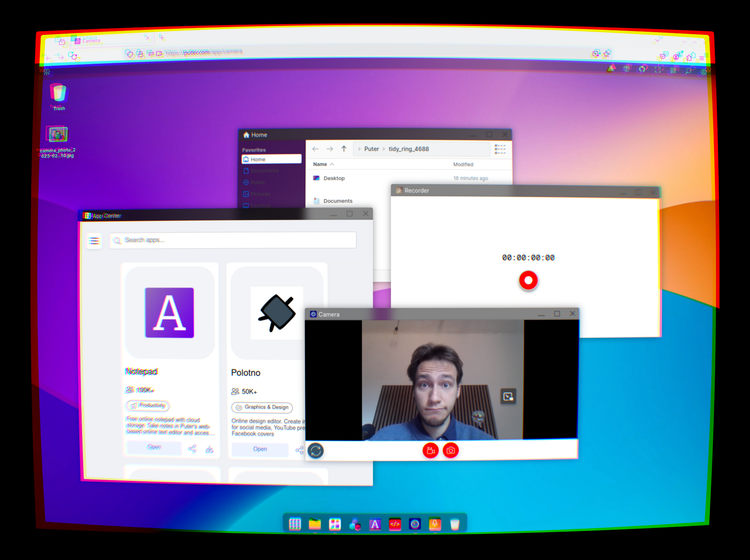
This is Puter, and it's an implementation of a full desktop within a browser.
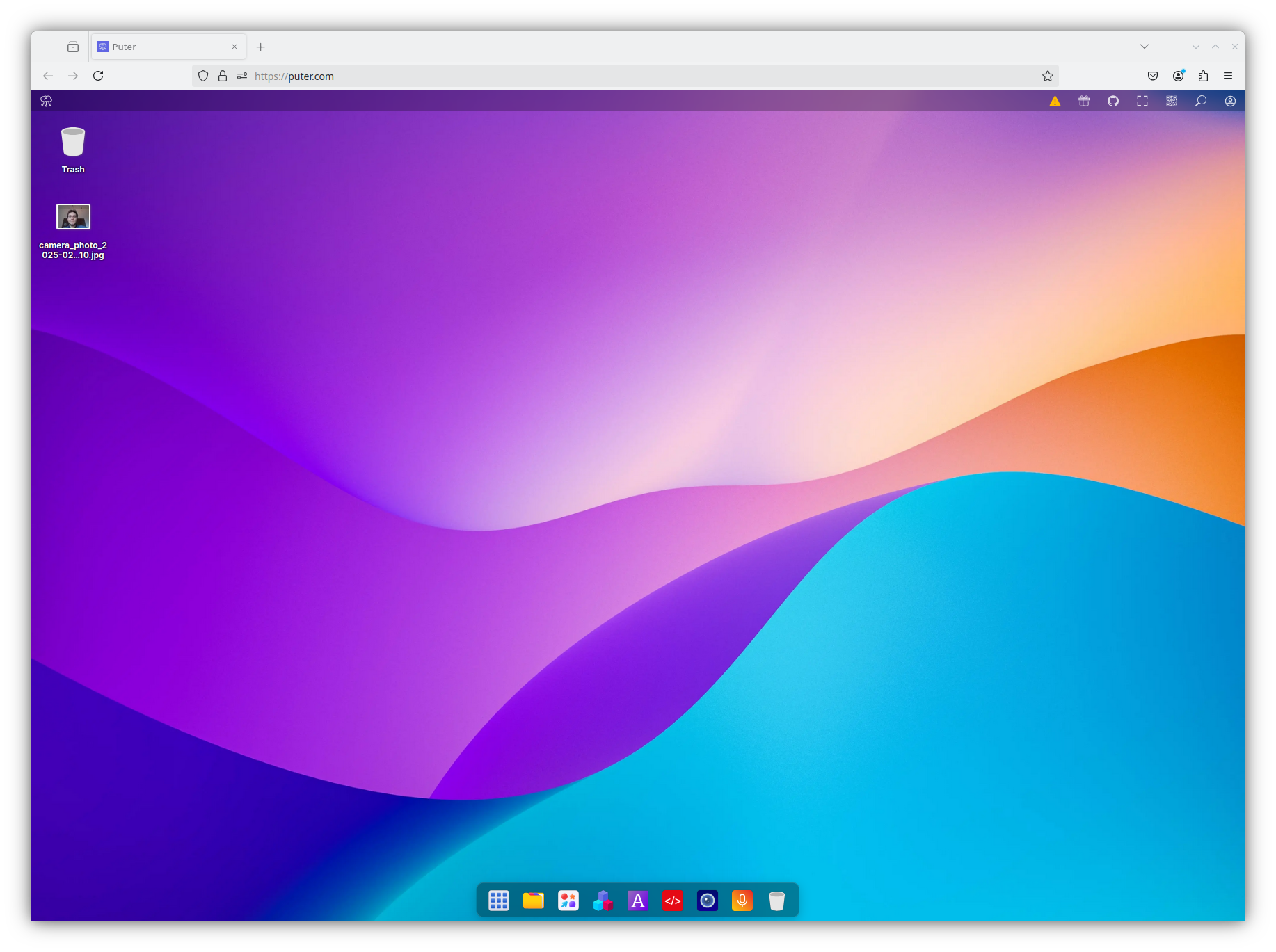
You might not be sold on this idea yet.
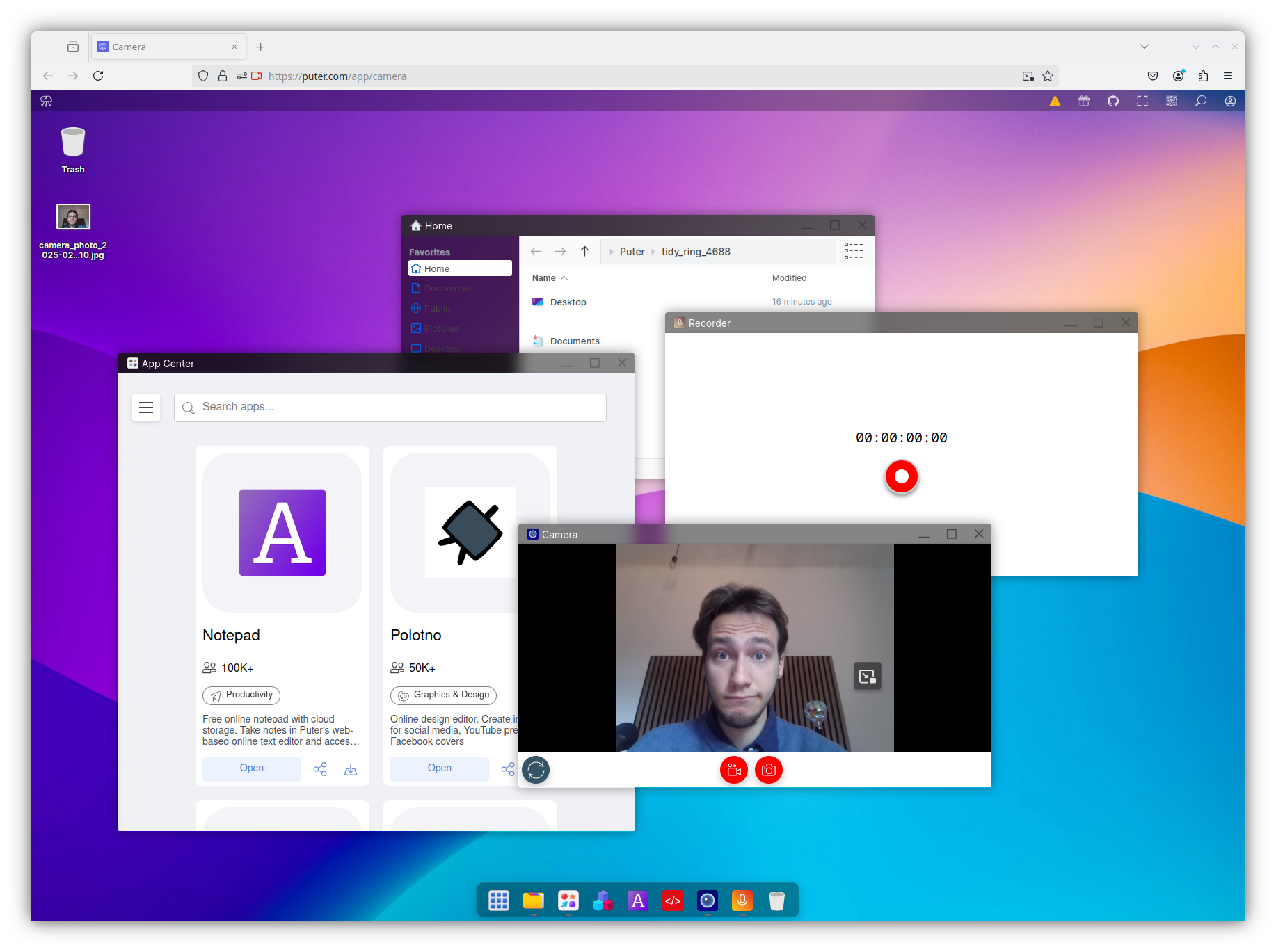
Though I'll go through this in more detail later on, I will immediately: this includes a file manager, a picture editing application, a simple IDE, a camera, a recorder, a PDF reader, a web browser, and more. It's at worst a useless but impressive product, and - at best - something that's actually useful.
Before we fully dive into this desktop's capabilities, let's start with the basics. How can this be useful if we lose all of our data as soon as we close the browser?
Well, there's no such worry. You can very quickly create an account (which only requires an email, a password and nothing else, not even to click on a confirmation link).
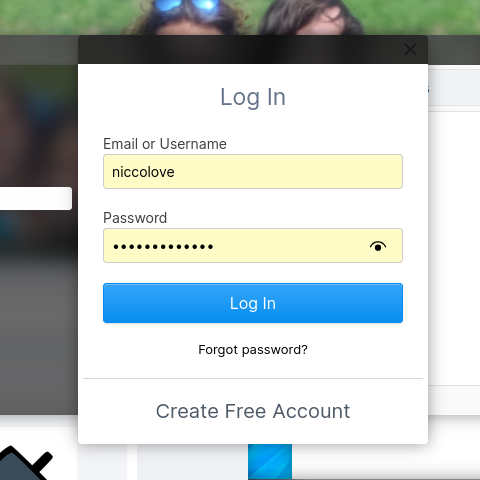
This will make your data persistent throughout sessions, and even devices: just by opening my phone and logging in, I could find all of my pictures and customizations already applied.
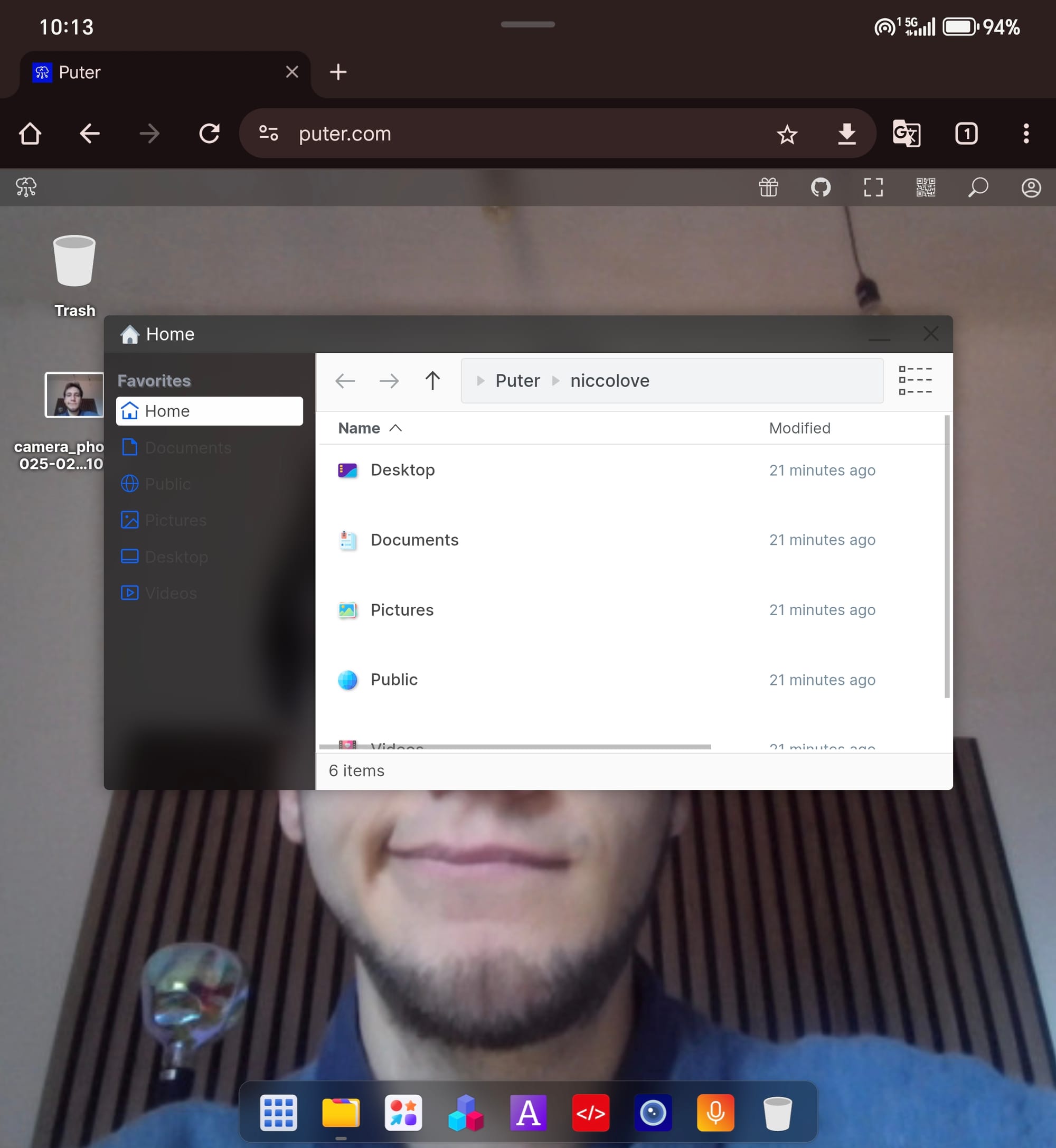
Even better, if you don't want to copy over your information, Puter provides a QR code that you can scan from your phone – and voilà, you'll be logged in on any other device, instantly.

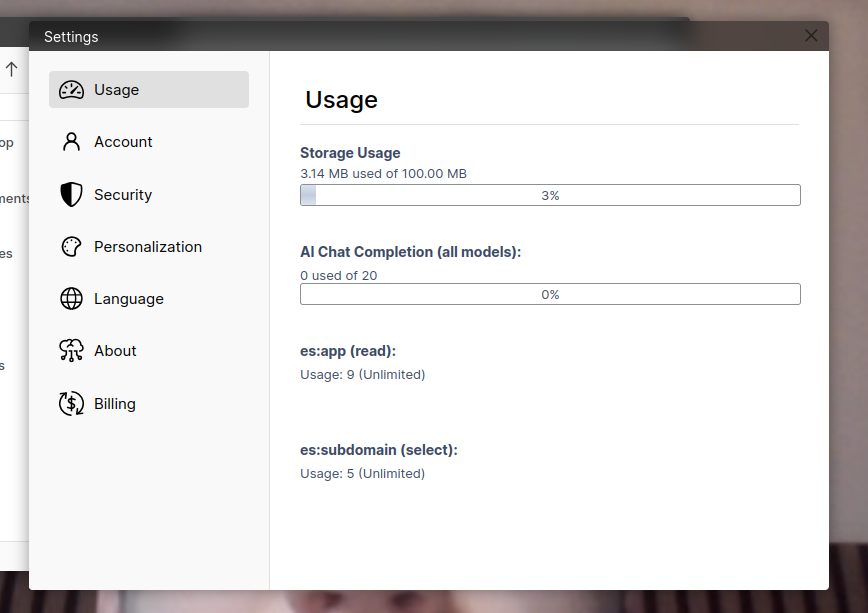
By creating an account, you get 100MB of storage out of the box (and 20 AI Chat Completion, which – thanks, but I won't be needing those).
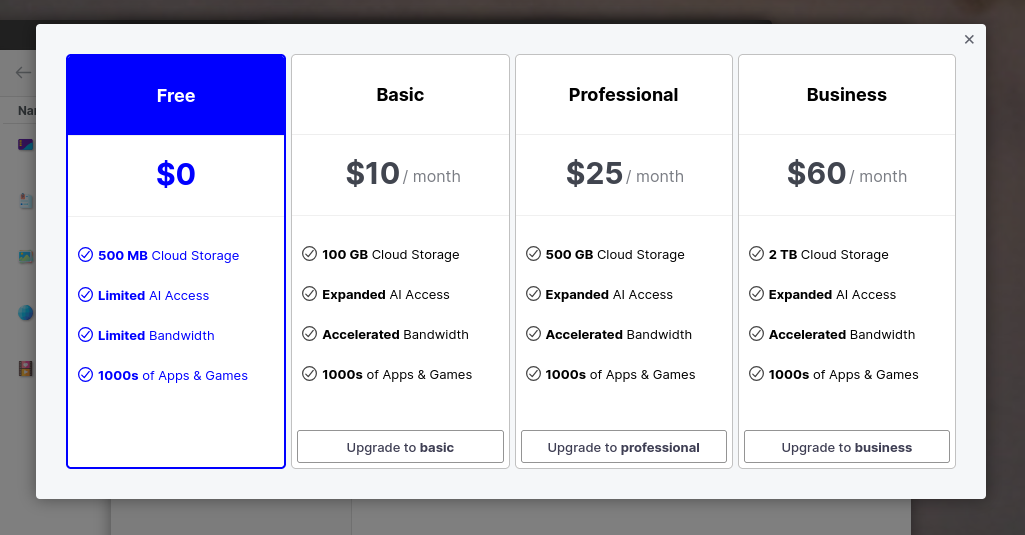
You can get another GB of storage by inviting a friend to make an account, and you can also buy additional storage, starting at 100GB at $10 a month. So, yes, this OS does come with optional subscriptions out of the box – we already have something that most Linux distributions lack out of the box.
Ah, and of course, the website is open source on their github; the developer even publishes videos on how the infrastructure works, though I would not even dream of understanding anything about that. I only know that it's made entirely in Node, which (I think) is a terrible crime against humanity!
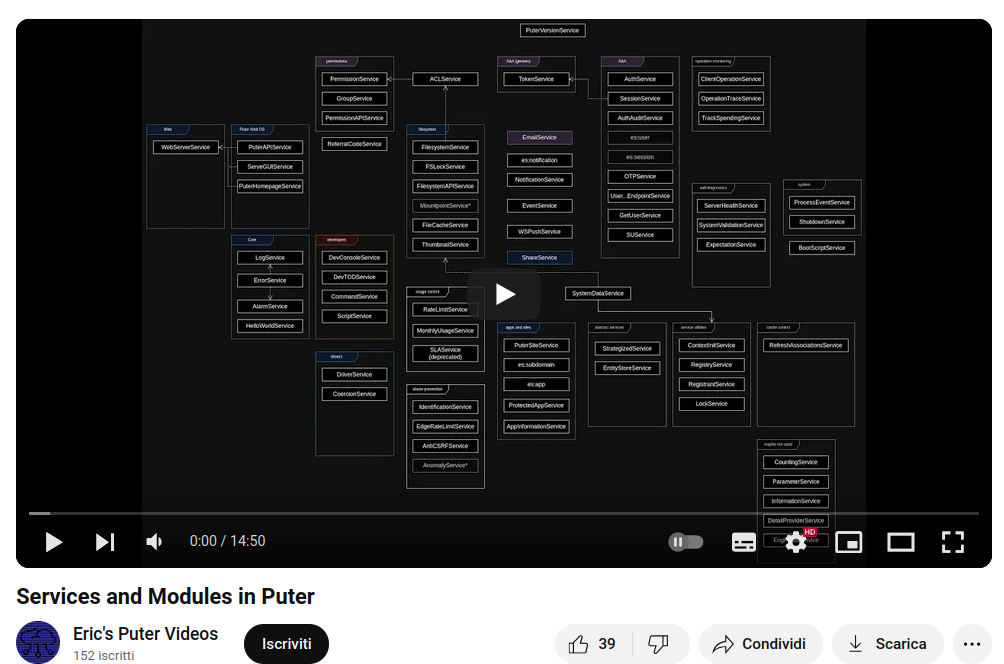
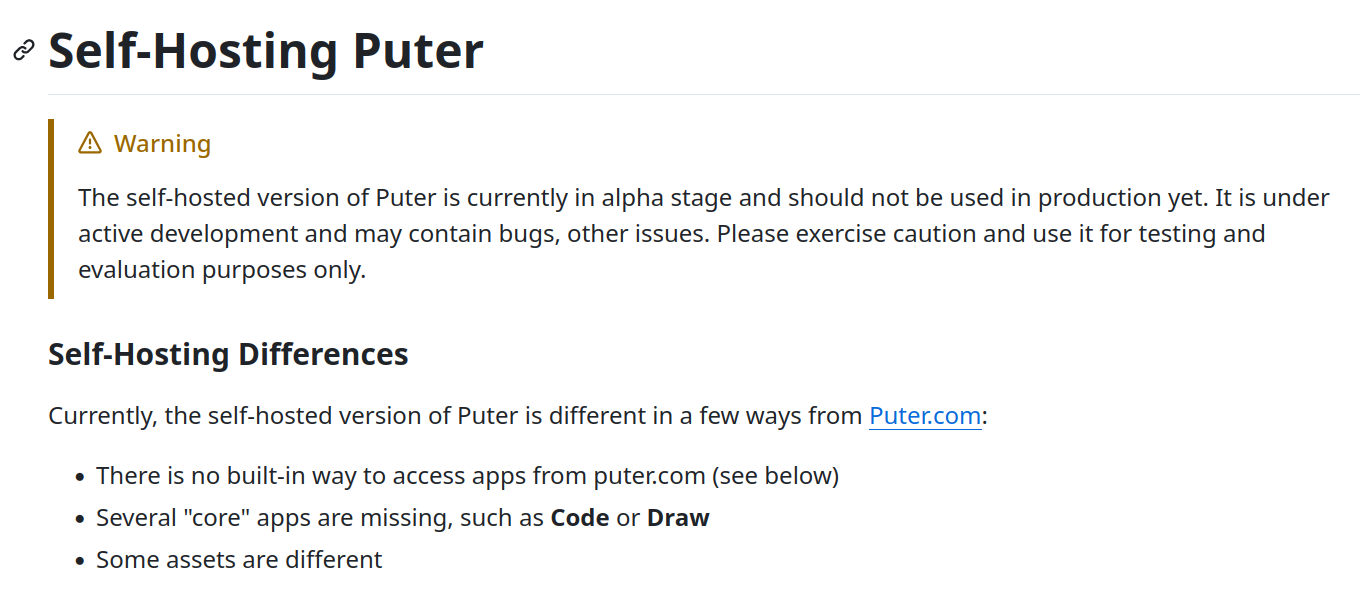
Since it's open source, you can also self-host it if you want, which - I can only guess - will allow you to use your local storage directly instead of relying on the cloud. You could wonder if that runs without an internet connection, but - as we will see - even if it could, you wouldn't want to.
But why? What can you do with this? Well, there are a few nice features to talk about.
Firstly, you can quickly create and publish websites. If you open the File Manager, right-click on any folder, and select "publish as website", you will be given a random subdomain puter.site that will point to that specific folder.
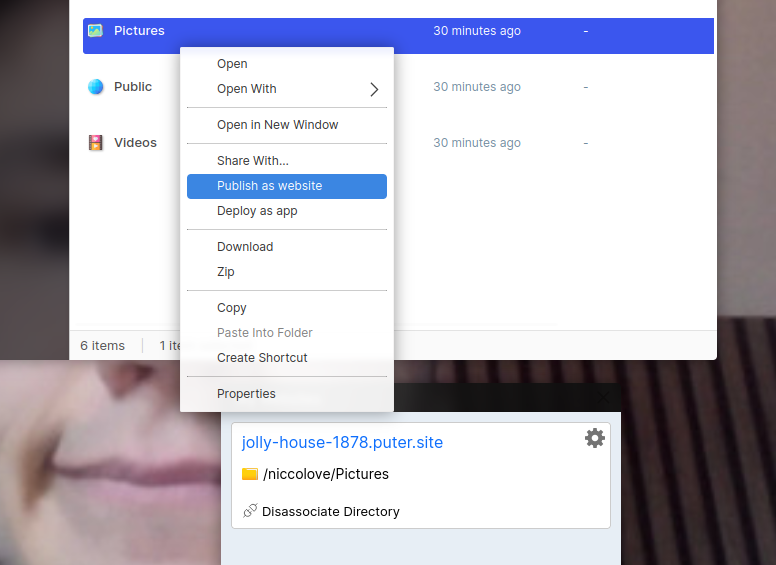
You can add a index.html file to change the look of the webpage and allow users to download files within; it updates pretty much instantly.
Okay, that looks fancy, but would you be able to do anything productive on the OS itself?
Puter comes with an App Center out of the box, which includes a lot of applications. Though each app has a download button, it merely adds the link to the app to your launcher: all apps are this sort-of-webpages, so you can just click "open" and they will open, which feels a bit like magic.
These seem to be re-embedding of other webpages within Puter, which does make sense – though, there's no visible performance overhead and they all behave quite well. Context menus and UI elements are extremely inconsistent, but that's understandable.
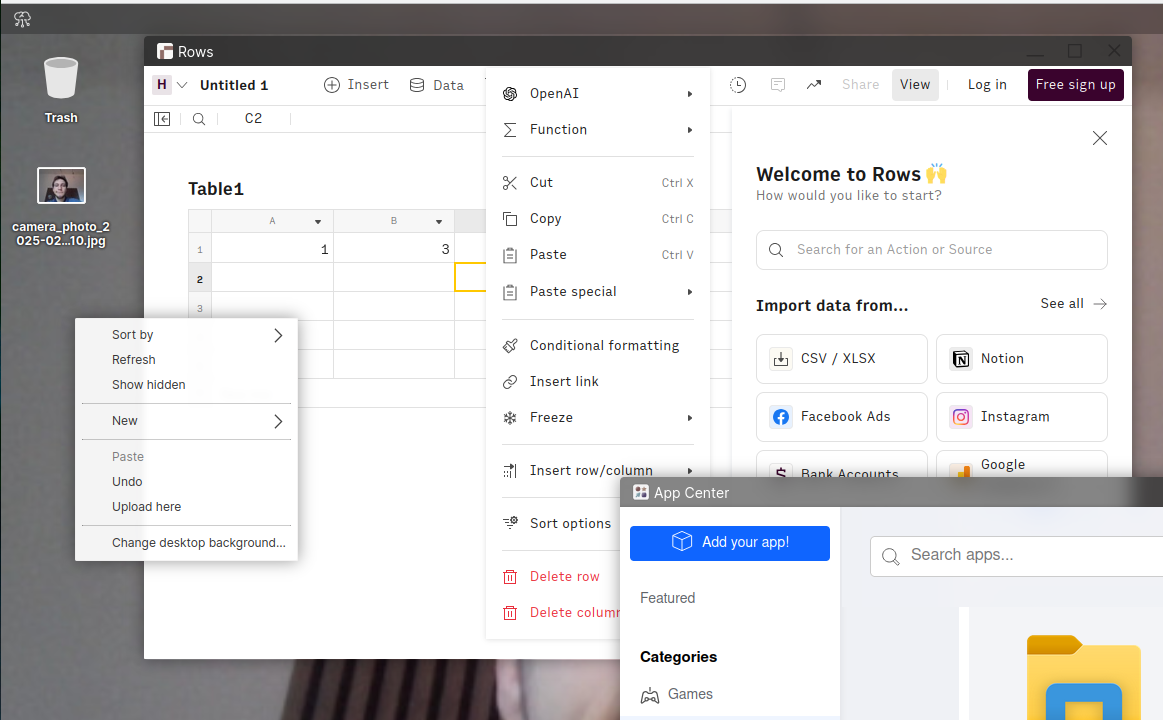
One thing I would like to see here is some additional transparency on each of these applications. Who made them? Who embedded them? Can I find them on their own website?
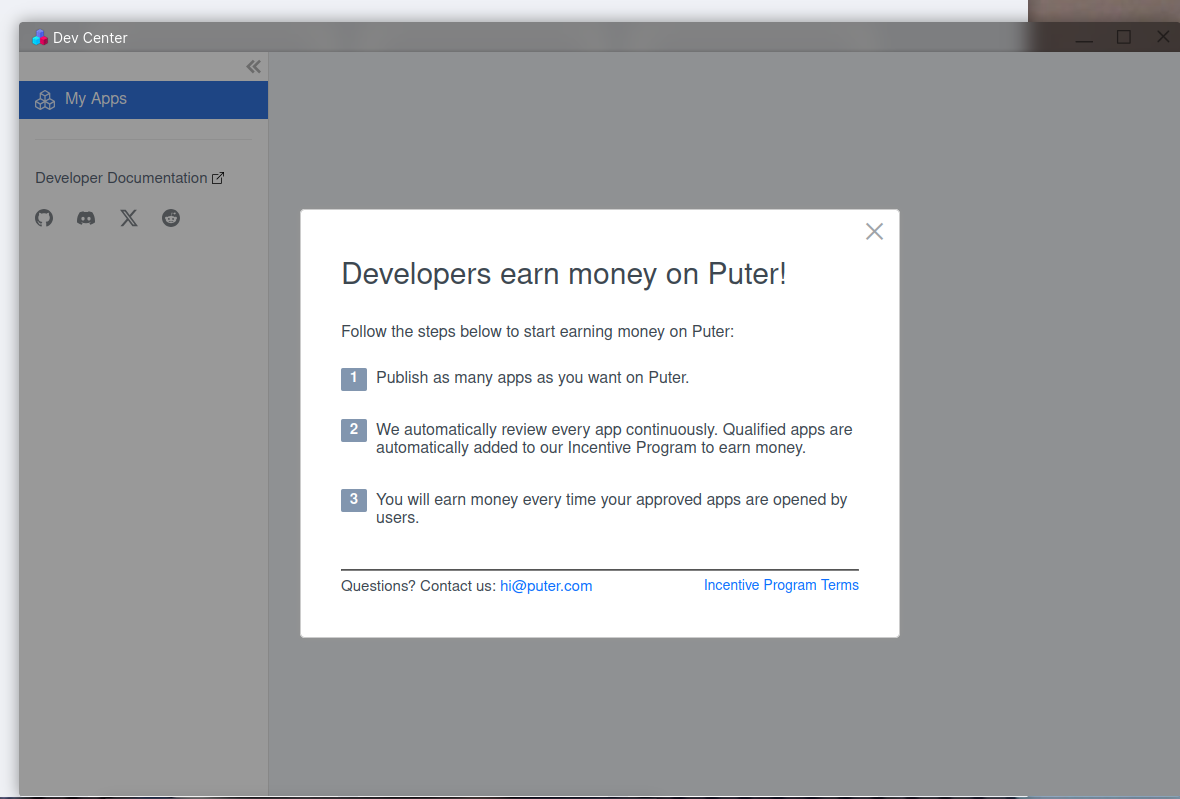
You're allowed to publish as many apps as you want in Puter, though they are reviewed, and you will even receive money every time they are opened. I have to say, I'm impressed here – though, this makes my "more transparency, please" request even more pressing.
In the store, we can find a barebone video editor. Though, it's not that barebone – it allows you to cut away parts of a video, yes, but also crop it, rotate it and flip it, apply various filters to it, change brightness/contrast/saturation/…, annotate the video (with lines, arrows, text, …), resize it, and more. I'm not going to switch to this as my video editing device, but still, it's more than what I was expecting.
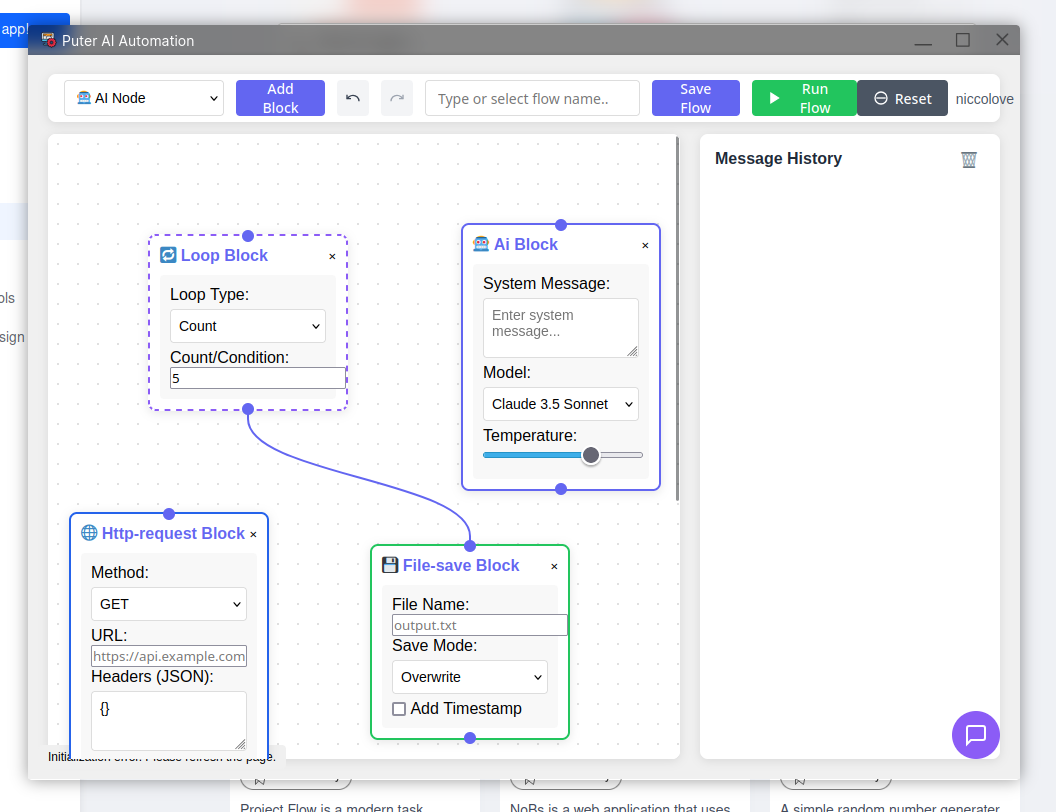
There's a Puter Automation application that allows building, well, automations using a drag-and-drop blocks interface. It's barebone (again) but not something I expected to find at all; of course, in this day and age, it's called the "Puter AI Automation" and the default block is an AI one.
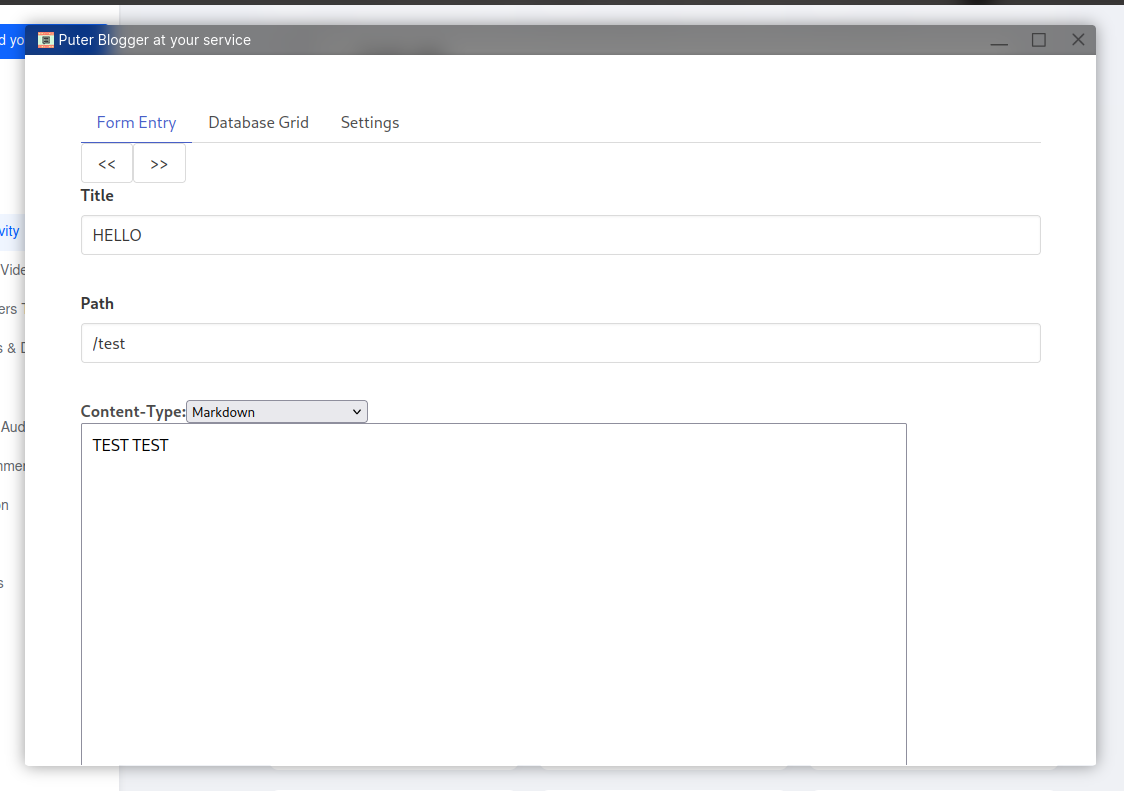
There is a Puter Blogger application that will create a blog within puter.site. It doesn't exactly feel nice to use, but it does allow to publish markdown posts – and, who knows, it might improve significantly over time.
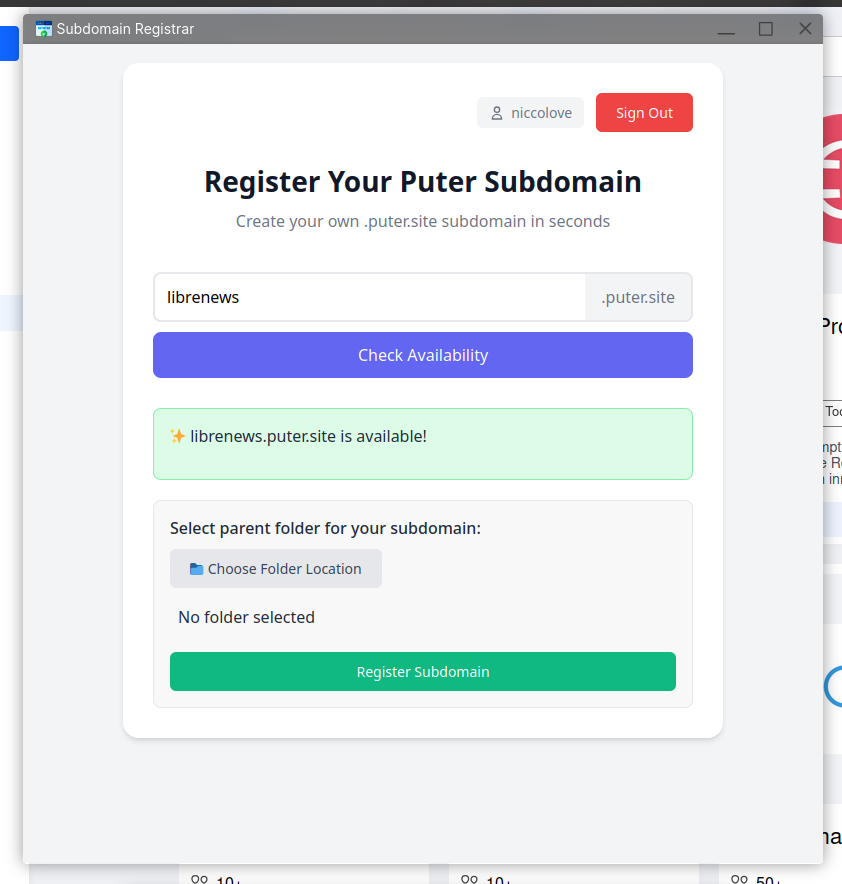
There's even a "Subdomain Registrar" application that allows you to check for the availability (and to reserve) of puter.site subdomains. As an example, I have just registered the website librenews.puter.site, though I'm not sure what I'll do with it.
Design-wise, one available application is "Polotno" (which, again, you could also access independently as a website). It allows to create even somewhat complex designs, though these third party website embedding won't really save anything on your Puter file manager, which - in my opinion - renders them at least somewhat pointless.

However, the data is associated to your Puter account, meaning that it should also survive when switching from a device to a different one. That's at least something!
There's also Photopea, to edit RAW images. I love that "Open From Computer" will open the Puter file manager, and not my computers', but somehow Photopea won't accept my Fujifilm raw images, which is sad.

I could go on, but you can kind-of guess what the rest of the app center is: full of applications, mostly well-integrated third-party web apps embedded into Puter, covering a wide range of scoper, from musing making, to book-writing, expense tracker, and so on.
Oh, and I almost forgot: you can customize things a bit. Sorry, as a KDE developer, I just had to mention that. You can change the background (obviously), but also the UI colors and their transparency:
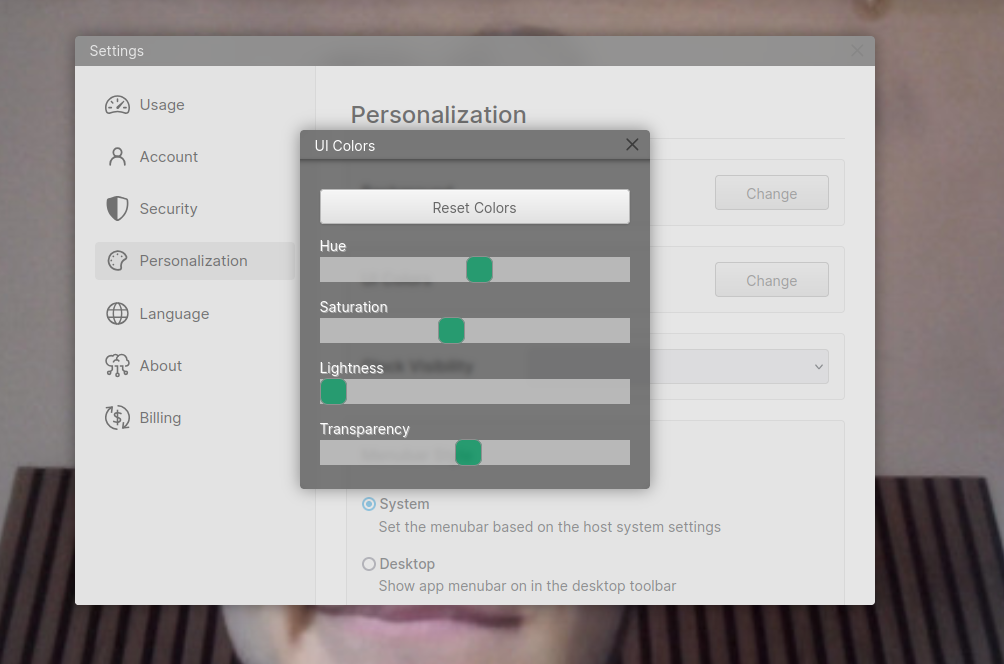
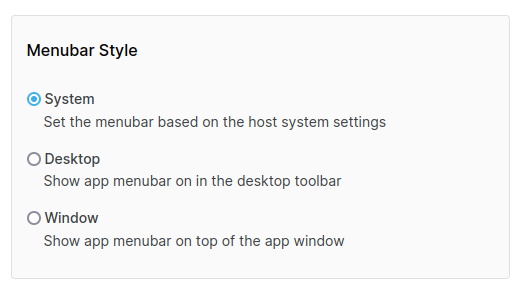
You can also hide/show a clock on the bottom-right corner of the screen, and choose whether you want the menubar to be part of the application or embedded in the desktop top panel. All of these settings update instantaneously.
Puter also includes notification support, though I have yet to see an application using one. Again, I would say that the greatest weakness of this OS is the fact that so many applications are just third party websites embedded in Puter, and won't follow Puter's API.

Of course, this still hardly beats your own OS right now. All of these applications could be accessed just as well as websites, and tools like Nextcloud could provide the same level of sync between devices that Puter offers.
Though, one thing that I'm looking forward is this promise by the Puter developer. They are working to include an emulation application that will virtualize Linux applications on the web, and allow you to interact with them. If that works, it means that Puter will also allow you to run Linux apps – though, I'd expect a significant performance overhead. All of that, by the way, would still run locally on your device.

Now, I have to say that the developer is a bit too obsessed with integrating AI everywhere (he recently posted an image with the title "Cloud OS -> AI OS?! 🤯" on his subreddit, which I hope was a meme).
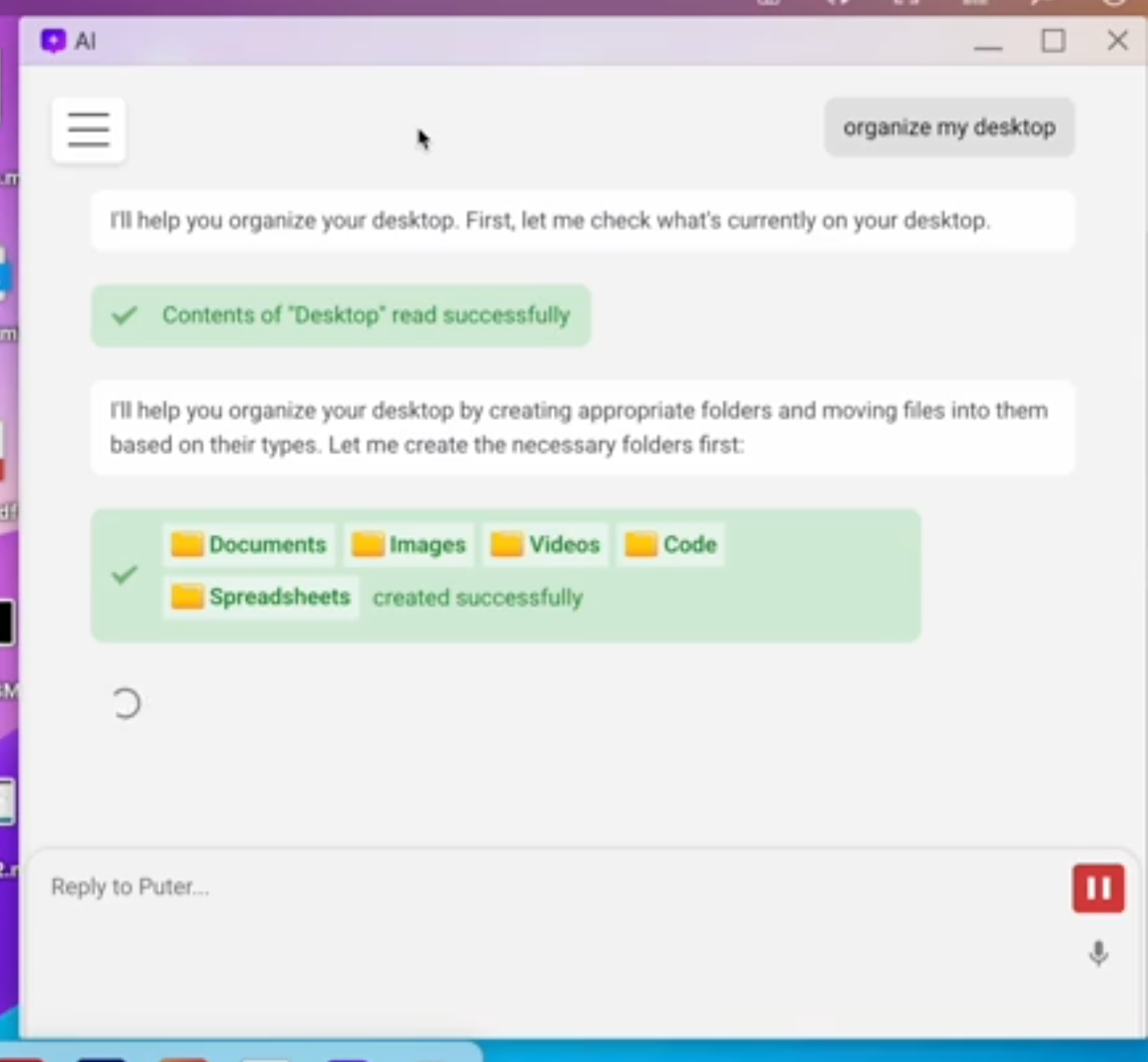
However, one proof of concept he has shared looks pretty cool: by having a standard API that's exposed to a language model, you can use natural language to perform even complex actions on Puter; as an example, you can just ask to organize files and folders on your desktop.
There's also work ongoing for thing such as a command line interface to interact with puter; this program allows you to log-in to your account, upload or download files, and more. Ideally, this would mean that you could keep a local folder in sync with a Puter one, which would finally start to make sense to me.
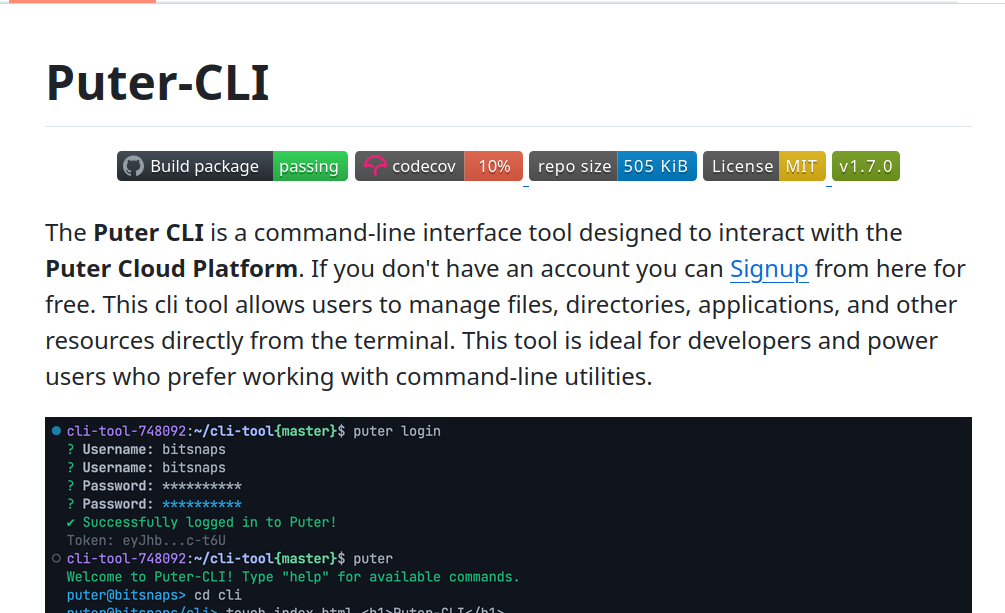
It would mean that I could use Puter as a Nextcloud alternative, but where I have an entire OS in the browser, which integrates with lots of other web applications, to see and do light work on my data from any device but still with the same interface, whilst still keeping serious business on my local machine.
Though, that's still far from reality. Maybe one day? For now, I'll stick to Nextcloud.
Will Google have to divest Chrome?

Just one hour ago - at the time of writing this, at least - news broke that China has announced retaliation against President Trump's imposed tariffs by launching an antitrust investigation on Google. The exact quote of the China government - according to, uh, Google Translate - is
Because Google was suspected of violating the Anti-Monopoly Law of the People's Republic of China, the State Administration for Market Regulation launched an investigation into Google in accordance with the law.

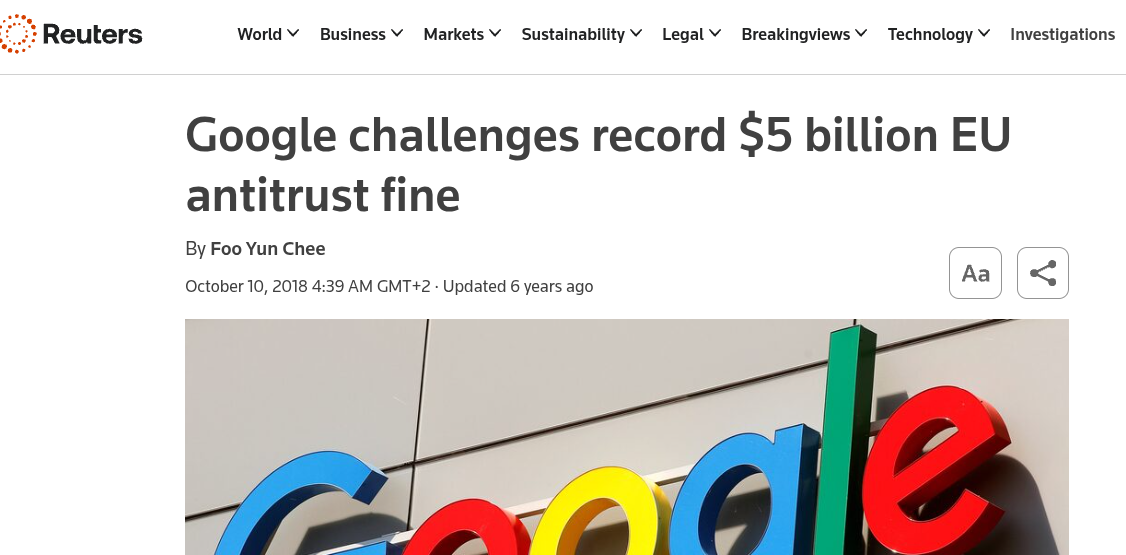
Indeed, investigating Google for antitrust lately seems like stealing candies from a child. In 2018, the European Union fined them about 5 billion dollars, the largest antitrust fine ever issued, though Google has decided to appeal that decision. According to the European Commission, the violations were that Google required manufacturers to pre-install Google Search and Chrome, prevented them from running competing operating systems based on the Android Open Source Project, and gave financial incentives to those who would only preinstall Google Search on their devices.
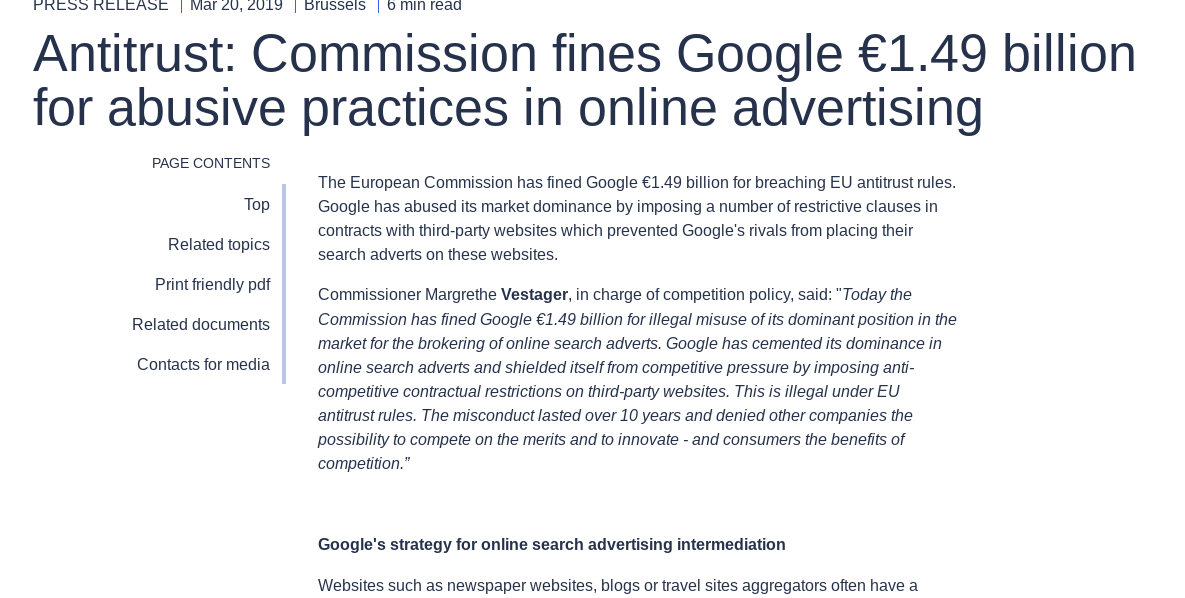
The year after that, the EU issued another 2 billion dollars fine due to "abusive practices in online advertising". Again, Google appealed the decision. This time around, the reasoning is that Google required partners to exclusively use AdSense, display a minimum amount of Google ads above any competitor's, and more.
As you very well know, Google has issued some changes to address these fines. As an example, in 2019 they said they would ask users for their preferred browser of choice upon first setup, to further comply with EU's decision. However, the biggest antitrust headache that Google is going through - the one we're focusing on today - is related to the US itself.
In September 2023, a trial began between the United States and Google concerning monopolies. Google, who probably wanted to avoid as much attention as possible, managed to obtain that this trial would be held behind closed doors, claiming that trade secrets could be released to the public, otherwise. However, we do know that the ruling of this trial states:
After having carefully considered and weighed the witness testimony and evidence, the court reaches the following conclusion: Google is a monopolist, and it has acted as one to maintain its monopoly.
According to the judge, Amit Mehta, Google has violated section 2 of the Sherman Act. The DOJ's proposed solution is to divest them of their browser, Chrome. Additionally, they also left the door open to potentially force them to sell the Android operating system as well.
Let's go step by step, and see what the DOJ wants to achieve.
Yes, divesting Chrome is one of their strongest suggestions, and the idea is to separate the most popular browser from the most popular search engine, to make sure that Google does not use the former as a gatekeeping platform to funnel users into their search.
Google would also have to part ways with Chromium, the Open Source base upon which Chrome is built. Keep in mind that this project is meant to be a bit more community-driven, though - as I'll mention later - the vast majority of work done on it is by Google. It's not entirely clear who would drive the project forward if they had to stop working on it.
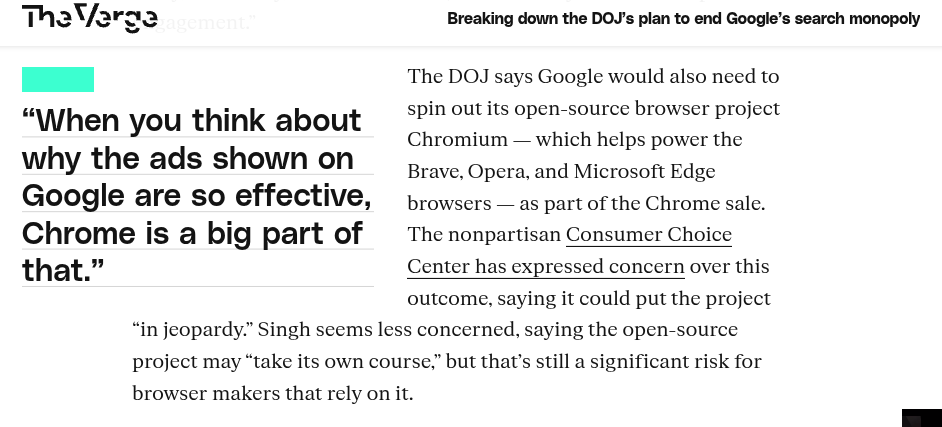
Generally speaking, Google would have to avoid offering Google Search as the out-of-the-box tool on any of its devices, something somewhat similar to what the Digital Markets Act proposes - if you don't know what that is, I have an entire video about it, by the way.
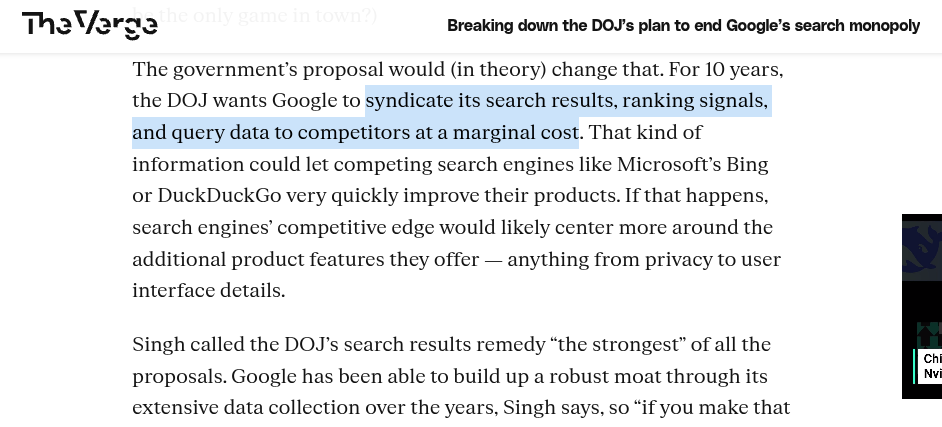
Another significant proposal from the DOJ is to publish Google Search rankings and query data to competitors. This would allow them to very quickly increase in quality, allowing for much more of a fair fight between them -- that is, if you consider "fair" to force Google to publish that data at all.
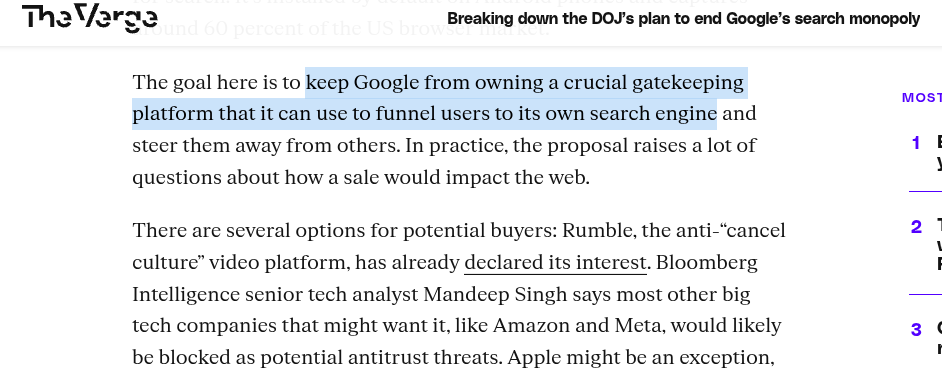
Finally, there would be a ban on having search deals with browsers to make sure that they use Google Search; again, you can see the patterns that are building up. This suggestion would be particularly significant for the Open Source world, as you will see later. All of this was an extreme summary of the proposals, but you can read more about them in the linked The Verge's article.
The reaction to this proposal, on Google's side, was pretty strong. They released an article titled: "DOJ’s staggering proposal would hurt consumers and America’s global technological leadership", and the language that they use is extremely telling. I have to read you an extract:
As just one example, DOJ’s proposal would literally require us to install not one but two separate choice screens before you could access Google Search on a Pixel phone you bought.
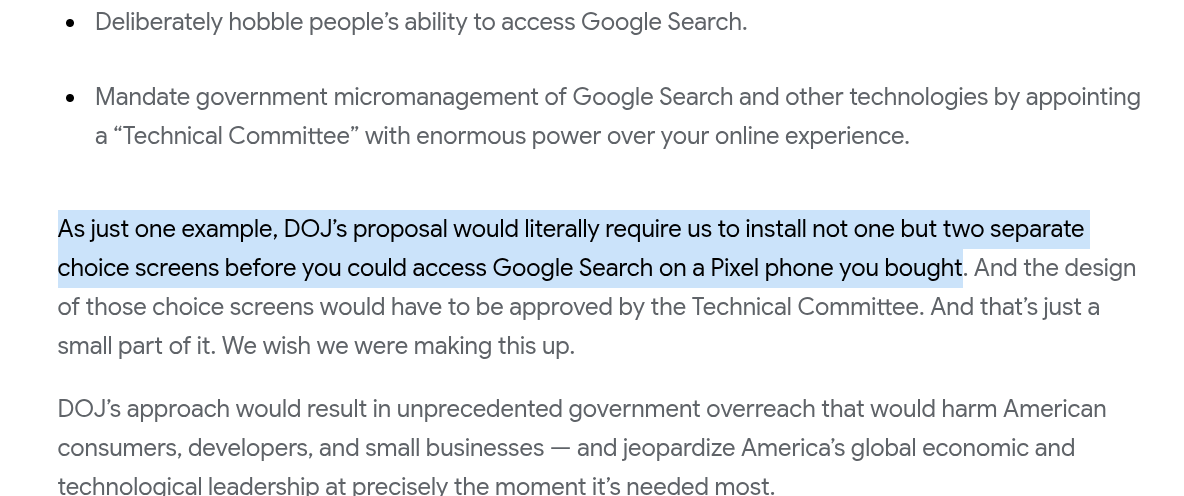
I don't know if you fully grasp the gravity of the situation. Two entire choice screens. Two. I'll keep reading.
And the design of those choice screens would have to be approved by the Technical Committee. And that’s just a small part of it. We wish we were making this up.
This extreme proposal would:Endanger the security and privacy of millions of Americans, and undermine the quality of products people love, by forcing the sale of Chrome and potentially Android.Hurt innovative services, like Mozilla’s Firefox, whose businesses depend on charging Google for Search placement.Deliberately hobble people’s ability to access Google Search.
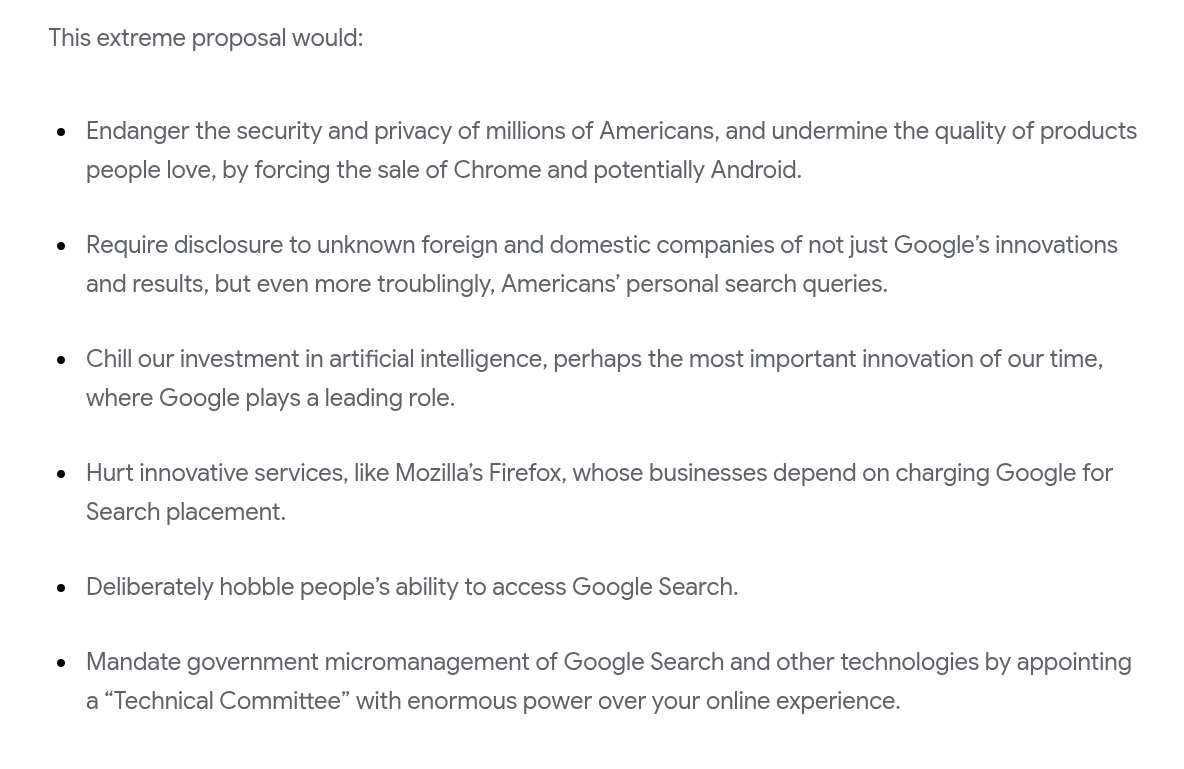
Yadda yadda. It is worth noting that Google must be very well aware of the risk of being considered a browser monopoly, especially since they pay around half a billion dollars to Mozilla to, formally, make sure that it uses Google search under the hood, but, informally, to try to escape from monopolistic accusations. Though, that didn't work.
Note that this sentence could also indirectly hurt Mozilla. Another part of the DOJ proposal was to stop this funding, since it technically was - is - a financial incentive to a competitor to keep using Google's search engine. As a result, Mozilla could be losing its main source of income here. Just a few weeks later, the Mozilla Foundation laid off 30% of its staff, by the way.
This is why it should not come as a shock to you that Mozilla is trying to help out Google. They don't want the DOJ remedies to go through. They have published a lengthy article, titled "Proposed contractual remedies in United States v. Google threaten vital role of independent browsers", where they point out that the revenue of "critical browser competitors" would be jeopardized. I do admire this article because it tries hard to frame this whole discussion to be about the freedom of choice of the user, saying that Google Search is only a default because it's the best search engine out there... but it's about money. They don't want to lose 80% of their revenue, understandably.
Google has the same deal with Apple as well; they pay them 20 billion dollars to make sure that they use Google Search out of the box. This deal would also have to be rescinded if the DOJ proposal would be accepted.
Though, to be clear - differently from what is sometimes reported - these are suggestions of the DOJ to the court made after Google was found guilty, so the exact measures that will be imposed to the company are not yet decided. This is a central point: it is now in the best interest of Google to put them in the shiniest possible light, to try their best to avoid something as drastic as losing their browser.
On the 20th of December, Google published a follow-up blog post called "Our remedies proposal in DOJ’s search distribution case". Similarly to how the DOJ suggested their remedies - such as divesting Chrome - Google is doing the same. Their proposals are the following:
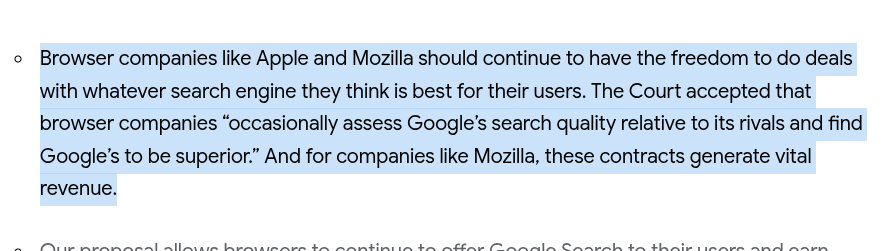
Firstly, they think browsers should have the freedom to make deals with search engines. They point out that Mozilla relies entirely on that deal, and that browsers have found Google's to be the best search engine out there anyway.
However, they will now offer more flexibility in those agreements. It would allow for different search engine defaults on different devices, and the ability to switch to a different one every 12 months. Browser-wise, that's it. I'm not sure whether this is enough to avoid the monopoly accusations.
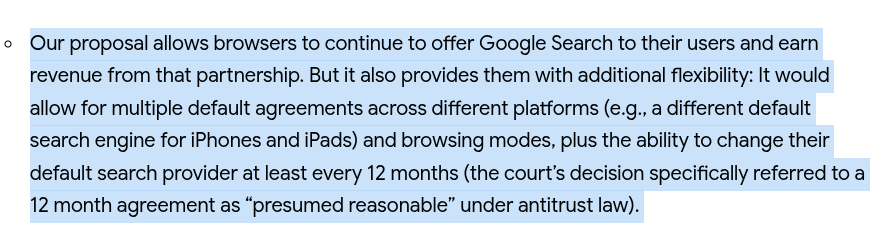
Android-wise, they will provide more flexibility to manufacturers in preloading multiple search engines. Again, that's it. That said, they claim that
we believe that [these changes] fully address the Court’s findings, and do so without putting Americans’ privacy and security at risk or harming America’s global technology leadership.
Please note how the two products that were suggested to be divested, Chrome and Android, are both open source-ish. To be exact, Google maintains the Chromium and Android Open Source Project, which are fully open source, but then it takes those, changes them, and ships them as proprietary software; the Android that you get on a Pixel nowadays hardly looks like the AOSP project, and the latter - by itself - is almost unusable; Linux Tech Tips made a video about this topic, recently.
Thus, what Google would love to happen is for more folks to join the Chromium and AOSP project, but especially Chromium. Throughout the years, they have been the source of roughly 94% of all the commits made to the project, and they are the de-facto owners of the project.
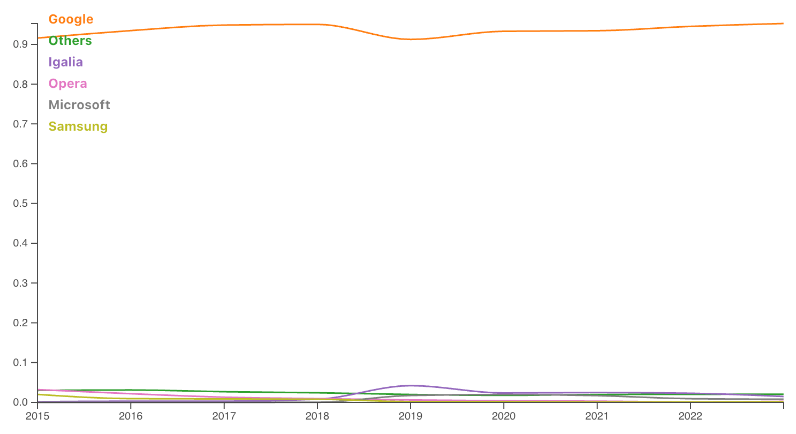
If they managed to make Chromium just a bit more independent, with possibly more companies contributing to it, though still retaining its control, that could help them tremendously in their antitrust cases. And, since the stakes are really high here - Google is an advertisement company, and Chrome is core piece of that business - they have a lot of money to invest in this project.
Enter the Linux Foundation.
On the 22nd of January, they announced the "Supporters of Chromium-Based Browsers". The goal is, and I quote,

fund open development and enhance projects within the Chromium ecosystem, ensuring broad support and sustainability for open source contributions that will drive technological advancement.
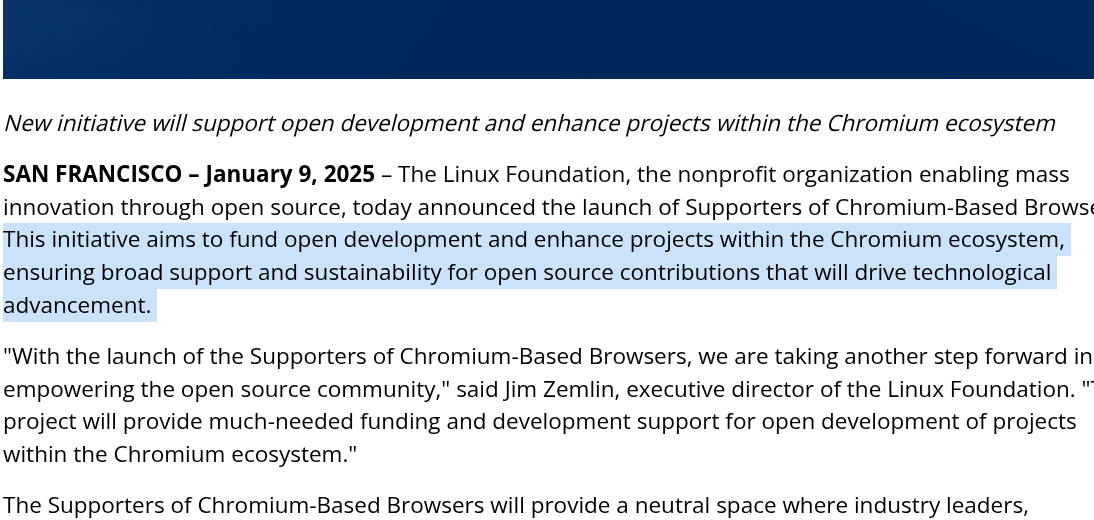
I have to say, it's pretty funny to see the Linux Foundation say that they want to work to "expand adoption" of Chromium-based browsers. "Expand adoption"? Of the most common web technology out there, by far?
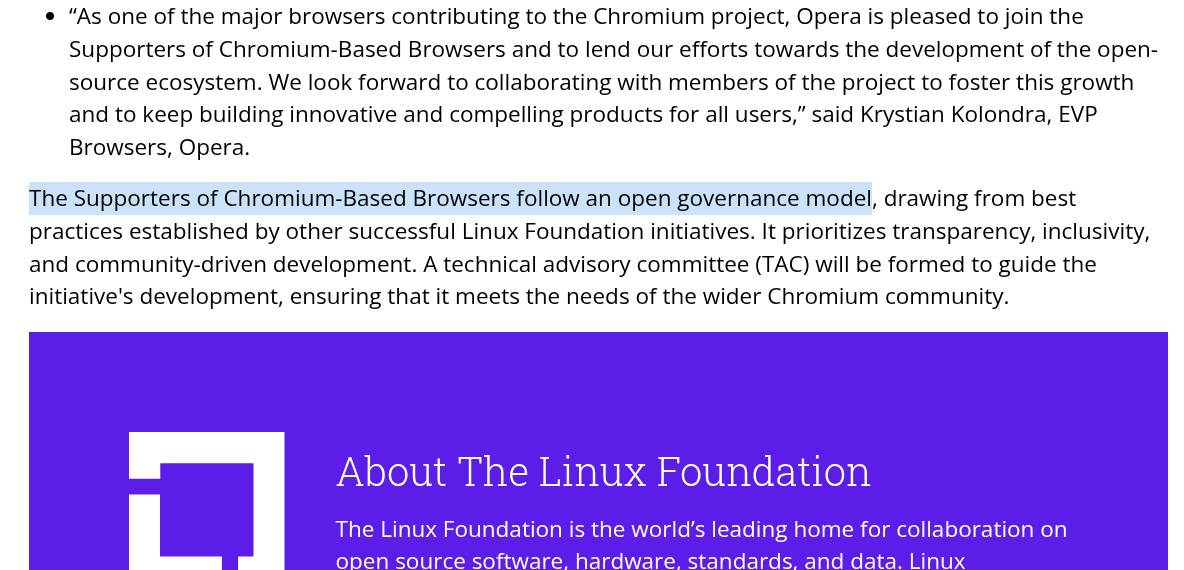
It's worth noting, though, that the Linux Foundation also hosts and, I believe, funds the development of Servo. The project, previously worked on by Mozilla, aim to implement a new and independent browser engine; so, they do seem to be doing genuinely good work on that side; assuming that this new Friends of Chromium Fanclub won't change their efforts on Servo.

Anyhow, the Supporters of Chromium-Based Browsers is supported by Google - obviously - Meta, Microsoft, and Opera. It "will provide a neutral space where industry leaders, academia, developers, and the broader open source community can work together", and it "follows an open governance model".
So, will this be enough? When will we know which remedies will be taken, and whether the court will divest Chrome? That will be decided by a two-week trial in April, and it seems pretty clear that Google is trying its best to get to that trial in the best possible position. That said, there's a very big factor that we have not considered so far, and it goes by the name of Trump. As you probably know, if you did not live under a rock, the administration over the US has changed since this story began, and it is somewhat unclear how the new one will handle antitrust regulations. Quoting the Jacobin,
GOP presidents have in recent decades typically embraced extreme free-market ideologies that see antitrust regulation as baleful government interference in the economy. But it should be remembered that most of the present cases against big online platforms like Google, Facebook, and Amazon actually originated in Donald Trump’s first term.
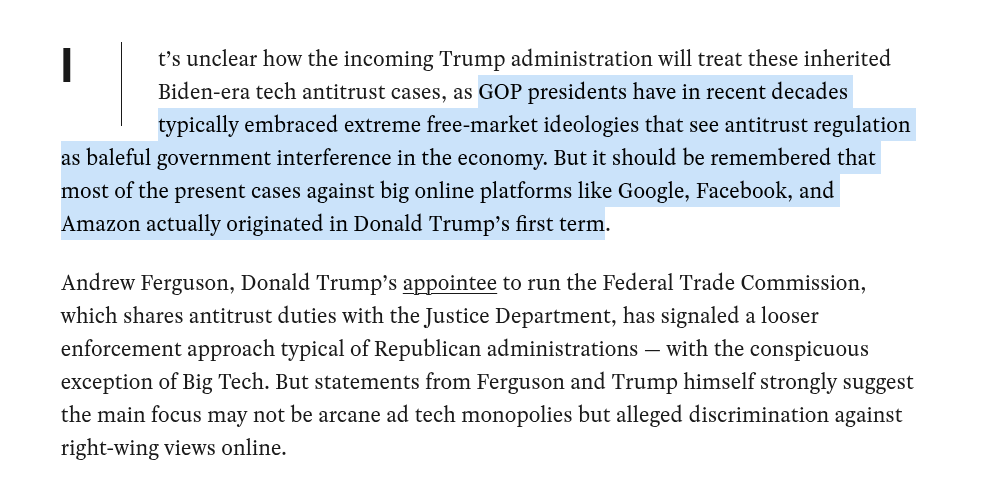
Ultimately, given Trump's apparent interest in making Big Tech submit to him, the change in administration could be good news for Chrome; it certainly increases the chances that this ends in nothing done. I'm not exactly sure whether I would even want the US to divest Chrome, to be honest.
Anyhow – I believe that is everything I had to tell you. See you tomorrow, then!
Behind Mozilla's Finances

I would like to take a moment to discuss Mozilla's money management. I have seen countless articles criticizing it, and possibly with merit, so let's dive in.
Firstly, what we call "Mozilla" is three (or more) different entities.
The topmost is the Mozilla Foundation, a non-profit American organization founded in Mountain View, California.

It has a board of directors composed of ten people, the chair of which is Mitchell Baker.

Whereas the executive director is Mark Surman.
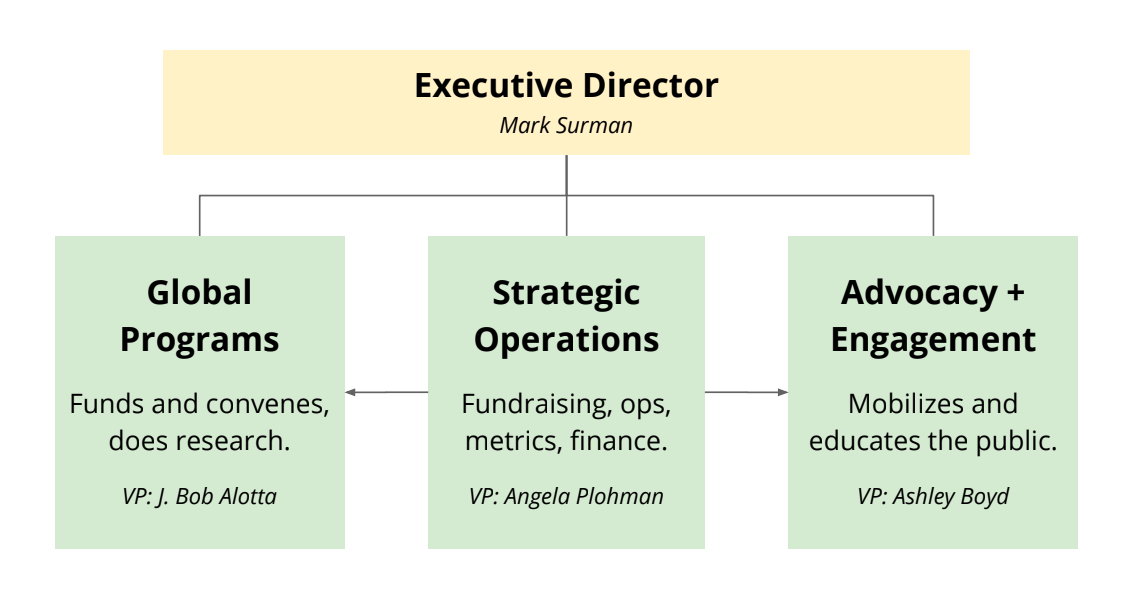
The foundation's current movement is described as having three phases. The first one is called "Fuel the Movement", active since 2016: the goal is to rally citizens on issues like trustworthy AI, privacy, and digital rights; support activists and leaders shaping the future of our online lives, and shape the agenda for open source research and internet health.
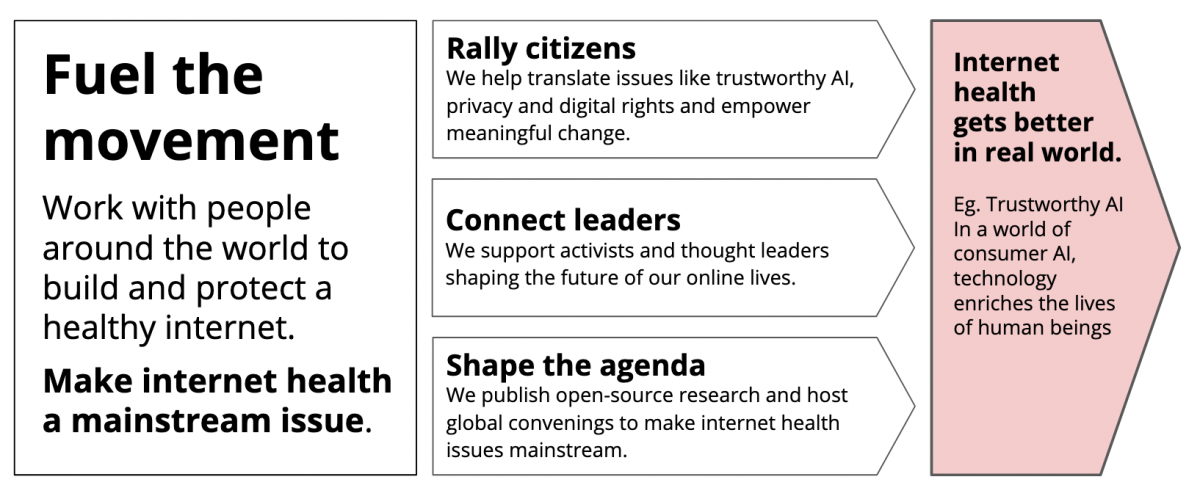
Since 2019 there has been a focus on Phase II: "Focusing on Trustworthy AI". They seem to have produced various documents on how "Trustworthy AI" should be implemented, in a way that's respectful to the user.

And, finally, since 2021+ we also have a third strategy phase, called "transparency, bias and data". Again, there's a focus on AI: how can we make AI decisions transparent, mitigate bias in AI, and so on.
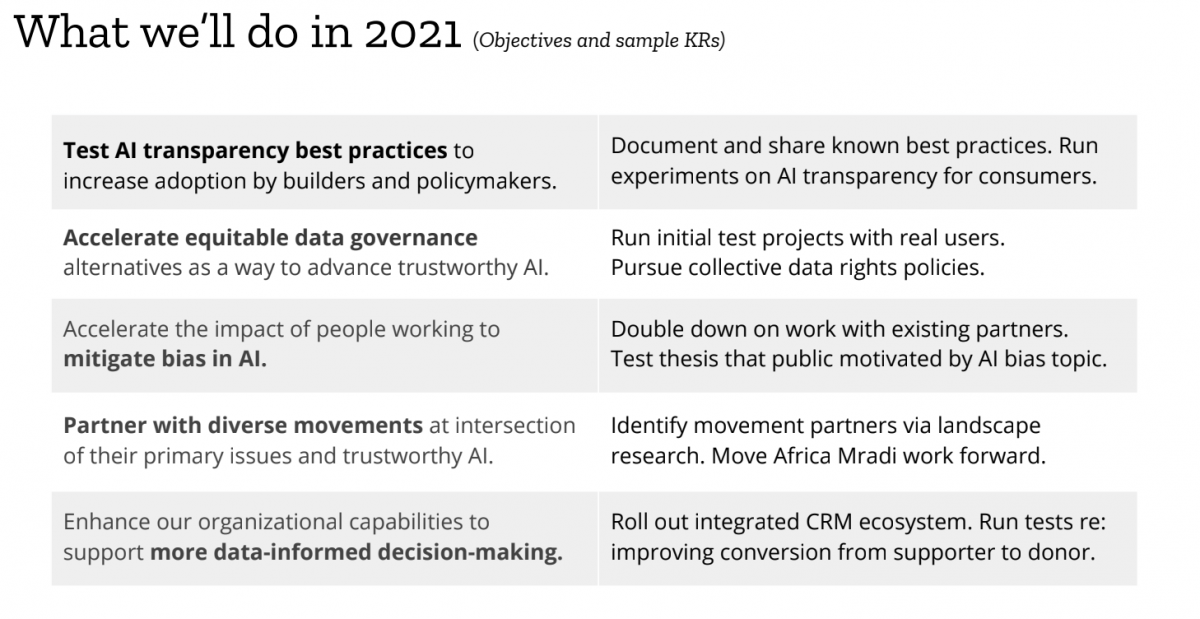
You may notice a surprising lack in mentions of Firefox, or Thunderbird. Indeed, the management of these two products is delegated to two for-profit subsidiaries, called Mozilla Corporation and MZLA Technologies Corporation respectively. Then, we have a venture capital arm, and a subsidiary specifically about it. There are even more, such as Mozilla China, but those are less interesting to us.
All other videos and articles I've seen on this matter usually conflate the Foundation and its subsidiaries into the same entity. I don't think this is particularly effective, even to understand how money is managed. I have thus decided to split up the video and talk about each entity separately.
Part 1: the Mozilla Foundation
Mozilla's financial statements are audited and published as a single entity, i.e., "Mozilla and its subsidiaries", which makes it difficult to distinguish the revenue from the three entities. Though, we do have some information about the Foundation specifically thanks to their 990 form, which refers to the 2023 year. So let's dive in.
One thing we discover is that the total number of employees of the Foundation is 66 people. Also, they estimate to have 10.000 volunteers. I'm not sure how they came up with the number, but sure.

The total revenue is 64 million dollars, mostly thanks to investment income - well, back in 2023 we had a bit higher interest rates than now - and "program service revenue", though contributions (such as donations) and grants still are around 10% of all income.

Expenses were just 39 million, mostly due to "Other expenses" (frustratingly vague), and "Salaries", which makes sense overall. That leaves us with a Renvenue less expenses value of 24 million dollars for 2023. Finally, the total assets currently owned by the Foundation amount to 124 million dollars.

Funnily enough, the "Other income" section is explained on page 8 to be … "other income". Yeah, no shit.

Finally, the Foundation pays the paycheck of Mark Surman, president and executive director, which amounts to 600k dollars yearly, before taxes. Other Foundation paychecks are listed, but this is the highest one.

This amounts to a total of three million dollars. They also pay almost two million to "Mauve Corporate System", which is an Employer of Record company: that is, they employ people on your behalf to make bureaucracy easier, instead of having to create subsidiaries for each country you want to have employees within.

Other two million dollars are spent in contracting on multiple companies. Mission North offers consultations regarding communication in the AI space, Russel Reynolds "help CEOs and boards solve their leadership challenges", Tourchbox is a non-profit digital agency that offers UX and development services, and Pacific is about audio and production.

Then, the Mozilla Foundation has given grants to various organizations. We're talking about grants for "integrating responsible computing and ethics", "support for African school on internet governance", "building and adding features to zeno" (a machine learning project), "closing the AI education gap initiative", "computing ethics", "feminist tech ecosystem", "2023 women's convention", "exposure of surveillance systems in schools", and so on. Grants are usually between 50 and 100 thousand dollars, and they are given to entities that range from universities to non-profits, such as "Lesbians who tech & allies", "the hearth genome", "whose knowledge", and so on.
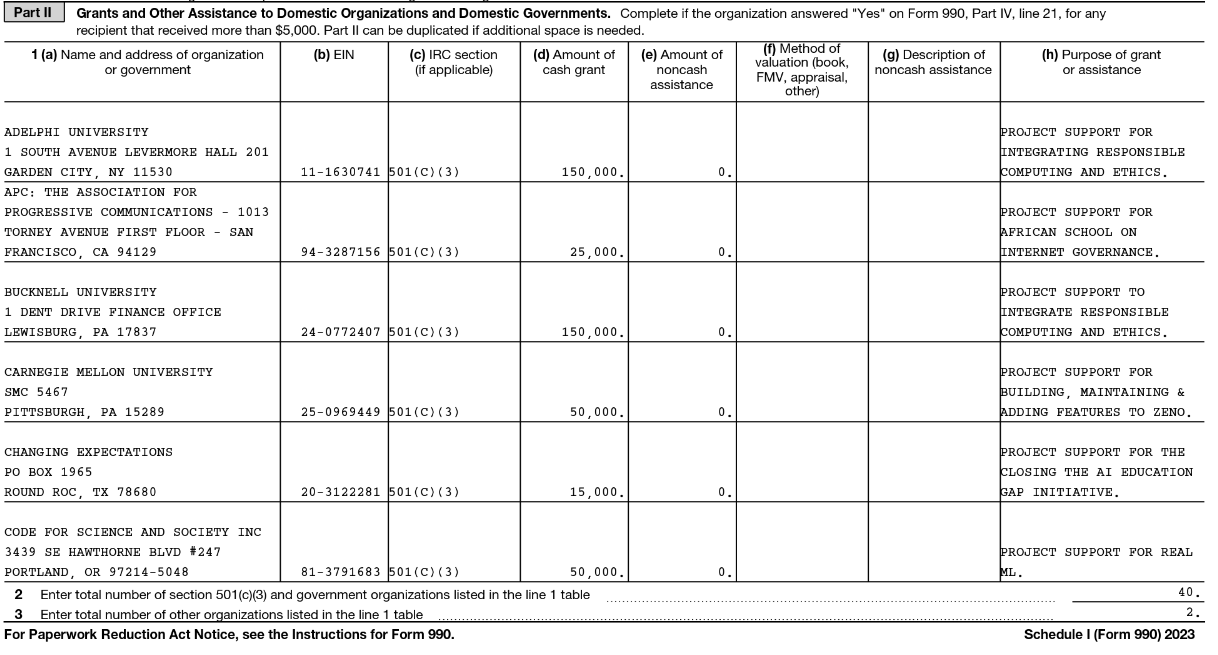
This is the sort of stuff that will get you under the scrutiny of right-wing folks, but personally, I'm a big fan of, well, helping people and using money to make the world better and fairer for all of us. Finally, the Mozilla Foundation also receives money from its subsidiaries, though not directly.
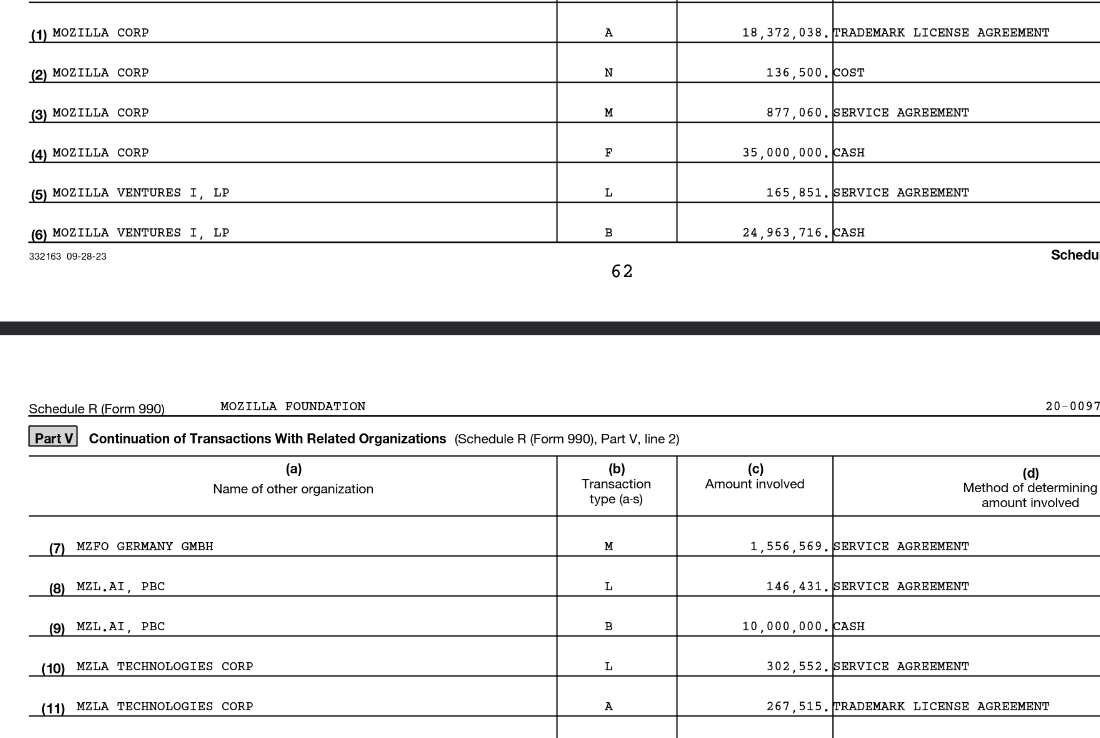
The 35 million dollars mentioned in the investment income were mostly actually dividends from the Mozilla Corporation, which also pays 18 mils for trademark license agreements. The Foundation also received a gift, grand or capital from Mozilla Ventures, an impact venture fund that's also a subsidiary, of 24 million; 10 million more were given for the same reason by MZL.AI, the AI subsidiary.
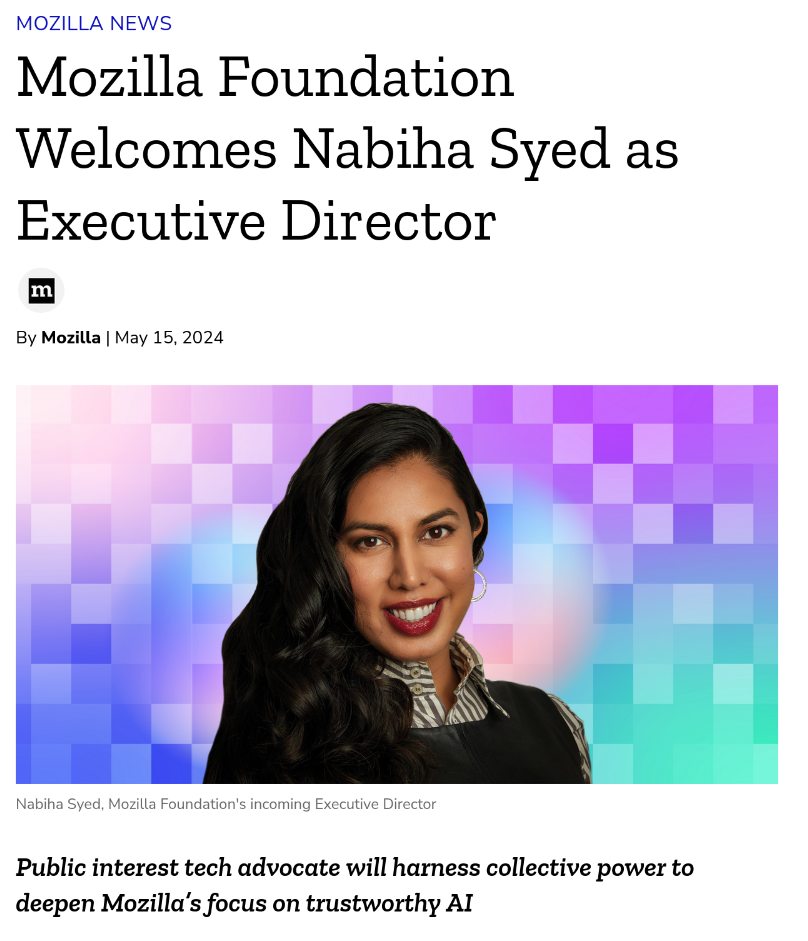
This was 2023. It's worth noting that the governance of the Foundation seems to be somewhat changing in recent times. In early 2024, the executive director was announced to be Nabiha Syed, previously CEO of The Markup.
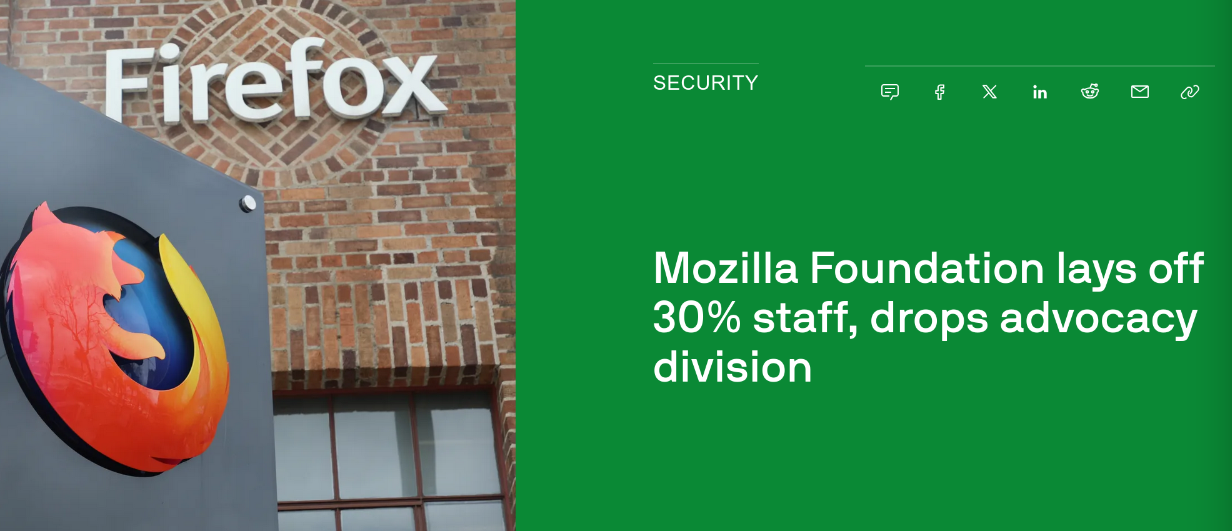
According to Tech Crunch, she sent an email to all employees on October 30th, 2024 announcing that the teams behind advocacy and global programs were laid off, which resulted in a 30% decrease in headcount. Some quick math tells us that this means a twenty-people reduction. Brandon Borrman, the chief of the Foundation's communication, claimed that "the advocacy is still a central tenet of Mozilla Foundation's work and will be embedded in all the other functional areas", though what that means exactly will probably only be clear over time.
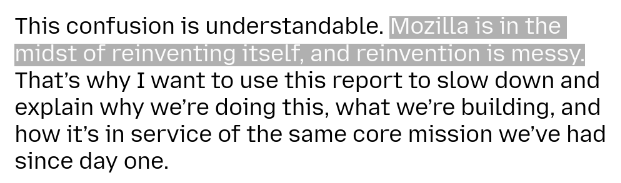
In December 2024, the Foundation published its annual report, including the financial audits I've mentioned, plus some talking points from Mark Surman (the director) and others. As he states, "Mozilla is in the mids of reinventing itself, and reinvention is messy".
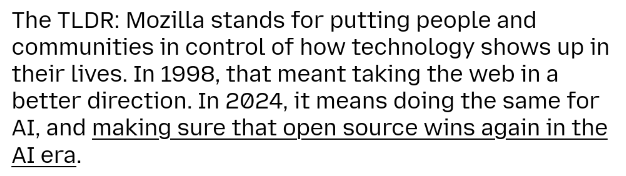
And, in the next paragraph: Mozilla stands for putting people and communities in control of how technology shows up in their lives. In 1998, that means taking the web ina better direction. In 2024, it means doing the same for AI and making sure that open source wins again in the AI era.
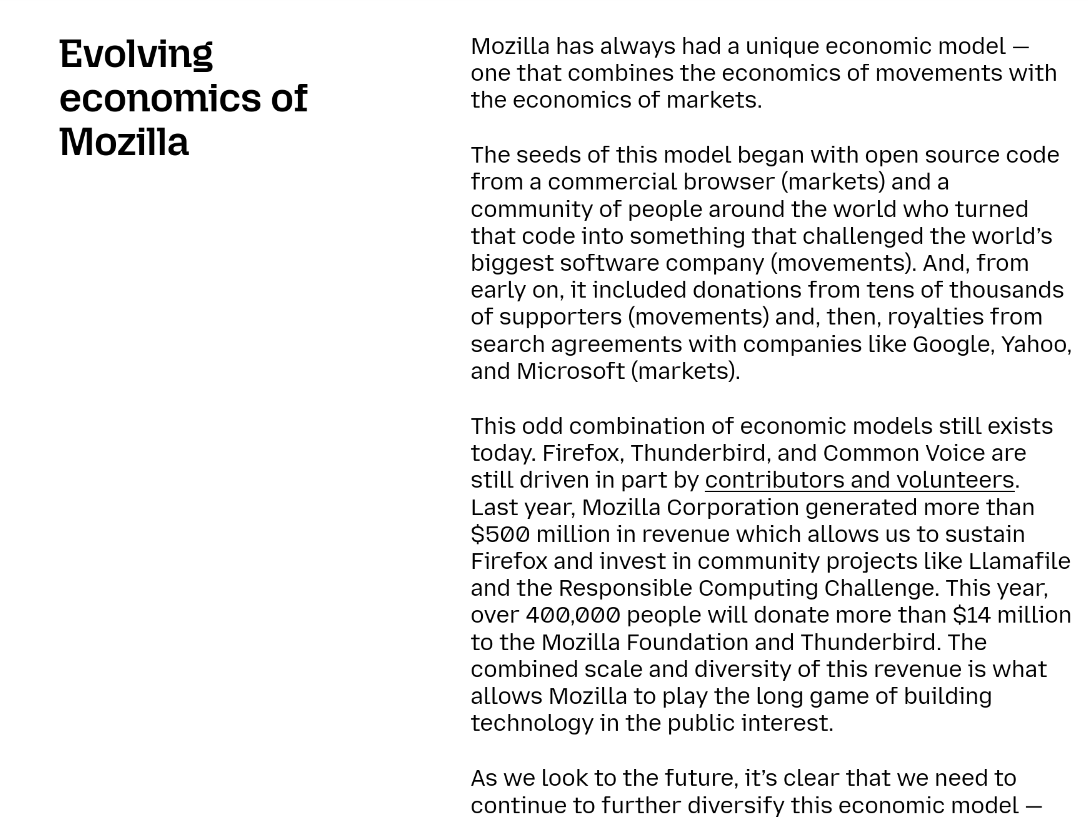
About the "economics of Mozilla", Surman says that the main focus of the Foundation is diversifying income. As we will see later, the vast majority of the money coming to Mozilla and subsidiaries comes from Google and amounts to almost 500M dollars, whereas donations "only" sum up to 14 million. If I had to guess, Mozilla itself isn't too excited to be that reliant on a single company, especially since the US Department of Justice as asked courts to prohibit Google from making search partnerships; this would result in a complete loss of income in the Mozilla Corporation.
It's worth noting that nowhere in these articles - that I could find, at least - is inclusivity or diversification of communities even mentioned. It seems to me like they do want to appear as a more neutral actor, rejecting the left-leaning image they had been associated with.
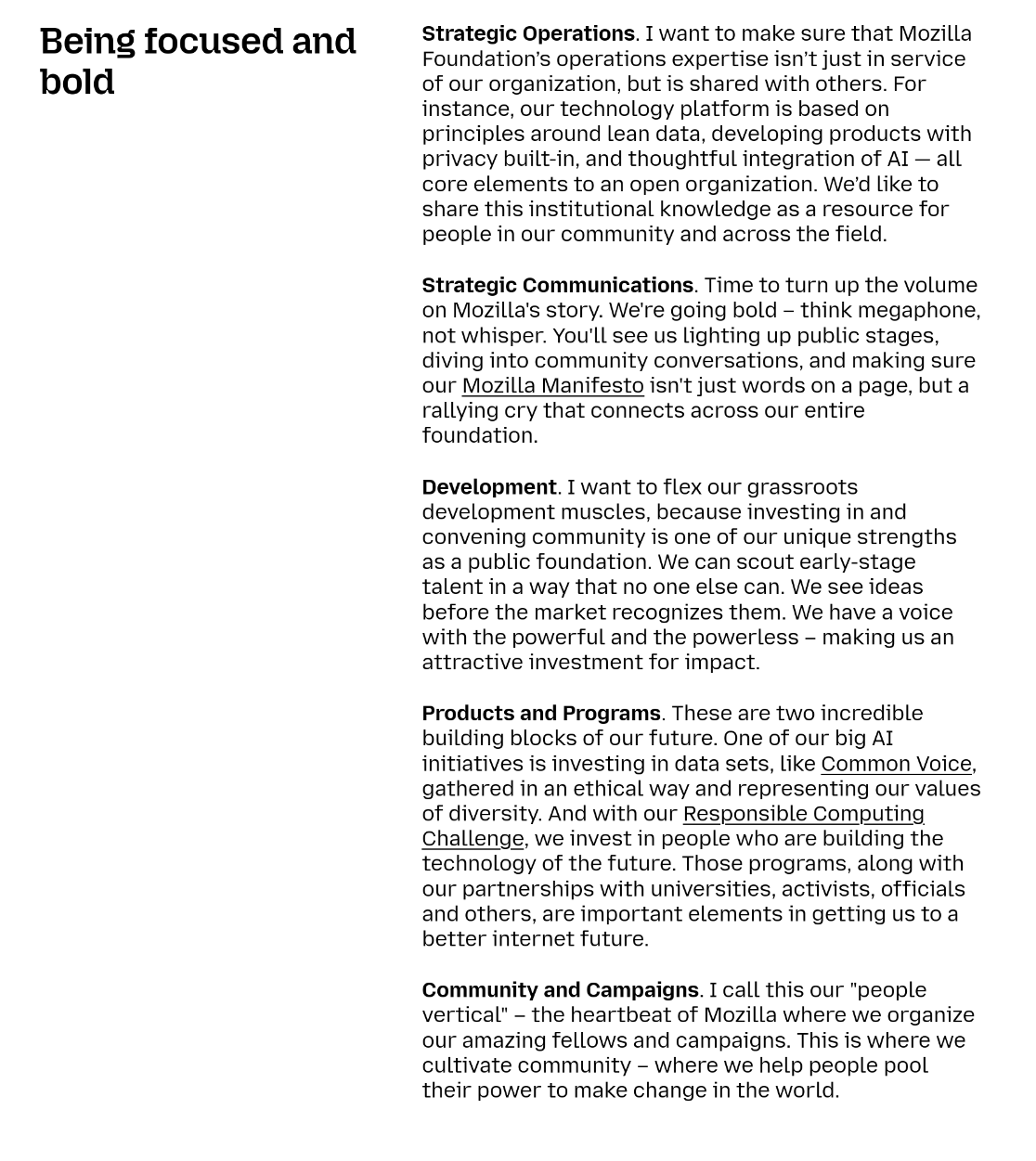
Nabiha Syed, the executive director, has also written an article, where the main points are: strategic operations, communications, development - although there's no mention of specific projects - products and programs, community and campaigns.
Overall, it should now be clear to you both the brand that Mozilla is trying to build - which is somewhat more detached from Firefox than one might expect - and how it's managing its money too. Apart from the criticism that could be raised for their 2023 inclusivity grants (I'm fine with that, I just know that some other people won't be), I would say the organization is taking somewhat reasonable steps. If the responsibility of Firefox and Thunderbird development is delegated to subsidiaries, which I haven't even touched for now, and which are directed by different people, then your job - as a non-profit foundation - becomes much more vague; you have to give values, you have to give a direction, you have to support the bureaucratic side of things, and so on. However, this only really works if those for-profit subsidiaries take the responsibility that they are given. Which raises the question: how is the Mozilla Corporation doing?
The Mozilla Corporation
Please note that I have not found a way to talk about the finances of the Mozilla Corporation, specifically. They don't have their own report, so I will analyze the "Mozilla and subsidiaries" financial report and sort-of assume that "most" of what is going on is happening in the Corporation. Other subsidiaries will get their own sections.
So, Mozilla total assets sum up to around a billion and a half dollars - again, this is data from the 2023 financial year. They are mostly distributed in various investments, as we'll see later.
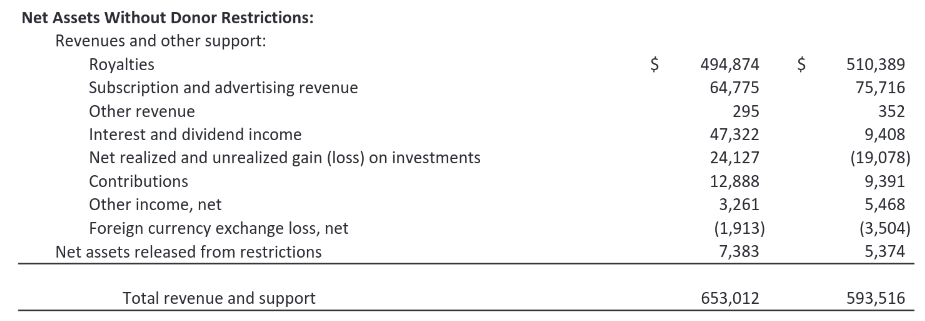
The total revenue is 653M dollars, and it increased since last year. Most of it - just shy of half a billion - comes from royalties, which includes the deal with Google to have their search engine be the default on Firefox. We don't know if other royalty incomes add up to it, but we can safely assume that the deal is "almost everything" of that section. Subscription and advertising revenue is 64M dollars; this includes their VPN subscription and Pocket. Interest from invested income is 71M, and contributions were 12M dollars in 2023; if you recall, 9M of that was to the Mozilla Foundation, and the remaining 3M probably originates from other subsidiaries, meaning - and this is a major point - that the Mozilla Corporation does not run on donations -- at all, almost. It's the Mozilla Foundation and other subsidiaries that do so; but not the Corporation.
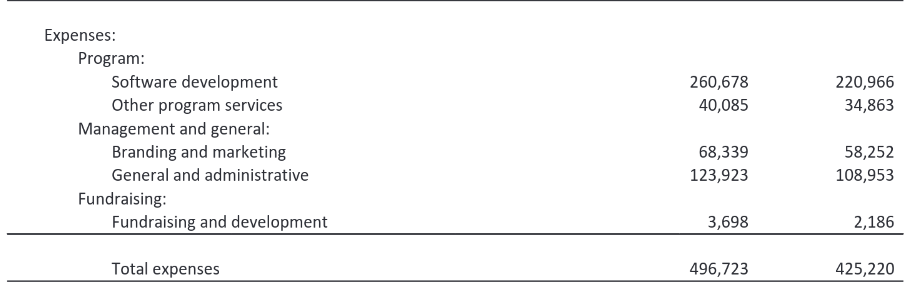
Let's see expenses then. These were just under half a billion dollars, again, half of which was spent on software development (of everything, from Firefox to Thunderbird to anything else). The remaining expenditures are General and administrative, Branding and marketing, Other program services, and a few mils on Fundraising too, in this order.
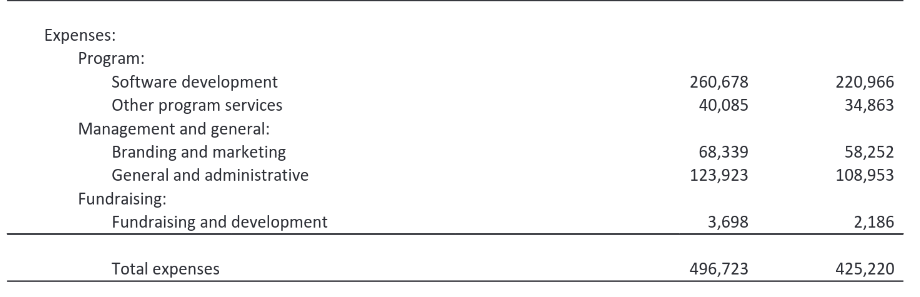
This should be somewhat reassuring: 60% of all expenses are on actual software development, and the remaining 40% is general expenses, administrative, branding, and marketing. However, remember that this includes the Foundation figures, and they don't do any development, so within the Corporation, software development expenses are probably higher than that. Say it's 70% development - 30% administration and marketing? That sort of balance does make sense to me.
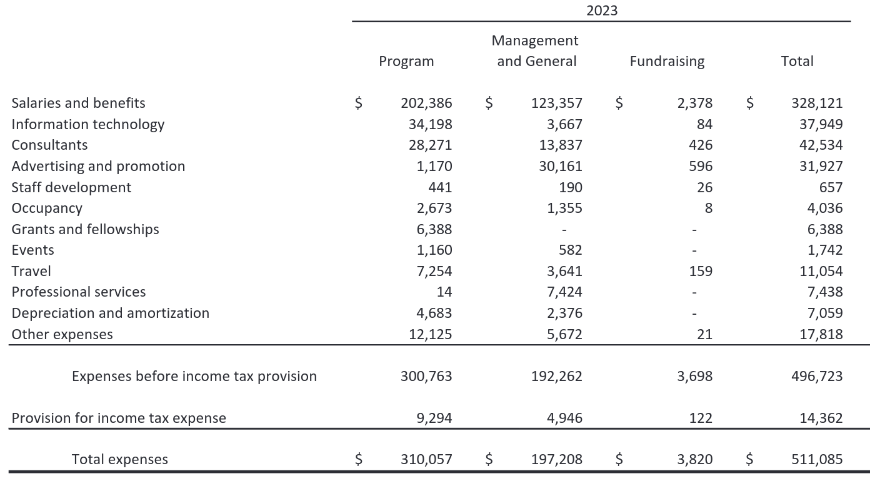
We also have a breakdown of the costs for each section in subsections. We don't learn much from it, though we can see that almost all money in management and general goes into employee salaries, as you would expect. They have around 750 employees, a bit less than now, given how they fired people since then.
One last thing I want to talk about in the expenses section is the paycheck of the CEO. In 2023, that role was held by Mitchell Baker, who you might remember from the beginning of the video, since she's also the chair of the Mozilla Foundation. For context – she is one of the founders of Mozilla; she started as a lawyer in Netscape in 1994, and helped launch the Foundation in 2003.

However, she stepped down on the 8th of February, 2024 to be replaced by Laura Chambers, acting as interim CEO.

We are not aware of what the salary of Chambers is - again, all the financial data comes from the year 2023 - but we can look into Baker's.
In that year, she had been paid 6.3M dollars; the entirety of that sum was paid by the Corporation, not the Foundation, which is a subtle difference -- but it does mean that she was paid by Google's money rather than our donations, if we want to say it like that. It's a bit less than 1% of the company's revenue.

Her paycheck was the subject of much controversy, especially because it increased significantly over time. In 2018 it was two and a half million dollars, in 2020 it raised to more than three million, in 2021 it was 5 million, and then it reached 7 million in 2022.

So, is this fair? Is she stealing money from us? Or, well, from Google? I'm going to say something unpopular here –
as much as I might not be a fan of today's capitalistic world if you are a company with a half a billion dollar revenue per year, you kind of gotta play the game, and that means having a CEO that is highly skilled and able to manage sort of revenue. Which is costly, but it's an important investment, and - as long as what she pays "makes sense", as in, it's the industry standard - then it's fine by me. But is it? Is she being overpaid for her role, or is that a normal paycheck for a CEO?
This is not an easy question to answer. Taking some data from the Heidrick & Struggles 2023 private equity-backed CEO compensation survey, we see that revenue for companies bigger than 500M dollars is, on average 737k dollars, plus a 687k dollars cash bonus. However, most CEOs are also given part of the shares of the company, and we see that the average long-term equity compensation is 13M dollars. We can even consider the averages in the 251M-500M range, to avoid outliers, but the data does not change significantly.
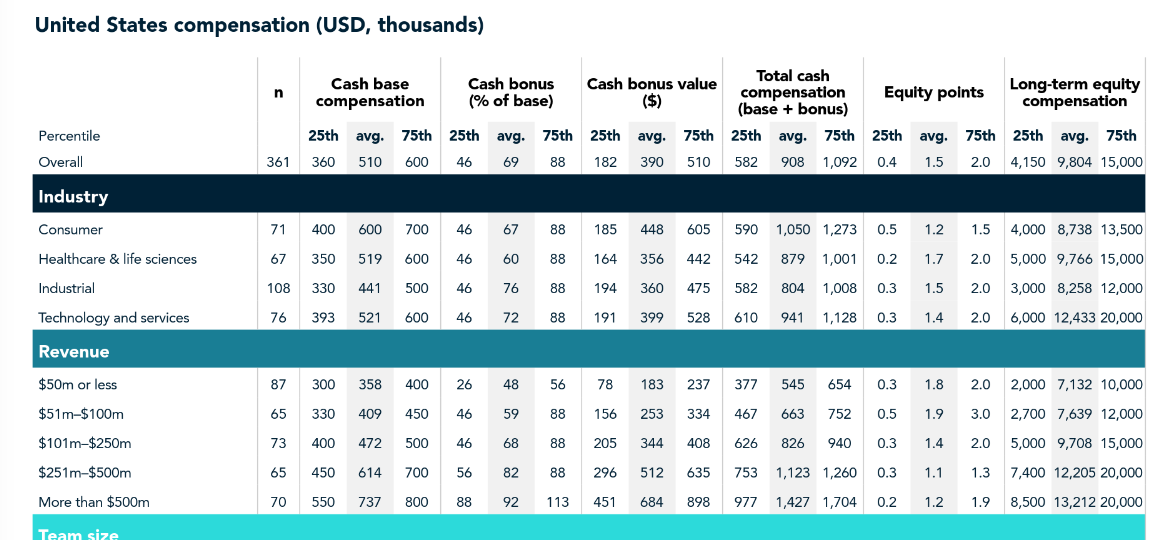
Note that the Mozilla Corporation does not have stocks. Thus, the entirely of Baker's paycheck is cash and does not include long-term equity compensation. It makes sense then to include to balance that out with a larger cash base compensation, which makes the 6M dollars figure … reasonable? Or, at least, not completely insane.
Overall, I'm somewhat satisfied with Mozilla's Corporation expenditure report -- as much as you can be satisfied with being almost fully funded by a competing product, and the Department of Justice wants to kill that revenue stream. Yeah.
MZLA Technologies Corporation
Let's now talk about MZLA Technologies Corporations.
Since 2020, this subsidiary has been the home of Thunderbird; this helped the project to try to monetize or sustain itself, at times where the parent Foundation was somewhat struggling to do so.
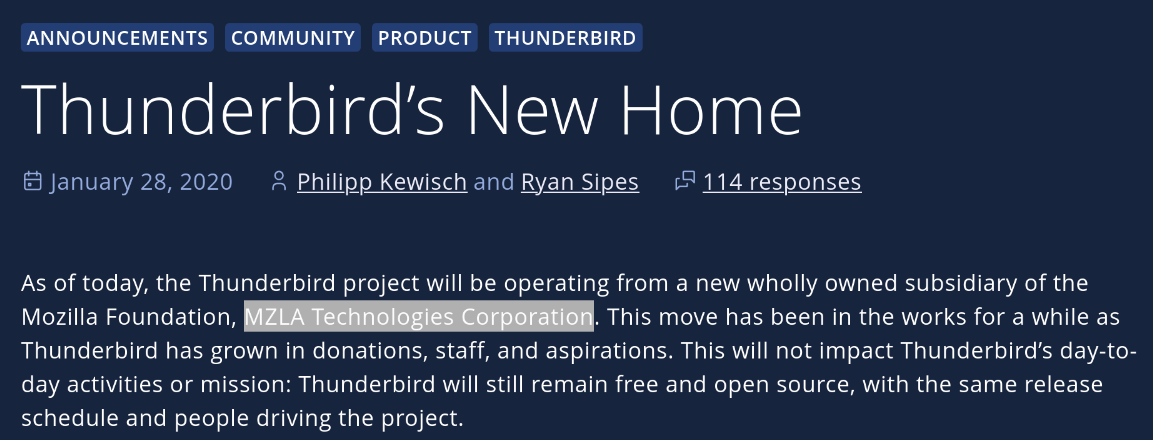
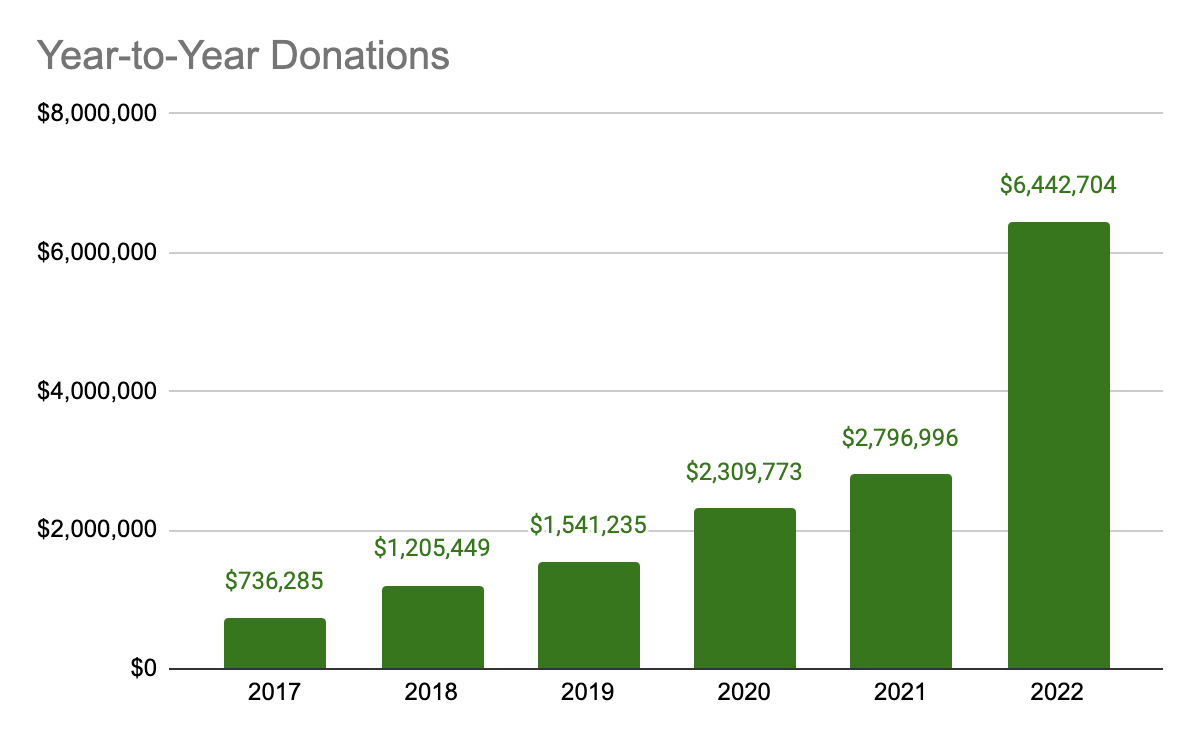
I believe that the MZLA Technologies Corporation - or, just, Thunderbird - should be taken as a reference implementation on how to do Open Source. In 2021 they managed to receive two and a half million dollars in donations, and in 2022 that number skyrocketed to six and a half million.
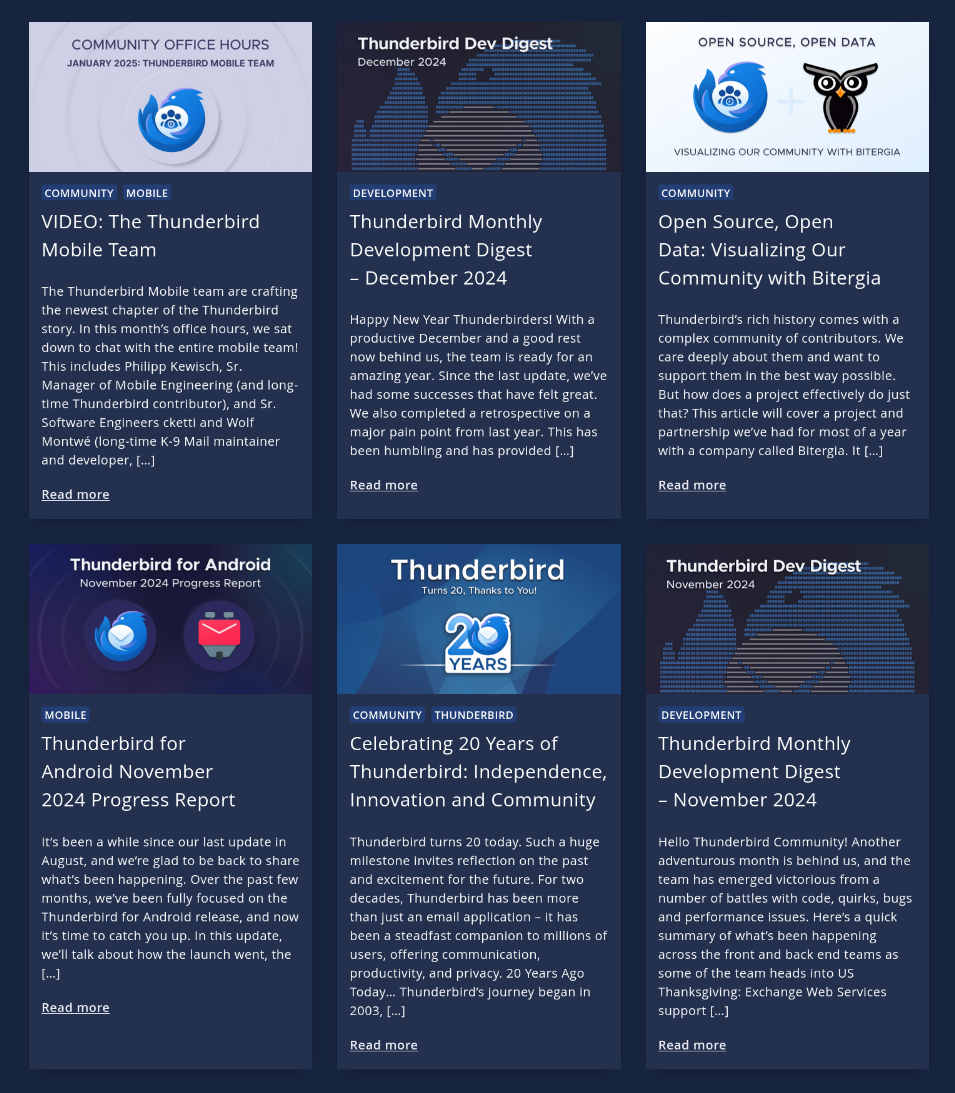
All of this was done whilst being extremely in touch with the community, publishing frequent blogposts about the development of Thunderbird, dev digest, community office hours, contributor highlights, and more.
Not to mention, they managed to effectively use that money in a complete redesign of the Thunderbird interface that brought it back from 199something to something that actually feels up to date.
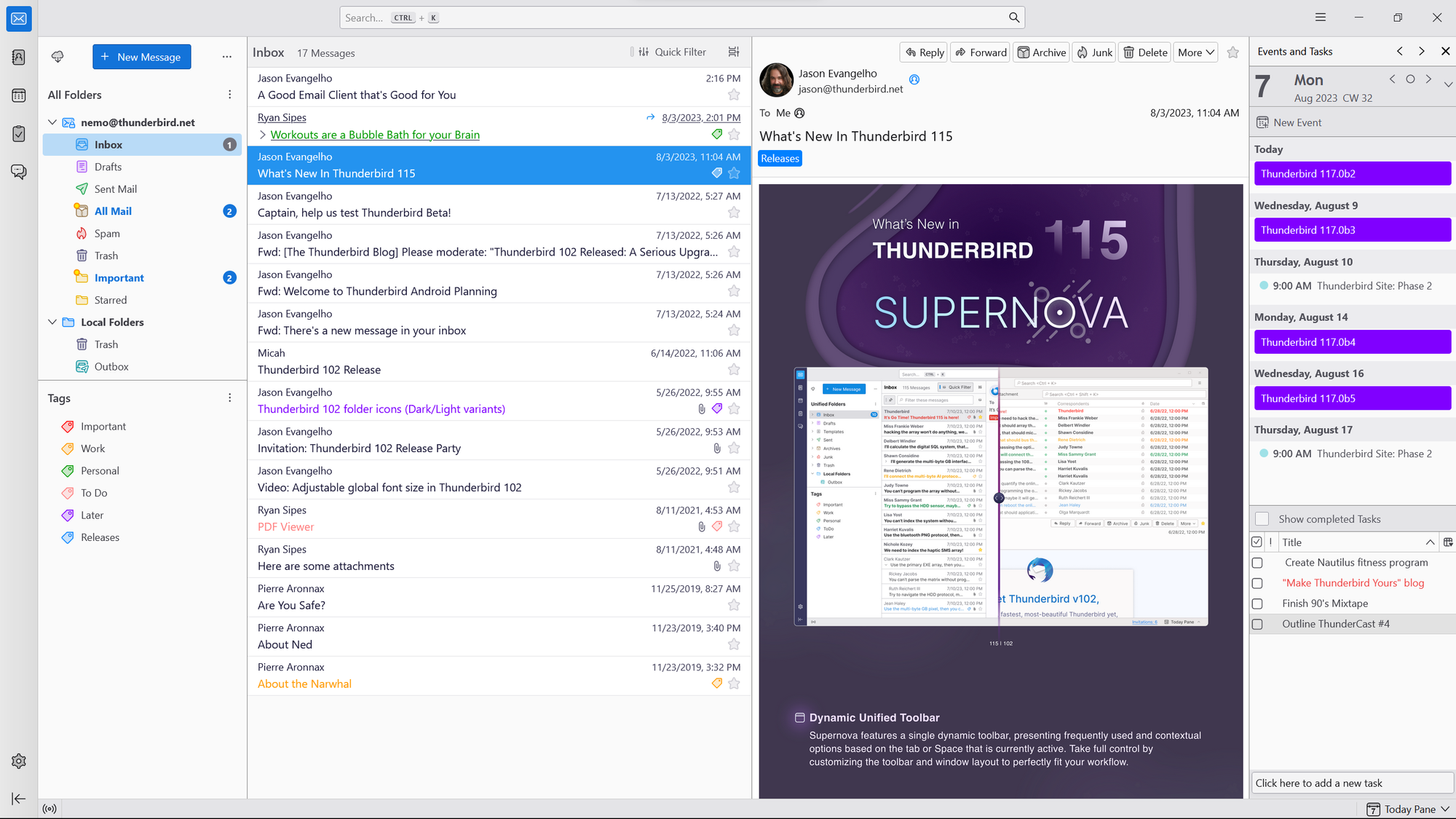
And, they managed to collaborate with the K9 mobile mail application developers to merge their products and announce Thunderbird on Android, again sharing a very modern design.

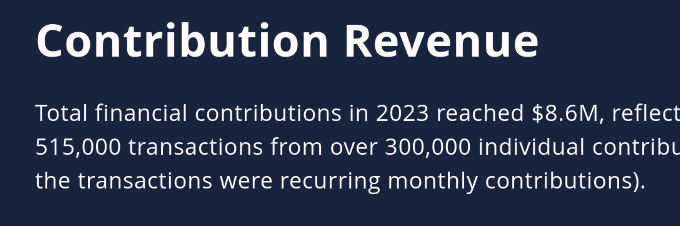
You won't be surprised to learn that in 2023 their donations numbers rose again to eight and a half million dollars, from over 300,000 individual contributors.
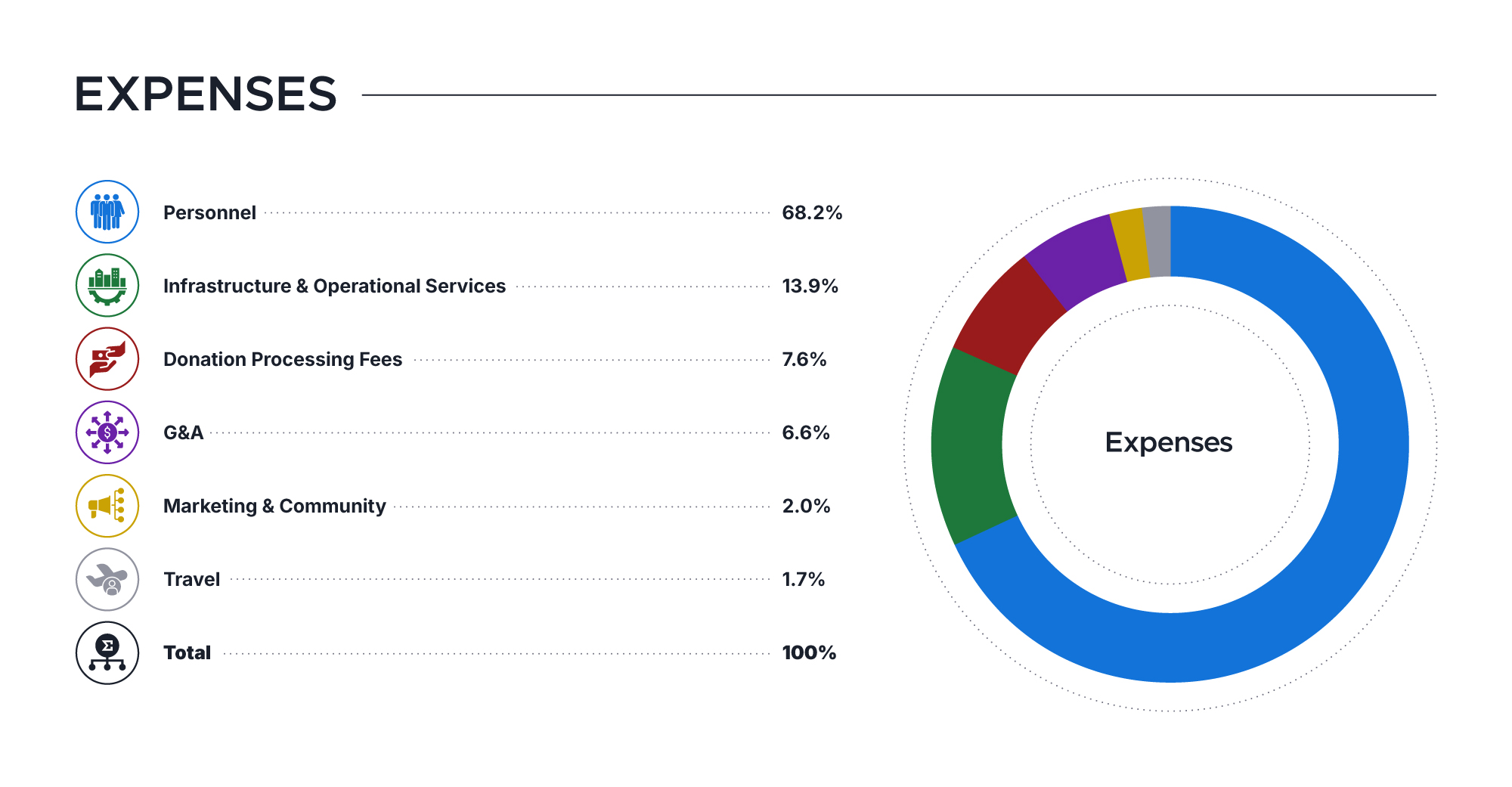
Talking expenses, 70% of the money goes to paychecks - from developers to marketing people, whereas the rest goes to infrastructure, donation processing fees, general and administrative, and so on.
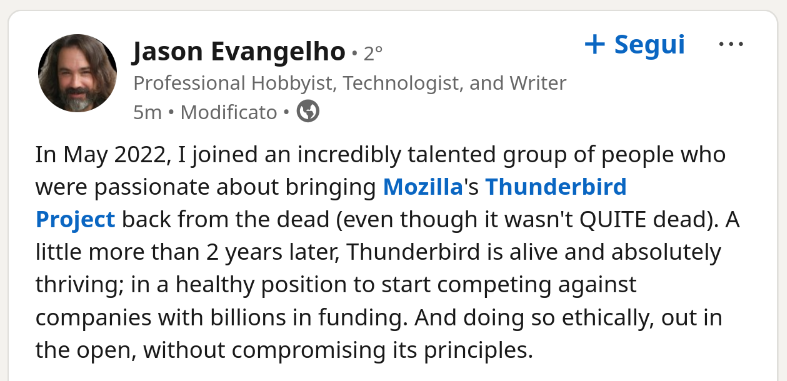
It seems to me like MZLA Technologies Corporation found a great way to be profitable and grow the product, and I love it for them. The whole team probably deserves a shoutout, but I'd particularly like to congratulate Jason Evangelho for is awesome work; he spent two years in Thunderbird, from 2022 to 2024 as the main promotion person, and I really saw him fully invested in the project.
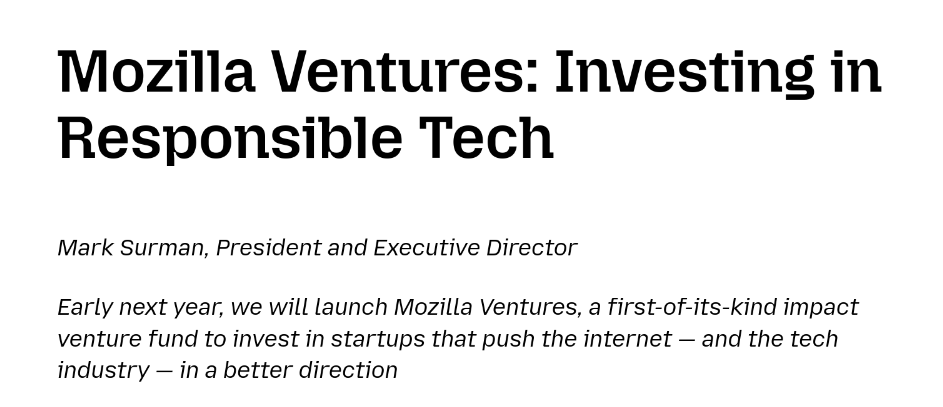
Mozilla Ventures
Next up, is Mozilla Ventures.
This subsidiary was announced in late 2021; it started with 35M dollars to invest in companies that shared Mozilla's values of open and user-respectful technologies.
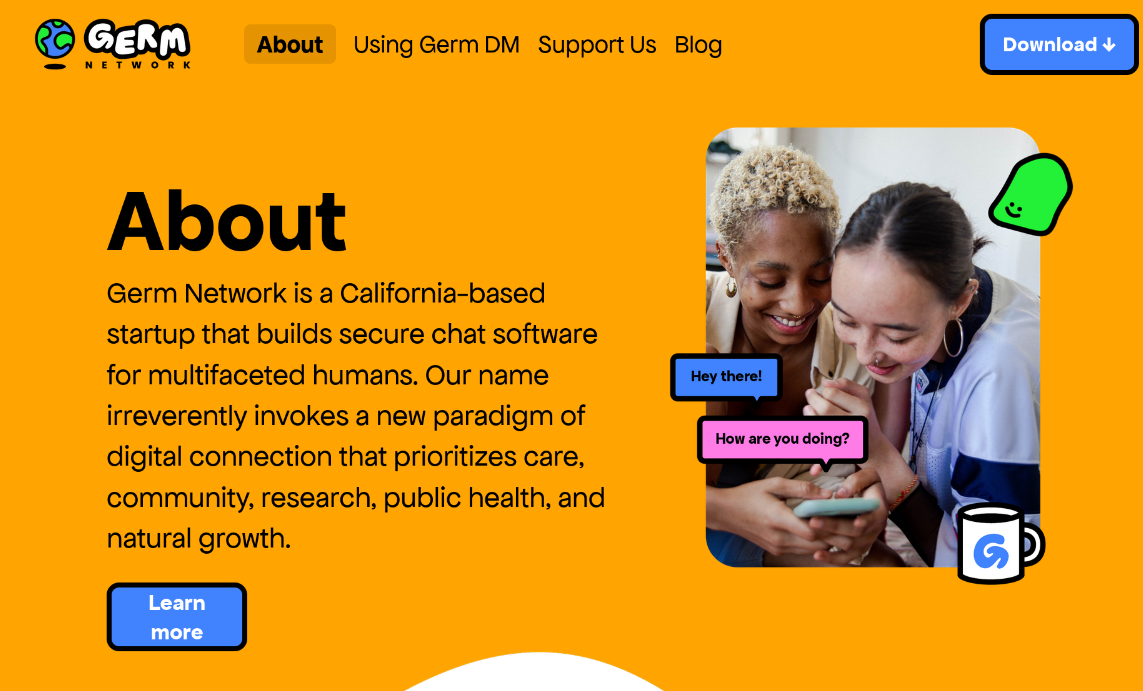
As an example, one of their last investments is "Germ Network", a private chat software where you have full ownership of what you decide to share -- I'd like to explain it better, but I didn't quite understand it.
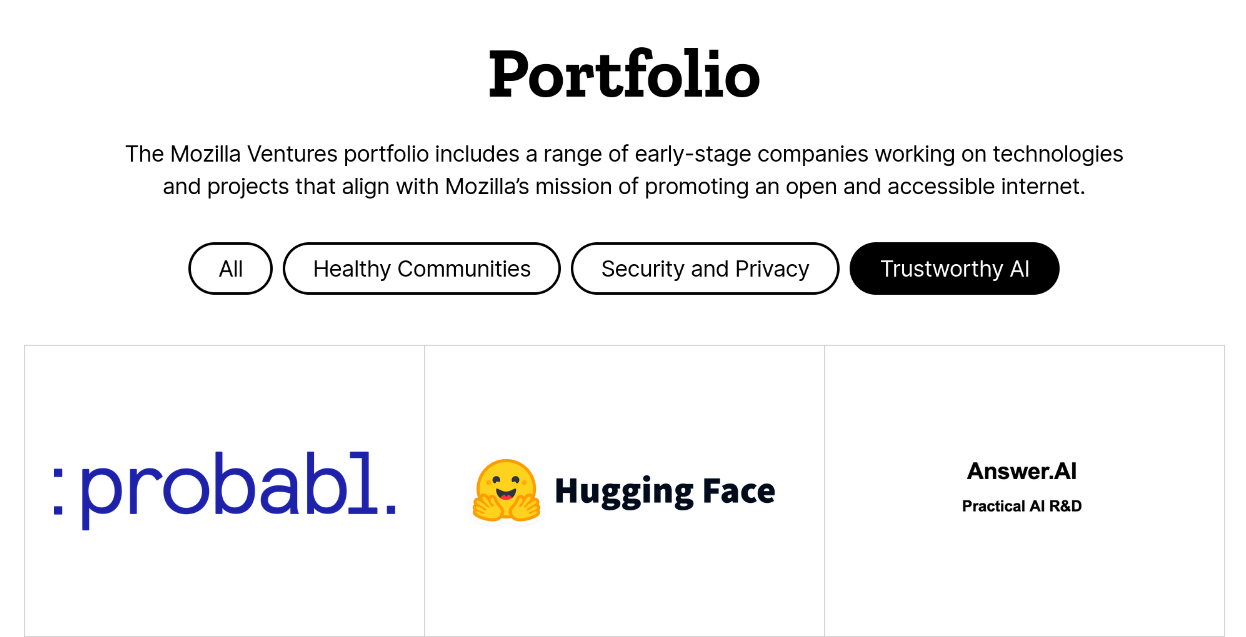
Mozilla Ventures also heavily invested in trustworthy AI; as an example, their portfolio features Hugging Face, the company that tried to implement an opt-out way for artists not to have their art trained on -- a project that was doomed to fail in how it was implemented, sure, but still.
Again, Ventures does not publish its own financial data, but we do get something (very little) out of the Mozilla and subsidiaries report since it has its own section on investment.
On one hand, as you'd expect, Mozilla invests in government-issued securities, mutual funds, equities, and alternatives. This is the standard stuff -- which we're not particularly interested with, but we get it anyway.
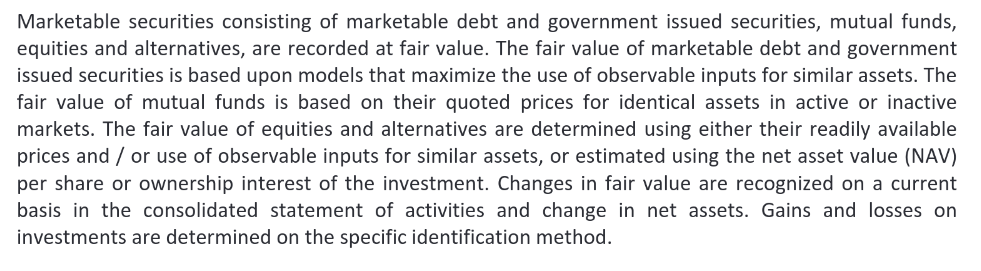
However, there are also non-marketable investments. These "include direct and indirect investments into various early stage, high growth technology companies".
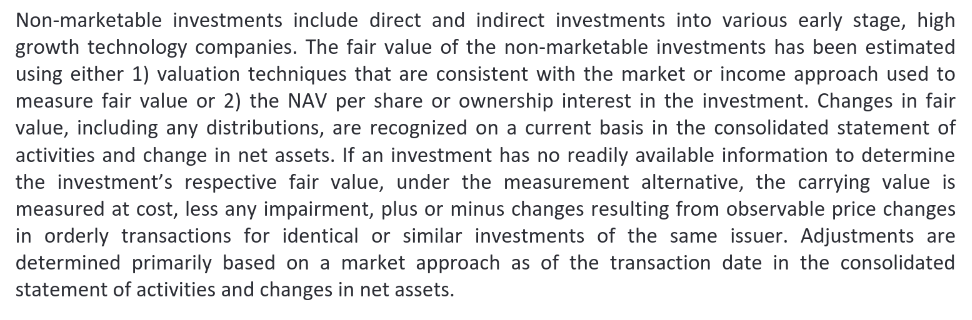
In 2022, the total Venture investments were 15.9M, whereas in 2023 that rose to 21.2M dollars. Thus, either not all of the starting 35M capital was invested, or there were some losses that are now starting to be balanced out. Though, admittedly, I have no clue whatsoever how any ventures work at all, so this is very speculative.

I'll merely point out that this number is extremely low compared to the one billion dollars invested in marketable investments, or compared to the amount of money they have at all. Currently, Ventures does not seem to me like one of the main Mozilla activities.
Mozilla.ai
The very last one I have to talk about is Mozilla. ai; I'll be quick -- I don't have much to say.
Mozilla.ai was announced in March of 2023, by Surman. Mozilla decided to make an initial 30M dollar investment in the company, which again is roughly 5% of their yearly income, and one-tenth of what they spend each year in software development, to put things into perspective.

It also seems to be a one-off expense; I don't know whether further money was sent to it, but I did not find any trace of that anywhere. The company is led by Moez Draief, who "has spent over a decade working on the practical applications of cutting-edge AI".

I have not found anything particularly interesting to say about this particular subsidiary; maybe it's just a bit too soon for anything significant to come out. I'll keep you updated in case anything happens, though.
Thanks everybody for following, and see you tomorrow.
Help us break even
We only run on donations. We have a goal of reaching 300 subscriptions, which would allow us to hire staff.
If you subscribe, you'll gain access to a few members-only pieces, though we aim to keep most of our content free for all.
no ads · no trackers · cancel whenever