Android prefers vibecoders over open-source developers
Allow me to compare and contrast two different choices taken by Android developers.
One. Google announced (at I/O) a new AI Studio application that will allow users to generate new applications by simply asking for specific functionalities, "all from your phone".
See https://blog.google/innovation-and-ai/technology/developers-tools/google-ai-studio-io-2026/
You're able to "share live deployments with your friends to gather feedback and collaborate". I'm not against this: I think AI is a good tool to quickly "create" barebone applications that do one specific task you need that might not be found in existing applications (we all have our niche requirement, after all).
The announcement also states:
Connect your Google Play Developer account in AI Studio to publish your app to Google Play's Internal Test Track with a single click.
The Internal Test Track is a way to privately share an application on the Play Store to test it out, with a limit of 100 registered users. This latter functionality seems to only be available on the desktop version of the AI Studio, but the general approach from Google seems to be to making it easier over time to share with friends or publicly a entirely vibe-coded application.
Two. In 96 days - at the time of writing - it will become significantly harder to sideload Android applications.
Currently, you can install Android applications from any source. Depending on your exact Android derivative, you will be prompted to allow the manual install from your specific source (are you sure you want to install this APK from "Firefox"?). This takes a few seconds.
In a few months, the same task will require the following (taken from Keep Android Open):
- Delve into System Settings, find Developer Options.
- Tap the build number seven times to enable Developer Mode.
- Dismiss scare screens about coercion.
- Enter your PIN.
- Restart the device.
- Wait 24 hours.
- Come back, dismiss more scare screens.
- Pick "allow temporarily" (7 days) or "allow indefinitely".
- Confirm, again, that you understand "the risks".
As Keep Android Open states: Nine steps. A mandatory 24-hour cooling-off period. For installing software on a device you own.
Allow me to express my frustration at this choice: this means that it will be significantly easier to try out a vibecoded app with an user that has no coding experience, compared to try out application from (mostly open-source!) skilled developers.
Forcing users to exclusively install applications from the Play Store means Google has the final pick over whether you can install a certain application or not on your software. Even better, making it so easy to vibecode an application allows Google for even more complete control over your software stack, as the app will directly be provided by them!
As an example, five years ago Google decided to remove an application by Alexei Navalny made to organize tactical voting. According to Reuters,
Russia demanded this month that Apple and Google remove the app from their stores, saying a refusal to do so would be treated as meddling in its parliamentary election.

Both Google and Apple decided to comply with this request. A more recent example was reported by 404 Media:
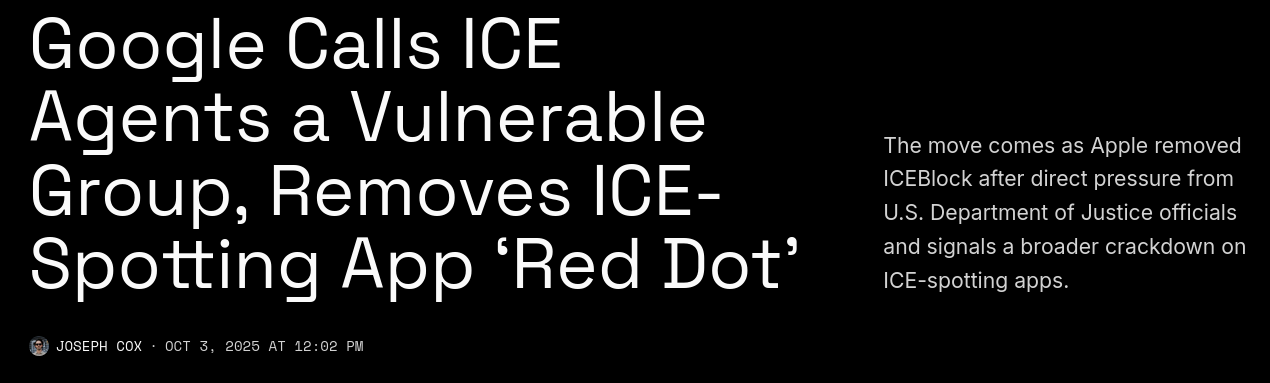
Both Google and Apple recently removed Red Dot, an app people can use to report sightings of ICE officials, from their respective app stores [...] Google told 404 Media it removed apps because they shared the location of what it describes as a vulnerable group that recently faced a violent act connected to these sorts of ICE-spotting apps—a veiled reference to ICE officials.
As long as users are required (or heavily incentivized) to only use the Play Store as their only app source, those same users will be forced to comply with Google political stances – or rather, the political stances of governments who are able to force the company to comply.
When moving towards heavier integration of tools like Gemini in their Android developer workflow, Google is pushing their influences in the development phase of an application, not just the deployment. I see no reason to think that those same governments wouldn't be able to also force Google to disallow Gemini from creating such applications, not just publishing them.
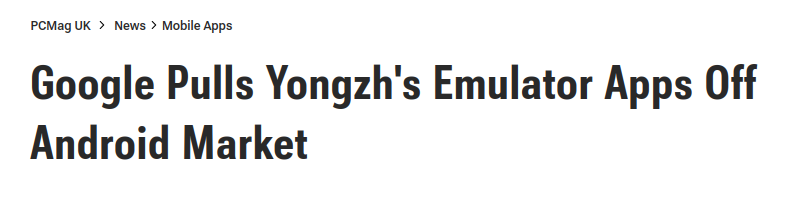
Generally speaking, Google is under very little scrutiny over its review process of applications. An older example is when they decided to pull an important Emulator application out of the store without providing any reason for it. Though it could be argued that the emulator was infringing trademark, these claims are hard to dispute and generally settled in court; here, Google was able to unilaterally decide on the application's future, and not much can be done about it.
Publishing on the Play Store also requires paperwork and a (small) fee. This is luckily trivial for somebody like me, but as the Keep Android Open project points out, it becomes a significant issues for developers from countries where Google does not allow developers to sign up from, or in regions with limited access to Google infrastructure, or in scenarios where quick deployment is required (e.g. for a local emergency response).
This will soon be required to even share your application with a few friends... unless, of course, you vibecode it! I hope you can see the absurdity in this.
Is there anything we can do? I don't think so.
Here's the options:
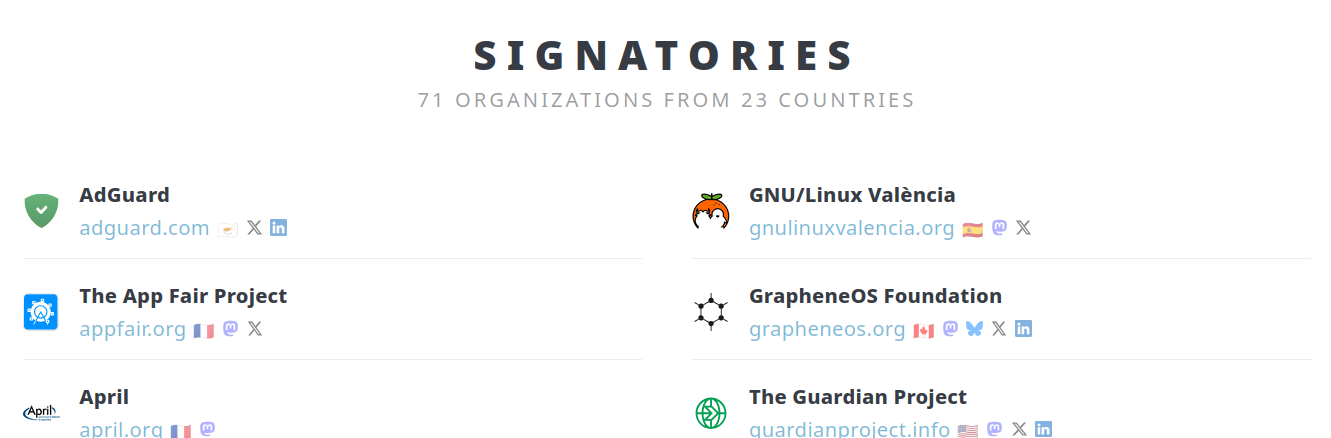
- There's an open letter that's been signed by most Free and Open Source organizations. This includes KDE, Nextcloud, the EFF, F-droid, FSFE, GNOME, VLC, TOR, Proton, and more.
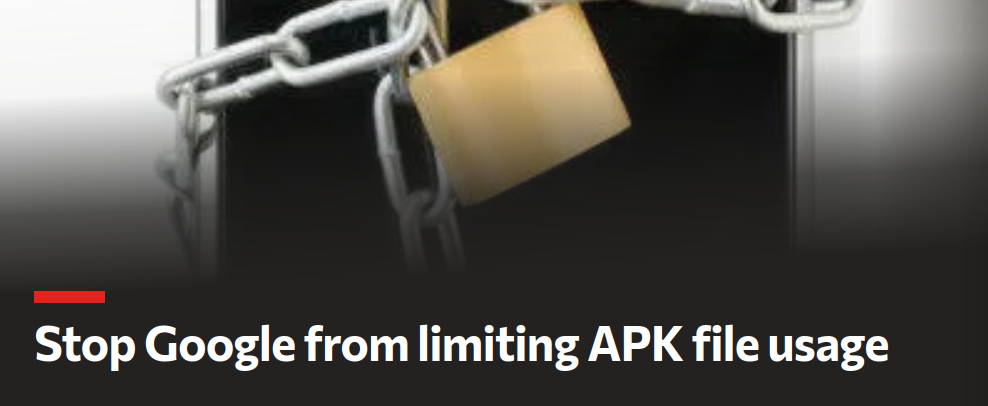
- There's a change.org petition with ~160k signatures. I have to say, I highly doubt that this will have any significant consequence.
A more likely path would be the regulatory one. Americans love to make fun of Europe for their digital rights laws, such as USB-C as a standard and the Digital Markets Act, but so far those laws are the single biggest source of user-respecting software from these giant multinational corporations we've seen.
Apple now allows application sideloading, to some extent, and it has finally switched over to USB-C for their phones too. Users are now asked for their web browser and search engine of choice. Interoperability is coming to messaging applications, and so on. These are all important victories that make everyday software more user-respecting, the opposite of what, in my opinion, Google is trying to do here.
However, I don't think this approach will yield significant results here. I'm afraid that Google will still argue that, technically, you're still able to install applications from third party developers easily (as long as they registered with Google, as described above), or even unregistered developers (through the mentioned nine steps process). They're not effectively closing down the ecosystem, but they are making it significantly harder to avoid it.
Nonetheless, I'll ask my local MEP (Member of the European Parliament) about this the next time I see him. Who knows! (Sorry Brando, I have to try.)
We only run on donations. If you liked this piece, help us reach 300 subscriptions.
no ads · no trackers · cancel whenever